Individual Land Prices in Seoul Announced on the 29th
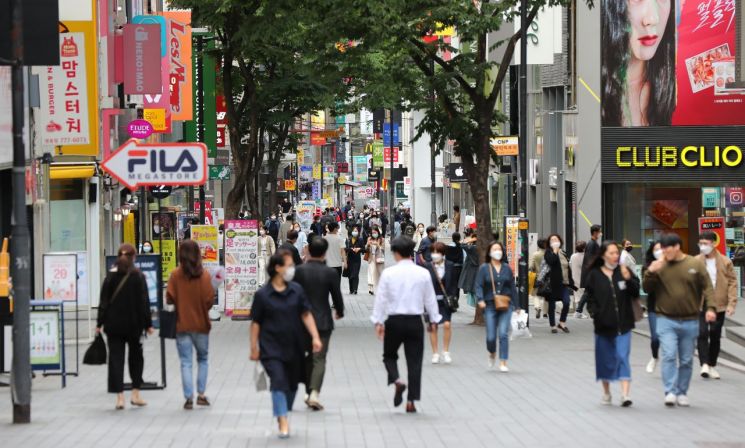
[Asia Economy Reporter Onyu Lim] As the spread of the novel coronavirus infection (COVID-19) causes key commercial districts such as Myeongdong in Jung-gu, Seoul, and Hannam-dong in Yongsan-gu to struggle, concerns are rising that landowners' holding tax burdens will significantly increase.
On the 29th, the Seoul Metropolitan Government announced the individual publicly announced land prices surveyed as of January 1 this year. The increase rate this year was 8.25%, lower than last year's 12.35%, but the second highest since 2009. Among a total of 880,827 parcels, 972,168 parcels, or 97.2%, saw an increase in individual publicly announced land prices. Only 16,670 parcels, or 1.9%, maintained a steady price.
This rise in individual publicly announced land prices is expected to increase the holding tax burden on landowners in major commercial districts.
According to a holding tax simulation conducted by Woo Byung-tak, team leader of Shinhan Bank Investment Advisory Center, the holding tax for the Nature Republic Myeongdong branch site (169.3㎡) in Chungmuro, which has the highest individual publicly announced land price in Seoul, is expected to be 169.81 million KRW, an increase of 49.1% (47.72 million KRW) compared to last year. The expected holding tax for the Uniqlo Myeongdong Central branch site (300.1㎡) in Chungmuro 2-ga is 335.72 million KRW, likely rising by 48.67% (109.9 million KRW) from a year ago. Although the increase rate of individual publicly announced land prices was not significant compared to last year, the tax increase that was previously capped at the upper limit of the tax burden increase rate (50%) is applied this year, resulting in a substantial rise in holding tax.
The expected holding tax for a commercial building site (3,570.2㎡) in Seongsu-dong, Seongdong-gu, Seoul, is 173.24 million KRW, an increase of 22.83 million KRW (16.23%) in one year. The total holding tax for a building site (342㎡) in Hannam-dong, Yongsan-gu, Seoul, is expected to be 23.04 million KRW this year, up 1.43 million KRW (6.59%) from 21.61 million KRW a year ago.
Experts believe that the increase in holding tax due to individual publicly announced land prices is likely to be passed on to rental fees for jeonse (long-term deposit lease) and monthly rent. Professor Kwon Dae-jung of Myongji University Graduate School of Real Estate said, "Although the recent real estate prices themselves are maintaining a slight downward trend, the reflection level will be minimal, but landowners are likely to pass on the burden to jeonse and monthly rent."
Meanwhile, among Seoul's autonomous districts, Seocho-gu recorded the highest increase rate in publicly announced land prices at 12.37%. Seocho-gu recorded a double-digit increase rate for two consecutive years following last year. Last year's increase rate was 16.49%. The Acro River Park area in Banpo-dong 2-12, Seocho-gu, was found to have the highest land price among residential areas.
Following Seocho-gu, Gangnam-gu had a high increase rate of 9.93%, although it was about half of last year's 18.74%. Jung-gu, which recorded the highest increase rate of 20.49% last year, saw its publicly announced land price rise by 5.39% this year. Jongno-gu had the lowest increase rate at 4.5%.
Next, Seongdong-gu's increase rate was 9.81%, influenced by the rise in apartment land prices in Eungbong-dong and Geumho-dong 1-ga areas. Seodaemun-gu also recorded a 9.09% increase rate due to the rise in land prices of apartment complexes in Bukahyeon-dong and Bukgajwa-dong, as well as commercial land in Changcheon-dong and Yeonhui-dong. Dongjak-gu's increase rate was 8.84%, with land prices rising following the completion of development projects in Dongjak-dong, Sadang-dong, and Heukseok-dong.
© The Asia Business Daily(www.asiae.co.kr). All rights reserved.