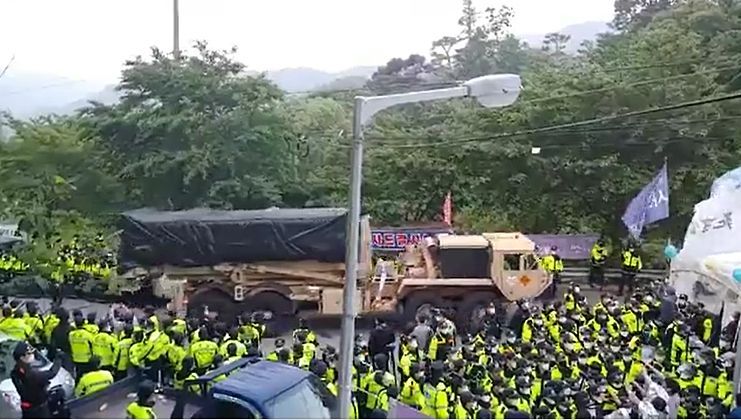
[Asia Economy Yang Nak-gyu Reporter] As conflicts between the United States and China erupt simultaneously across military, economic, and diplomatic fronts, speculation has arisen that performance upgrade work has begun at the Terminal High Altitude Area Defense (THAAD) base in Seongju, Gyeongbuk, which is managed by the Ministry of National Defense, raising expectations that the controversy will intensify. If this is not just a simple parts replacement but a step toward upgrading the interception defense system, China’s backlash is bound to be strong, making it highly likely that this issue will rapidly reemerge as a "core conflict" between South Korea and China.
On the 29th, the Ministry of National Defense announced in a briefing that a transport operation was conducted to replace some aging equipment at the US Forces Korea Seongju base. However, there is speculation that the US military has begun performance upgrade work on THAAD under the pretext of equipment replacement. Shin Jong-woo, Secretary General of the Korea Defense and Security Forum (KODEF), said, "Looking at the photos of the transport operation, key equipment that constitutes the THAAD battery, such as additional launchers and electronic equipment trailers, can be seen," adding, "It can be seen as the THAAD battery being upgraded to the latest specifications."
The THAAD system performance upgrade has already been announced. According to the US Missile Defense Agency (MDA) 2021 fiscal year budget briefing, MDA allocated $1 billion (approximately 1.18 trillion KRW) to improve THAAD batteries and training equipment deployed at seven locations. The THAAD systems deployed on the US mainland, Guam, and Seongju, Gyeongbuk, are all subject to upgrades.
The performance upgrade means that the US will change the THAAD launch system from a short-range wired type to a long-range wireless type to integrate missile defense capabilities on the Korean Peninsula. Currently, wired command is conducted via fiber optic cables, which requires the launcher and fire control center to be close to each other. To overcome distance limitations, the US military plans to switch to remote wireless control. The upgrade also includes using the THAAD radar for Patriot missile launches. Currently, the detection range of the Patriot radar is only 100 km, but the THAAD radar has a much wider detection range. The AN/TPY-2 radar used for THAAD has a maximum detection range of 1800 to 2000 km. If the Patriot missile system utilizes the THAAD radar, it will be able to detect enemy missiles earlier. Once this phase is completed, the Patriot missile system and the THAAD system can be fully integrated and operated together.
The issue is cost. Both the THAAD performance upgrade and deployment costs could be paid through defense cost-sharing funds. In February 2018, then-Minister of National Defense Song Young-moo responded to a question from Kyung Dae-soo, a member of the Liberty Korea Party, at a National Defense Committee plenary session, asking, "Is there a possibility that the US will request that the cost of the THAAD base also be borne as part of the defense cost-sharing?" Song replied, "Because there is such a possibility, we are strategizing whether to adopt a lump-sum or itemized approach for the defense cost-sharing agreement." Song’s answer was interpreted as a flexible response in preparation for a possible US demand for an increase in defense cost-sharing contributions.
China’s backlash is also expected. Regarding THAAD, South Korea has maintained a "3NO" stance?no requests, no consultations, and no decisions related to THAAD considering China. However, after North Korea’s fourth nuclear test in 2016, South Korea suddenly decided to deploy THAAD, which led to China’s economic retaliation. The government appears to have decided to refrain from making statements for the time being and to closely monitor the US-China conflict situation. On the 28th, the government held an integrated subcommittee meeting on diplomatic strategy adjustment at the Ministry of Foreign Affairs building to review and exchange opinions on the US-China conflict issues.
Some argue that although the Ministry of National Defense says the general environmental impact assessment for the Seongju base has not been completed and that the deployment is temporary, it is in fact a permanent deployment. The US Forces Korea submitted a project plan for 700,000 square meters of land within the Seongju THAAD base to the Ministry of National Defense in February last year. According to the plan, the Ministry of National Defense must proceed with the general environmental impact assessment procedure in consultation with the Ministry of Environment. The government’s policy is to decide on the final deployment of THAAD based on the results of the general environmental impact assessment. However, the general environmental impact assessment work remains at a standstill, which has led to such criticism.
© The Asia Business Daily(www.asiae.co.kr). All rights reserved.