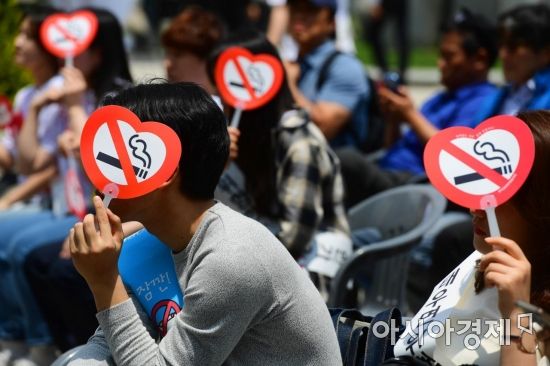
 On the 31st, World No Tobacco Day, attendees at the commemorative ceremony hosted by the Korea Anti-Smoking Movement Association at Sejongno Park in Jongno-gu, Seoul, shielded themselves from the sun with fans engraved with the no-smoking logo. Every year on May 31, the World Health Organization (WHO) designated this day to create a smoke-free society in celebration of its 40th anniversary. Photo by Moon Honam munonam@
[Asia Economy Reporter Junho Hwang] Domestic medical staff conducted a survey on the smoking status of 1,949 cancer patients and released research results showing that smoking directly affects the occurrence of esophageal cancer. In particular, it pointed out that elderly smokers aged 70 and over have a significantly increased incidence of esophageal cancer, making smoking cessation essential.
On the 29th, the Southeast Regional Radiation Medicine Institute announced these findings based on a study conducted by medical staff including Chief of Nuclear Medicine Department Seung-O Yang. The study investigated the correlation between smoking and patients with lung cancer, pancreatic cancer, head and neck cancer, and esophageal cancer among those who underwent PET/CT scans since the institute's opening.
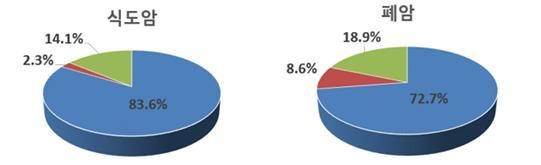
In addition to cancer patients' imaging records, the research team analyzed the correlation with smoking through medical record interviews, phone calls, surveys, and direct inquiries. As a result, more than 6 out of 10 cancer patients (67.7%) were identified as direct smokers. Passive smokers accounted for 6.9%. About 25.4% (496 patients) had no experience of either direct or passive smoking.
Among direct smokers, 83.6% were esophageal cancer patients. This was followed by lung cancer (72.2%), head and neck cancer (62.1%), and pancreatic cancer (52.4%). In the case of pancreatic cancer, the ratio of smokers to non-smokers was 52.4% and 41.1%, respectively, showing a low correlation with smoking. The impact of passive smoking was uniformly observed at 6-8% regardless of cancer type.
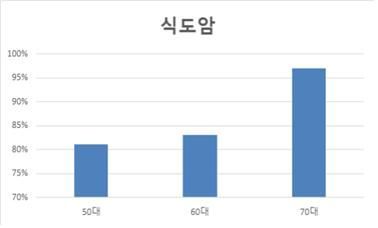
In the case of esophageal cancer, which showed the highest impact from direct smoking, the incidence of cancer tended to increase with age. In particular, it increased by about 10% or more in elderly patients aged 70 and over. Elderly smokers aged 70 and above also showed the highest average smoking exposure (42 pack-years) in this survey.
Chief Yang Seung-O said, "More direct smokers were observed in esophageal and lung cancers than in other types of cancer. Especially, elderly patients aged 70 and over showed the highest smoking exposure. This is evidence that 'quitting smoking is essential' for modern people living in an era of longevity reaching 100 years."
© The Asia Business Daily(www.asiae.co.kr). All rights reserved.