[Asia Economy Reporter Junho Hwang] A technology capable of detecting various illegal activities at customs, such as smuggling goods exceeding the duty-free allowance, disguising imports, or falsifying the country of origin, has been developed. This is expected to improve the efficiency of customs operations.
The research team led by Cha Mi-young CI, within the Data Science Group of the Mathematical and Computational Sciences Research Division at the Institute for Basic Science (IBS) (and a professor in the Department of Computer Science at KAIST), announced on the 29th that they have developed an algorithm for smart customs administration in collaboration with the World Customs Organization (WCO).
Since September last year, the research team has participated in WCO's Bakuda Project and developed the algorithm called DATE together with National Cheng Kung University (NKCU) in Taiwan. DATE prioritizes goods that are highly likely to involve illegal activities and help secure customs revenue, and informs customs officers of the reasons for the selection.
Kim Seon-dong, an IBS research fellow, explained, "We expect this to help reduce unnecessary labor by customs officers inspecting low-risk goods and to streamline the complex customs clearance process."
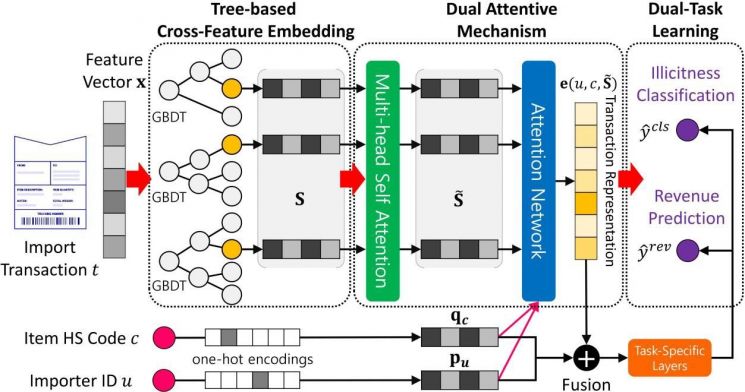 Customs Screening Algorithm Using Decision Tree (Gradient Boosting Tree) and Dual Attentive Mechanism (DATE Model)
DATE was pilot introduced in March at the Tin Can and Onne ports in Nigeria. As a result, it was found to detect customs fraud about 40 times more efficiently compared to traditional full inspection customs clearance. After the pilot operation ends, DATE will be improved and expanded to WCO member countries.
The Data Science Group plans to present the results of DATE's development at ACM SIGKDD 2020, the premier conference in data mining and artificial intelligence, this August.
Cha Mi-young CI said, "DATE will make a significant contribution to establishing smart customs administration by assisting customs officers in inspecting goods and communicating with detected importers. In the future, we plan to enhance the algorithm's accuracy by adding methods such as utilizing X-ray images of goods and applying transfer learning to jointly use customs data from multiple countries."
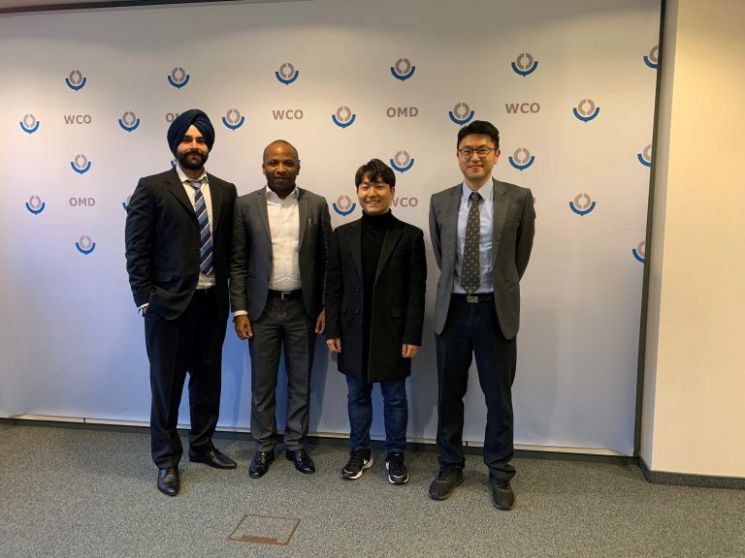 Research Fellow Seondong Kim (third from the left) and Research Fellow Karandeep Singh (first from the left) of the IBS Data Science Group are taking a commemorative photo after a meeting hosted by the World Customs Organization.
© The Asia Business Daily(www.asiae.co.kr). All rights reserved.