Statistics Korea, April Industrial Activity Trends
[Sejong=Asia Economy Reporters Kim Hyun-jung and Joo Sang-don] The average operating rate of the manufacturing industry has plummeted to the level of February 2009 during the financial crisis. The contraction of the manufacturing industry due to the impact of the novel coronavirus disease (COVID-19) has been confirmed by the figures.
According to the 'April Industrial Activity Trends' released by Statistics Korea on the 29th, the average operating rate of the manufacturing industry was 68.6%, down 5.7 percentage points from the previous month. This is the lowest level in 11 years and 2 months since February 2009 (66.8%), and the largest drop since December 2008, when it fell by 7.2 percentage points.
An Hyung-joon, Director of Economic Statistics Trends at Statistics Korea, explained, "Until March, orders and shipments were being made, so the impact of COVID-19 on exports was limited. However, in April, the spread of COVID-19 and economic lockdowns in major export countries such as the United States and Europe affected our exports and manufacturing production."
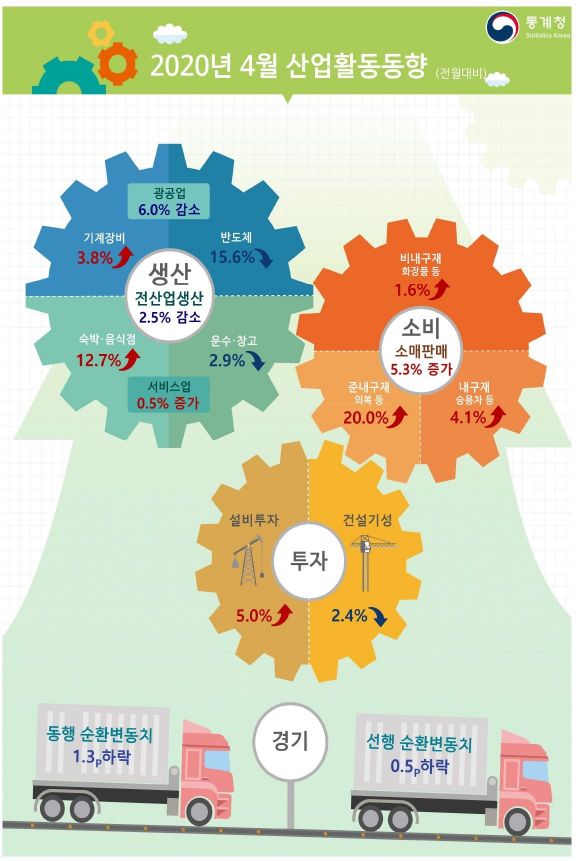
In April, overall industrial production decreased by 2.5% compared to the previous month, with production declining in mining and manufacturing industries (-6.0%), including manufacturing, and construction (-2.4%), although service industries increased (+0.5%). This marks the fourth consecutive month of decline.
In particular, manufacturing production decreased by 6.4% compared to the previous month, with semiconductors (-15.6%) and automobiles (-13.4%) declining. Manufacturing shipments also fell by 7.2% overall, with export shipments down 12.9% and domestic shipments down 2.4%.
However, service industry production increased by 0.5% compared to the previous month, despite decreases in transportation and warehousing (-2.9%) and professional, scientific, and technical services (-2.9%), due to increases in accommodation and food services (12.7%) and education (2.8%).
The retail sales index rose by 5.3% compared to the previous month, with sales of semi-durable goods such as clothing (20.0%), durable goods such as passenger cars (4.1%), and non-durable goods such as cosmetics (1.6%) all increasing.
Facility investment also increased by 5.0% compared to the previous month, with investments in transportation equipment such as automobiles (13.6%) and machinery such as computers and office equipment (1.8%) both rising.
The coincident index, which shows the current economic situation, and the leading index, which predicts future economic phases, both declined for three consecutive months. The April coincident index stood at 97.3, down 1.3 percentage points from the previous month, and the leading index was 99.1, down 0.5 percentage points.
© The Asia Business Daily(www.asiae.co.kr). All rights reserved.