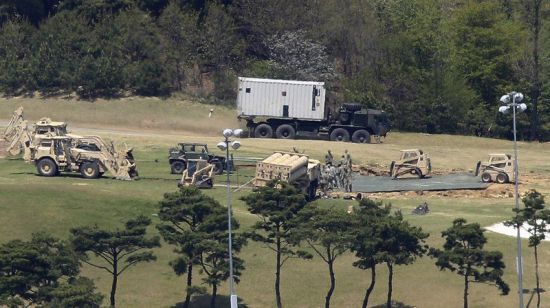
[Asia Economy Reporter Yang Nak-gyu]On the night of the 29th, the Ministry of National Defense and the United States Forces Korea began ground transportation work to replace outdated equipment at the high-altitude missile defense system (THAAD) base in Seongju, Gyeongbuk Province, which was completed at 6 a.m. that day.
The Ministry of National Defense stated, "From last night (the 28th) until this morning (the 29th), we have been supporting the ground transportation of the US Forces Korea at the Seongju base, and it is now in the final stages."
The Ministry explained that this ground transportation is intended to improve the working conditions of the Korean and US soldiers stationed at the Seongju base and to replace some outdated equipment. However, to minimize conflicts with residents opposing the THAAD base construction, construction equipment and materials had been transported by helicopter until now, but some equipment was too large, making ground transportation unavoidable. Some have raised suspicions that this equipment transport might be related to additional deployment.
The Ministry of National Defense and the US Forces Korea have been carrying out improvement construction on the living environment of soldiers' accommodations (the former golf course clubhouse) within the THAAD base since August last year. The Ministry reportedly held several consultations with residents regarding this but failed to reach an agreement.
In January 2016, following North Korea's 4th nuclear test and long-range rocket (missile) launches, voices calling for the deployment of the US Forces Korea's high-altitude missile defense system (THAAD) increased due to the heightened nuclear and missile threats. In July of the same year, the South Korean and US military authorities selected Seongju County in Gyeongbuk Province as the site for the THAAD base. Despite strong opposition from civic groups and local residents, the Seongju Golf Course was confirmed as an alternative site in September amid the aftermath of North Korea's 5th nuclear test, and the THAAD deployment proceeded. THAAD is a high-altitude defense system that intercepts ballistic missiles at altitudes of 40 to 150 km. Together with the Korean missile defense system, which is a low-altitude defense system below 40 km, it establishes a multi-layered defense system.
In February last year, the US Forces Korea submitted a project plan for 700,000 square meters of land within the Seongju THAAD base to the Ministry of National Defense. According to the plan, the Ministry must consult with the Ministry of Environment and undergo a general environmental impact assessment procedure. The government’s policy is to decide on the final deployment of THAAD based on the results of the general environmental impact assessment. However, it is reported that the general environmental impact assessment process has not yet started.
© The Asia Business Daily(www.asiae.co.kr). All rights reserved.