'Sejong Autonomous Driving Demonstration Project' Launched
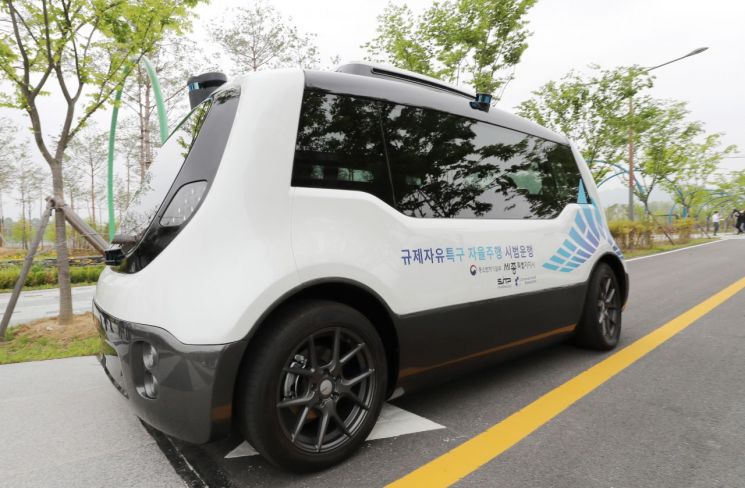 On the morning of the 25th, the autonomous driving shuttle 'Withus' is conducting a pilot operation at the Sejong Autonomous Driving Demonstration Regulatory Free Zone Business Operators Communication Meeting held at Central Park in Sejong City. Photo by Yonhap News
The shuttle buses roaming throughout Sejong City Central Park, located between the Government Sejong Complex and the Geumgang River, are somewhat different from typical park shuttles. Upon closer inspection, there is no separate driver's seat inside. These driverless vehicles use lasers to recognize their surroundings and three-dimensionally identify and respond to other vehicles, roads, buildings, and people. If a person suddenly steps in front of the vehicle, it immediately stops. The maximum speed is 30 km/h. Park Young-sun, Minister of SMEs and Startups, who boarded this vehicle, said, "I truly felt that the era of autonomous vehicles has arrived."
Announcing that the era of autonomous vehicles is rapidly approaching, the autonomous shuttle that ran inside Sejong Central Park on the 25th is named 'WITH:US.' Unmanned Solution, a domestic venture company possessing both hardware and software technologies related to autonomous driving, independently developed this vehicle last year based on its own design, production, and vehicle control technologies. Although current road traffic laws and passenger automobile transportation business laws hinder autonomous vehicle operation, this location is a regulatory free zone, allowing the first step toward commercialization of autonomous driving. The challenge of autonomous driving by domestic venture companies has begun to overcome regulations and see the light. However, tasks such as infrastructure development remain before full commercialization.
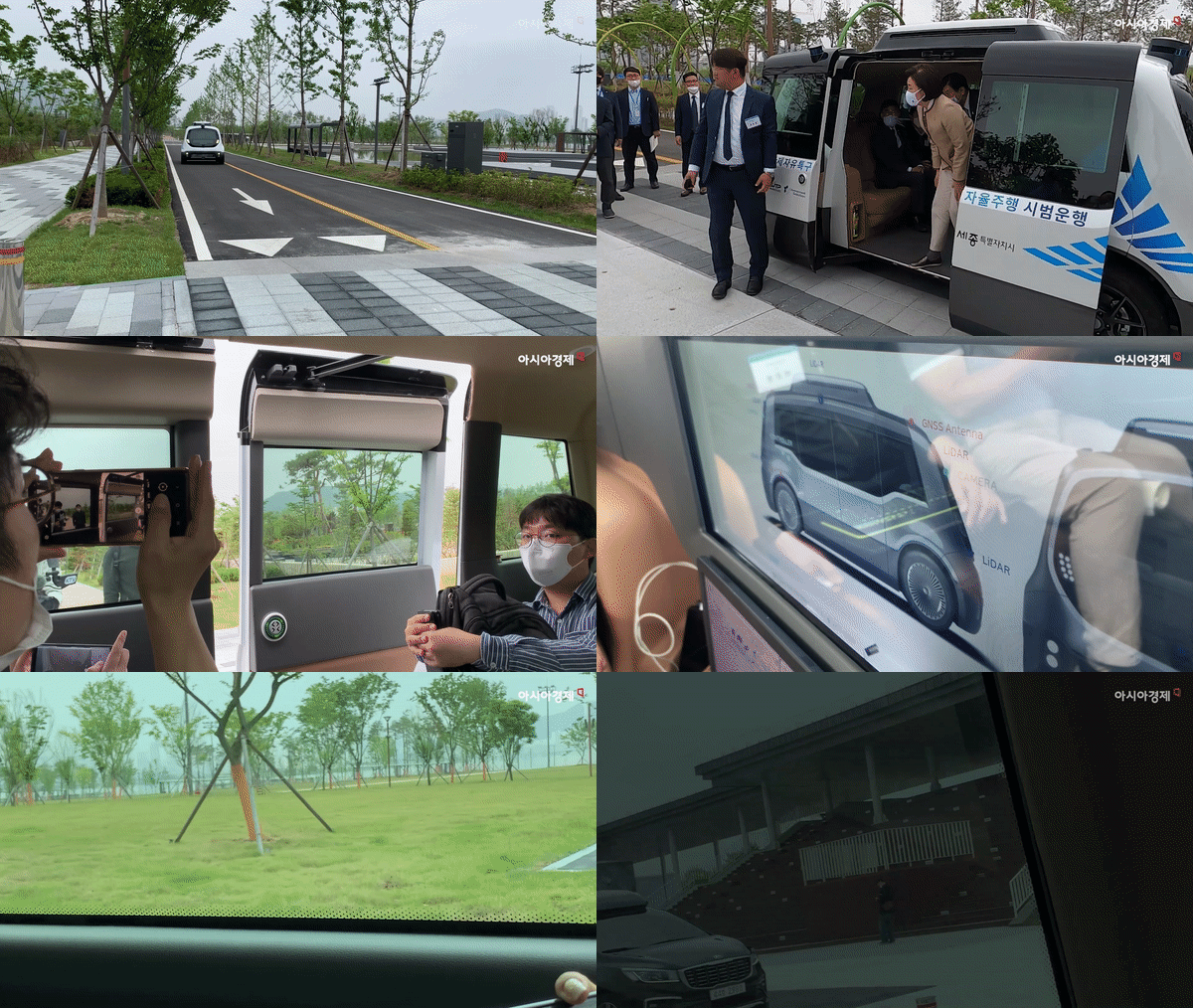 The autonomous vehicle 'Withus' has no driver's seat. It is a 6-seater shuttle operating at a maximum speed of 30 km/h. Video by Heeyoon Kim
◆ Launch of the 'Sejong Autonomous Driving Demonstration Project' = The Ministry of SMEs and Startups and Sejong Special Self-Governing City began the 'Sejong Autonomous Driving Demonstration Project' from this day. So far, in the Sejong special zone, preparations for autonomous driving demonstrations have focused on three sections: autonomous driving in urban parks, low-speed autonomous driving in residential complexes, and high-speed autonomous driving on general roads. Efforts have been made to manufacture autonomous vehicles, improve vehicle positioning technology, establish safety manuals, form safety inspection committees, and subscribe to liability insurance to ensure safety. Since May of this year, capable domestic and international autonomous driving-related companies such as Phantom AI Korea, Autonomous A2Z, and Naver Systems have also been joining the Sejong special zone one after another.
Based on this, the domestic autonomous vehicle 'WITH:US' will be available for anyone to ride in Sejong Central Park this fall. Before the park opens in September, a large-scale autonomous shuttle service demonstration will be conducted within the urban park, and once safety is secured, preparations will be made for citizens to experience it directly. On roads, AI Mobility's low-speed autonomous vehicles will be demonstrated in residential complexes near Sejong Tech Valley, and in September, Autonomous A2Z's high-speed autonomous vehicles will be demonstrated on general roads. Various vehicle types will be deployed to discover commercialization models of autonomous driving services suitable for Sejong City's traffic conditions.
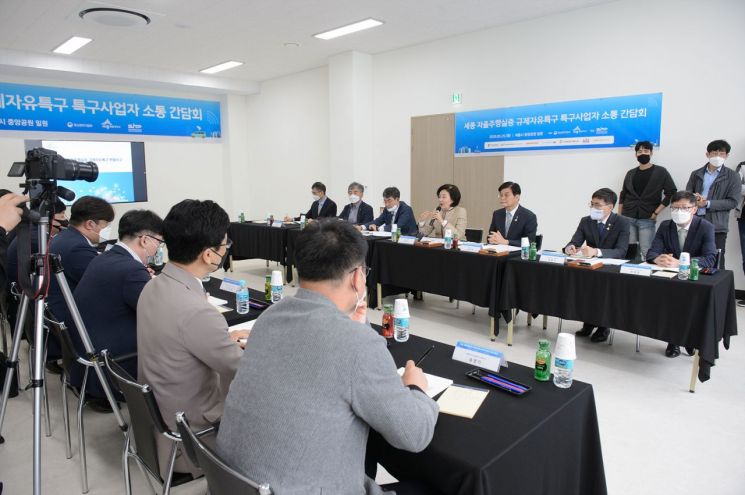 At the communication meeting with special zone operators for the Sejong Autonomous Driving Demonstration Regulatory Free Zone held on the 25th, various voices from the field regarding infrastructure construction after regulatory relief were heard. Photo by Sejong City
◆ After Removing Regulations, the Task of 'Infrastructure Development' Remains = Companies that have gained opportunities through the regulatory free zone unanimously agreed that the removal of regulations has greatly helped by enabling technological linkage and exchange among autonomous driving companies within the zone, especially allowing the sharing of infrastructure and information for demonstrations. However, challenges remain. Moon Hee-chang, CEO of Unmanned Solution, which developed WITH:US, said, "Preemptive infrastructure development is essential for 5G-based solution development, but it is quite difficult for small and medium-sized enterprises to build this on their own," adding, "Government-level infrastructure development is urgently needed to enable the development of various 5G-based services."
For vehicles at the fully autonomous driving stage without a driver's seat to be commercialized, relay stations for millimeter-wave 5G technology must be densely installed. This is why Minister Park emphasized, "Since the core of digital infrastructure is the convergence of 5G and foundational industries, the '5G 28GHz millimeter wave,' which is attracting attention as a key technology for autonomous driving, must be applied to the Sejong special zone. To this end, public and private sectors must unite to revitalize digital new industries based on 5G."
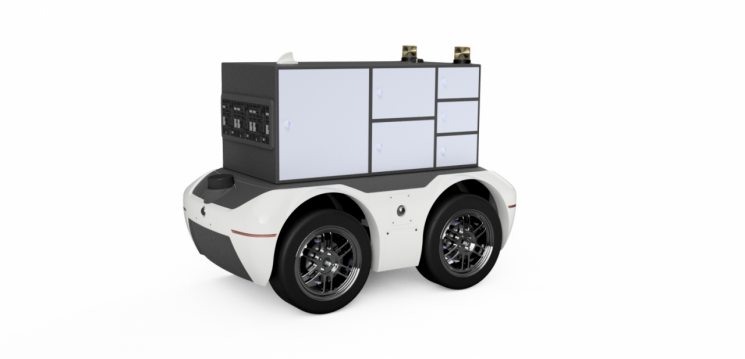 Unmanned Solution, the developer of 'Withus,' has showcased various mobility solutions utilizing autonomous driving technology. The photo shows an autonomous delivery robot.
◆ Autonomous Driving Technology Also in Delivery = Unmanned Solution plans to start another autonomous driving technology demonstration in Sangam-dong, Seoul, overcoming current regulations. This is an autonomous delivery robot that recently received a regulatory sandbox demonstration exception from the Ministry of Science and ICT this month. This delivery robot is a four-wheeled mobile unit capable of outdoor driving, designed to recognize surrounding objects using various sensors while driving. Unmanned Solution applied for a demonstration exception to provide a service where this robot delivers packages while driving on sidewalks and parks around Sangam Culture Plaza, with remote control and monitoring from a central control center.
Under the Road Traffic Act, autonomous delivery robots are classified as 'vehicles,' not pedestrians, restricting their passage on sidewalks and crosswalks. Additionally, the Park and Green Space Act prohibits powered devices weighing over 30 kg from entering parks, preventing this robot, which weighs about 450 kg at maximum load, from entering. Furthermore, for route generation and accurate delivery, the robot must record video with an attached camera, but the Personal Information Protection Act requires the consent of data subjects, making it practically impossible to obtain prior consent from an unspecified number of pedestrians.
With the demonstration exception granted to Unmanned Solution this time, the commercialization of delivery robots roaming around Sangam-dong is becoming a near reality. Unmanned Solution plans to conduct preemptive measures such as safety tests to ensure pedestrian safety and proceed with demonstrations under privacy protection measures like de-identification. CEO Moon said, "We will go beyond vehicles and continuously develop platforms that respond to autonomous driving, becoming a company that provides a container for services developed by various small and medium-sized enterprises."
© The Asia Business Daily(www.asiae.co.kr). All rights reserved.



















