Urgent Need for Fiscal Rules as Tax Revenue Securing Becomes Critical Amid Low Growth Trend Due to COVID-19
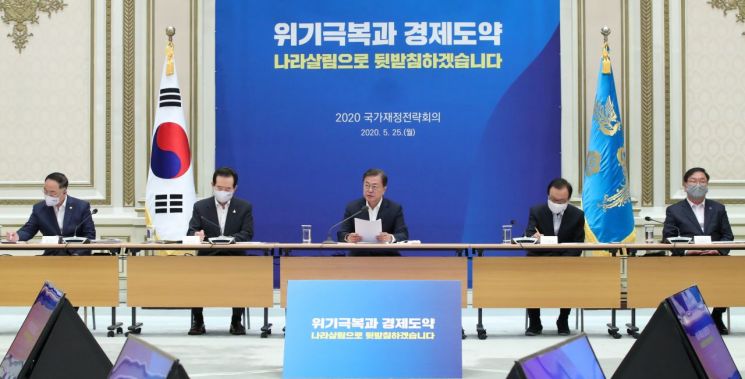
[Asia Economy Reporter Jang Sehee] As President Moon Jae-in emphasized the need for 'bold fiscal policy,' concerns are growing that government spending will expand indefinitely under the pretext of responding to the novel coronavirus infection (COVID-19). Already, talks of a 4th supplementary budget (supplementary budget) are emerging, and there are forecasts that next year's main budget increase will reach double digits.
On the 26th, a government official said, "Although COVID-19 seems to be gradually calming down, if the recovery is slow, additional measures will continue to be introduced," adding, "We cannot rule out the possibility of a 4th supplementary budget." The reason the 4th supplementary budget discussion is gaining traction is that the 1st, 2nd, and 3rd supplementary budgets were all carried out in the first half of the year.
The government is reportedly planning to set the 3rd supplementary budget at around 40 to 50 trillion won, following the 1st supplementary budget (11.7 trillion won) and the 2nd supplementary budget (12.2 trillion won). In this regard, Cho Jung-sik, the Policy Committee Chair of the Democratic Party of Korea, attending the floor strategy meeting held at the National Assembly on the same day, stated, "We will prepare a supplementary budget that significantly surpasses the existing ones."
As the government maintains a positive economic growth forecast for this year in the economic policy direction for the second half of the year to be announced early next month, there is also a possibility that it will unleash massive fiscal spending to defend against a decline in growth rate. Professor Sung Tae-yoon of Yonsei University's Department of Economics said, "Given the current economic situation, it is natural to forecast a negative growth," adding, "If the government forecasts positive growth, it should be seen as a policy intention to avoid negative growth through substantial government spending."
Voices are also emerging that the budget size will be the largest ever as some budgets from the Korean New Deal project are reflected in next year's budget proposal. Kim Tae-nyeon, floor leader of the Democratic Party of Korea, emphasized on the same day, "We must push the New Deal properly with the determination to organize wartime administration." Additionally, some projects that could not be executed this year due to COVID-19 are postponed to next year, increasing the likelihood that next year's budget increase rate will reach double digits. Looking at the main budget, it increased by 28% from 400.5 trillion won in 2017 to 513 trillion won in 2020. Even in the last two years, it increased by 9.5% and 9.2% in 2019 and 2020, respectively.
Above all, securing funding is a problem. If the low-growth trend continues due to COVID-19, securing tax revenue will also be in crisis. Experts are urging the prompt establishment of fiscal rules and plans to expand revenue.
Professor Kim Sang-bong of Hansung University's Department of Economics said, "This year, due to the impact of COVID-19, value-added tax, corporate tax, and income tax will all decrease," adding, "The fiscal deficit will widen further. There is a need to establish active fiscal rules. Specific details should be included, such as increasing a certain scale of fiscal spending when the unemployment rate reaches a certain level."
Professor Jung Se-eun of Chungnam University's Department of Economics added, "When the economy improves, discussions on tax increases to secure tax revenue should be held one to two years later," adding, "Tax reform such as strengthening inheritance tax is also necessary to lay the foundation for future tax increases."
Meanwhile, according to the May issue of the Monthly Fiscal Trend published by the Ministry of Economy and Finance on the 7th, national tax revenue from January to March this year was 69.5 trillion won, down 8.5 trillion won from a year earlier. Corporate tax revenue decreased by 6.8 trillion won compared to last year. It is expected that the supplementary budget for tax revenue adjustment to cover the shortfall in the 3rd supplementary budget will exceed 10 trillion won.
© The Asia Business Daily(www.asiae.co.kr). All rights reserved.

















