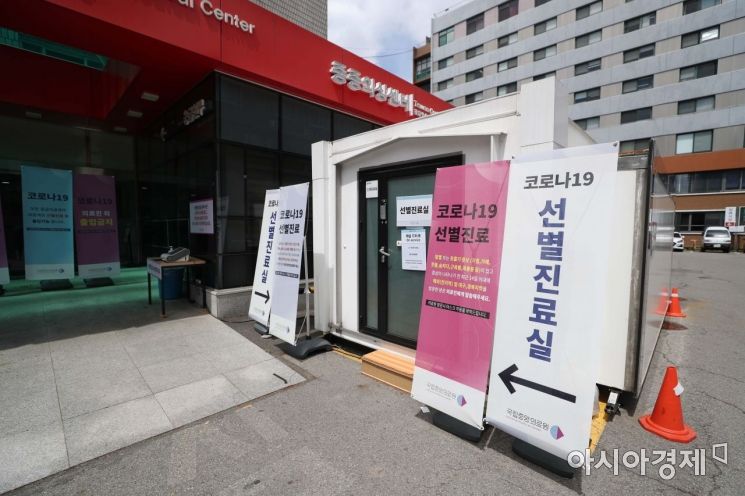
 On the 21st of last month, when the number of new confirmed cases of the novel coronavirus infection (COVID-19) was decreasing, the screening clinic at the National Medical Center in Jung-gu, Seoul was quiet. Photo by Mun Ho-nam munonam@
[Asia Economy Reporter Choi Dae-yeol] From now on, the Director of the Korea Disease Control and Prevention Agency (KDCA) will directly handle tasks such as designating and supporting the operation of the Central Infectious Disease Hospital. Currently, these duties fall under the Minister of Health and Welfare, but the regulations have been changed to delegate related tasks to the KDCA Director.
According to the amendment to the Enforcement Decree of the Infectious Disease Prevention and Control Act passed at the Cabinet meeting on the 26th, the Minister of Health and Welfare will entrust the KDCA Director with tasks including the operation and support of the Central Infectious Disease Hospital, evaluation and management of laboratory testing capabilities of infectious disease pathogen identification institutions, and the distribution and transfer of high-risk pathogens.
The Central Infectious Disease Hospital is designated to take charge of diagnosis, testing, and patient treatment during outbreaks of new infectious diseases, and currently, the National Medical Center is designated as such. Since clinical information is insufficient for new infectious diseases, it also manages resources such as treatment guidelines, education and training for frontline medical staff, and patient transfers in case of bed shortages.
The government is responsible for designating and supporting the operation of the Central Infectious Disease Hospital, and specifically, the KDCA will take charge of this. Although the KDCA has been practically handling these tasks during the COVID-19 pandemic, the delegation was not explicitly stated. The KDCA, as an agency under the Ministry of Health and Welfare, serves as the control tower for infectious disease response.
Additionally, many tasks related to infectious disease response previously assigned to the Minister of Health and Welfare have been delegated to the KDCA Director. These include stockpiling, contracting, and reporting on production and import plans for essential and temporary vaccines, information disclosure during infectious disease crises, designation of quarantine facilities for contacts, support for paid leave costs when patients occur, and protective measures for vulnerable groups.
The amendment also includes provisions allowing the Minister of Health and Welfare to handle passport numbers when dealing with personal information, aimed at strengthening management of individuals who have come into contact with infectious disease patients on aircraft. Furthermore, standards have been established to impose fines if there is a failure to report changes in permits related to possession of pathogens causing bioterrorism infectious diseases or if mandatory vaccination drug reports are not properly submitted.
Meanwhile, at the same Cabinet meeting, amendments were approved to the Enforcement Decree of the National Health Promotion Act, allowing smokers who receive smoking cessation education and treatment to receive a 50-100% exemption from smoking fines; to the Enforcement Decree of the Regional Public Health Act, enabling infertility injections to be administered at public health centers; and to the Enforcement Decree of the National Health Insurance Act, permitting the purchase of pharmaceuticals and medical supplies with the Pregnancy and Childbirth Medical Expense Voucher (National Happiness Card) beyond just medical consultations.
© The Asia Business Daily(www.asiae.co.kr). All rights reserved.
![Clutching a Stolen Dior Bag, Saying "I Hate Being Poor but Real"... The Grotesque Con of a "Human Knockoff" [Slate]](https://cwcontent.asiae.co.kr/asiaresize/183/2026021902243444107_1771435474.jpg)
















