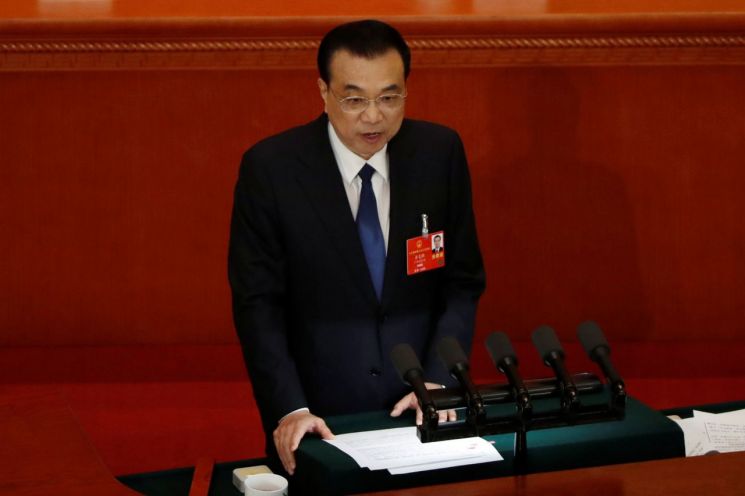
[Asia Economy Beijing=Special Correspondent Park Sun-mi] On the 22nd, China did not set an economic growth target in the government work report at the National People's Congress (NPC), which is an unusual move. This reflects the Chinese government's concerns about the internal economic shocks caused by the COVID-19 outbreak in the first half of this year and the global economic uncertainties depending on whether the pandemic subsides worldwide in the second half.
Premier Li stated in the work report, "Due to uncertainties related to COVID-19, we did not set a specific target," adding, "Not setting a target is expected to better help achieve the six stabilities (employment, finance, trade, foreign investment, investment, and economic expectations). This year, the priority is on job stability, ensuring people's livelihoods, poverty alleviation, and building a moderately prosperous Xiaokang society where everyone lives well."
Since President Xi Jinping took office at the 18th National People's Congress, China's economic growth rate has been on a declining trend: 7.8% in 2013, 7.3% in 2014, 6.9% in 2015, 6.7% in 2016, 6.8% in 2017, 6.6% in 2018, and 6.1% in 2019. Despite this downward trend, China has consistently tried to maintain the growth targets announced at the beginning of each year. Last year, the growth target was set at 6-6.5%, and the actual growth rate achieved was 6.1%, within the target range. Therefore, the growth targets announced in the NPC work reports have traditionally been considered important benchmarks for China's economic policy direction and global growth outlook for the year.
Prior to the Two Sessions, economic experts in China predicted that the government might set this year's growth target around 3%, about half of last year's, but there was also speculation that the government might choose not to set a target at all. This was because most of the first half of the year had passed and the economic uncertainties were high, so announcing a target could become a burden.
By not setting a growth target, China has broadened its economic management scope and is expected to pursue more proactive fiscal policies and relaxed monetary policies in the second half of this year to revive the economy.
China's decision to set this year's fiscal deficit ratio at over 3.6% of GDP, up from 2.8% last year, also indicates the implementation of more active fiscal policies. In particular, the government announced plans to issue special government bonds worth 1 trillion yuan for COVID-19 control measures. This is the first issuance of special national bonds in 13 years. The issuance scale of local government special-purpose bonds, mainly used to secure infrastructure funding, was also increased to 3.75 trillion yuan from 2.15 trillion yuan last year.
Following last year, large-scale tax cuts will continue this year. Premier Li stated in the work report that efforts will be made to reduce taxes and fees by an additional 500 billion yuan to help market entities overcome difficulties and achieve development.
Regarding monetary policy, it was mentioned that the existing "prudent monetary policy" will be pursued but implemented in a more flexible and effective manner. The expansion of credit provision by financial institutions and reduction of loan costs using various tools will accompany this. Tools such as lowering the reserve requirement ratio for banks and interest rate cuts to expand loans to small and medium-sized enterprises and private companies were mentioned as possible monetary policy instruments. It was also reported that efforts are underway to develop new monetary policy tools that did not exist before, so that liquidity can directly stimulate the real economy.
© The Asia Business Daily(www.asiae.co.kr). All rights reserved.
![Clutching a Stolen Dior Bag, Saying "I Hate Being Poor but Real"... The Grotesque Con of a "Human Knockoff" [Slate]](https://cwcontent.asiae.co.kr/asiaresize/183/2026021902243444107_1771435474.jpg)











