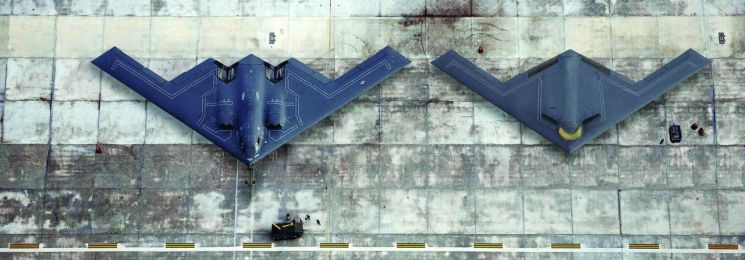
 Currently operated by the U.S. Air Force, the B-2 strategic bomber (photo left) and the U.S. new strategic bomber, the B-21 Raider (photo right)

[Monthly Aviation Editor-in-Chief Kim Jae-han] The United States' new strategic bomber, the B-21 Raider, is gradually unveiling its veil. This year, the U.S. Air Force has been revealing key exterior features of the B-21 little by little, allowing its specific appearance to become known. Although detailed performance specifications remain undisclosed, the revealed exterior closely resembles the B-2 strategic bomber currently operated by the U.S. Air Force.
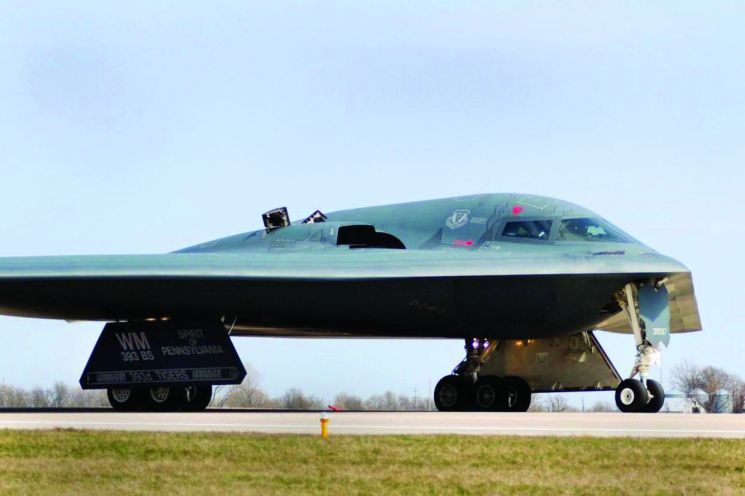
▲ Resemblance to the B-2 and Differences?= Looking at the images of the B-21 released by the U.S. Air Force last January, it bears a strong resemblance to the B-2. However, upon closer inspection, several differences can be observed. First, the front windshield, akin to a car's windshield, is positioned further back compared to the B-2. Additionally, unlike the B-2’s air intakes which bulge upward, the B-21’s air intakes are smoothly integrated with the aircraft surface. This is a feature of the so-called “low-observable design” that makes radar detection more difficult.
The smoothly integrated air intake design is notoriously complex and challenging to engineer. The shape of the air intake affects airflow, which in turn significantly impacts engine performance, making the design process demanding. In fact, engineers at Northrop Grumman, the manufacturer of the B-21, are known to have devoted considerable effort to the air intake design.
The overall aircraft shape is a flying wing configuration, where the wings make up most of the fuselage, similar to the B-2 bomber. However, the streamlined upper surface of the fuselage is shorter than that of the B-2. This is reportedly because the cockpit seating was reduced from three seats to two. In the current B-2, this space is used by pilots or mission commanders to take short naps during missions lasting up to 40 hours.
The landing gear appears similar to that of the B-2. However, the front landing gear is positioned slightly further back compared to the B-2, and the main landing gear on the rear sides consists of two large wheels instead of the four wheels found on the B-2. This likely reflects the smaller size and weight of the B-21 compared to the B-2.
Previously released images also show a change in wing shape. The trailing edge of the wing on the B-2 has a serrated “WW” shape, whereas the B-21’s trailing edge forms a “W” shape. This difference arises because the B-2 was developed for low-altitude penetration flights and designed to withstand the loads imposed on the airframe during flight accordingly.
▲ U.S. Air Force Proceeding on Schedule= Along with the image release, the U.S. Air Force stated that the B-21 program is progressing smoothly according to the original schedule. Northrop Grumman has begun assembling the first test aircraft at its factory in Palmdale, California, but it remains uncertain when the actual aircraft will be publicly revealed. Meanwhile, the U.S. Air Force plans to procure more than 100 units of the new B-21 strategic bomber and anticipates the first flight to take place in the latter half of 2021, although experts suggest that the first flight schedule could be delayed.
© The Asia Business Daily(www.asiae.co.kr). All rights reserved.
![Clutching a Stolen Dior Bag, Saying "I Hate Being Poor but Real"... The Grotesque Con of a "Human Knockoff" [Slate]](https://cwcontent.asiae.co.kr/asiaresize/183/2026021902243444107_1771435474.jpg)


















