20 Reasons for Operating Losses for 4 Consecutive Years
14 Companies with Capital Impairment Rate Over 50%
Increasing Trend Over the Last 3 Years
But Financial Conditions Worsened Due to COVID-19
61 Cases Related to KOSDAQ and Performance Issues
[Asia Economy Reporter Oh Ju-yeon] #KOSDAQ-listed company YOM, designated as a management item this year, saw its stock price fall from the 15,000 won range in August last year to 688 won at the end of March this year, a drop to one-twentieth of its value. The current stock price has risen to 1,880 won, narrowly avoiding penny stock status, but shareholders remain anxious about the current situation, which is on the brink of delisting. YOM was finally designated as a management item on March 30 after receiving a preliminary notice from the KOSDAQ Market Headquarters of the Korea Exchange in February due to 'continuing operations loss before corporate tax expenses' exceeding 50% of equity capital in two of the last three fiscal years. This is due to continued business deterioration. Recently, the company also withdrew its capital increase plan and received a preliminary notice of designation as an 'insincere disclosure corporation' from the exchange due to disclosure reversal. The company stated, "Due to the COVID-19 pandemic, exchanges with business partners have been impossible, and the capital increase was withdrawn due to rapid changes in the internal and external environment."
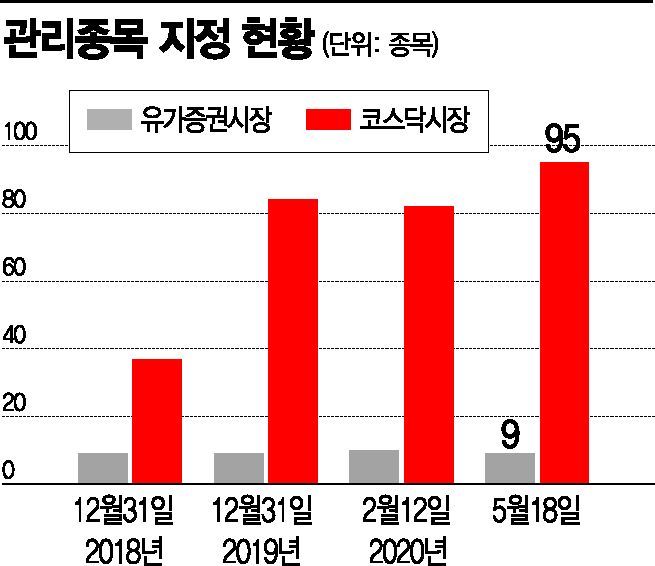
Since the global financial crisis of 2008-2009, the number of management items has again exceeded 100, drawing attention to the reasons for their designation. Management items are stocks on the verge of delisting, with delisting decisions made after substantive reviews of listing eligibility. Looking at those newly designated or with changed reasons for designation as management items this year, a significant number had poor financial structures or declining performance, as in the case of YOM.
According to the Korea Exchange on the 21st, management items have shown a clear increasing trend over the past three years. At the end of 2017, there were a total of 40 management items: 6 in the KOSPI market and 34 in the KOSDAQ market. By the end of 2018, these numbers increased to 9 in the KOSPI market and 37 in the KOSDAQ market, totaling 46, followed by a sharp increase last year.
This was largely due to the reform of the listing management system. Last year, the Financial Services Commission revised the existing system, which immediately delisted companies receiving adverse audit opinions such as qualified, adverse, or disclaimer opinions, to reduce the external audit burden on companies. Even if a company receives an adverse audit opinion, it is not immediately delisted but designated as a management item, and if the company submits an objection, a one-year grace period for management improvement is granted. As a result, stocks that would have been delisted remained as management items, significantly increasing their number.
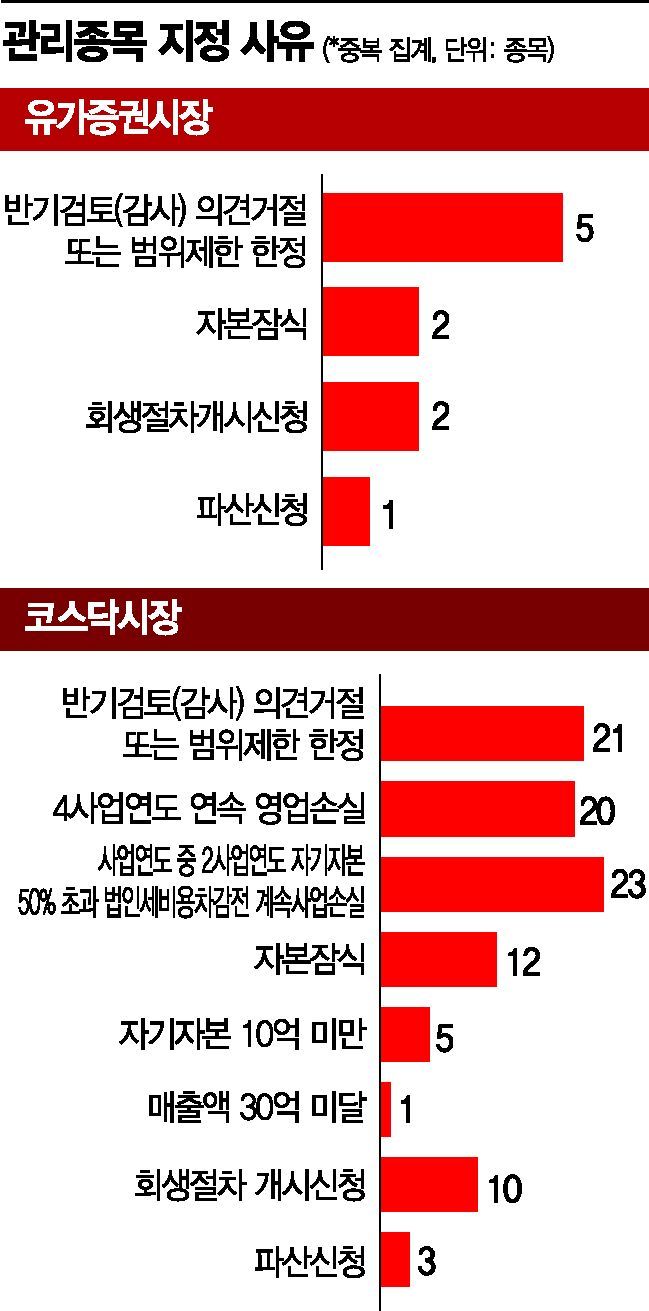
However, many cases were related to corporate fundamentals such as operating losses and capital erosion. This was especially prominent in the KOSDAQ market. Analyzing the reasons for designation as management items in the KOSDAQ, there were 21 cases of half-year review (audit) opinion disclaimers or scope limitations with qualified opinions, but 61 cases were directly related to fundamentals: 20 cases of operating losses for four consecutive fiscal years, 23 cases of continuing operations loss before corporate tax expenses exceeding 50% of equity capital in two of the last three fiscal years, 12 cases of capital erosion exceeding 50%, 5 cases of equity capital below 1 billion won, and 1 case of sales below 3 billion won. Including business deterioration such as applications for rehabilitation procedures (10 cases) and bankruptcy filings (3 cases), most cases were related to corporate health.
YOM, along with Semiconlight and NCITRON, were designated as management items at the end of March for the reason of 'continuing operations loss before corporate tax expenses exceeding 50% of equity capital in two of the last three fiscal years,' and U-Tech was designated for 'operating losses for four consecutive fiscal years.' Solgo Biochemical, designated as a management item last March for 'operating losses for four consecutive fiscal years,' added the reason of 'capital erosion exceeding 50%' this March. The same applies to Redrover and Cellumed. Redrover, which was subject to a substantive review of listing eligibility last March, added the reason of capital erosion exceeding 50% this year, and Cellumed added the same reason about three months after being subject to the review in December last year.
There are differences when looking at stocks delisted from the domestic stock market this year compared to last year. Last year's delisted stocks were due to reasons such as becoming wholly owned subsidiaries of holding companies (major shareholders), prior listings, absorption mergers, or failure to submit listing preliminary examination applications. However, this year, additional reasons have become noticeable.
As of the 19th of this month, a total of 12 stocks have been delisted from the domestic stock market this year, five more than the same period last year. Among them, KOSDAQ-listed companies Suntech and Lead were delisted due to concerns about corporate continuity and management transparency. Mirae Asset Daewoo SPAC No.1 and Hanwha Suseong SPAC were delisted after being designated as management items for failure to submit listing preliminary examination applications and failing to resolve the issue within one month.
© The Asia Business Daily(www.asiae.co.kr). All rights reserved.


















