Government Plans to Focus on Developing Non-Face-to-Face Medical Services as Part of the 'Korean New Deal'
Advantages Include Infectious Disease Preparedness, Non-Face-to-Face Treatment, and Medical Imbalance Resolution
Concerns Over Increased Misdiagnosis and Monopoly by Large Hospitals
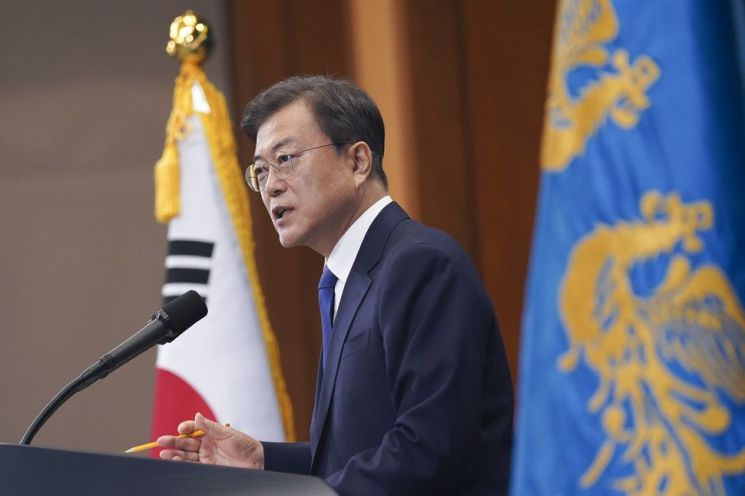 President Moon Jae-in is delivering a special national address on the third anniversary of his inauguration at the Blue House Chunuchu-gwan on the morning of the 10th. / Photo by Yonhap News
[Asia Economy reporters Seung-gon Han and intern reporter Juhyung Lim] The government announced plans to establish a non-face-to-face medical service infrastructure as part of the 'Korean New Deal' project, a stimulus plan launched after the COVID-19 pandemic, sparking growing controversy.
Supporters expect that this service will help respond to infectious disease outbreaks like COVID-19 while securing new growth engines. However, some in the medical community express concerns that remote medical care might effectively be allowed, potentially lowering the quality of medical services.
Non-face-to-face medical care refers to services where doctors diagnose and treat patients without meeting them in person, utilizing information and communication technology.
Earlier, on the 10th, President Moon Jae-in announced in his special speech marking the third anniversary of his inauguration that the government would promote the so-called 'Korean Digital New Deal,' focusing on fostering non-face-to-face industries in the medical, education, and distribution sectors.
Under current medical law, remote medical care, which involves consultation and prescription without direct contact between doctor and patient, is generally prohibited. However, controversy ignited when the government temporarily allowed non-face-to-face medical care limited to chronic patients in February due to concerns about COVID-19 spreading within hospitals.
Proponents argue that it is necessary to build non-face-to-face services where doctors and patients do not come into contact to prepare for infectious disease outbreaks like COVID-19. They also explain that introducing remote medical care can provide medical services to patients with mobility difficulties or those living in medically underserved areas, thereby addressing medical disparities, and can be utilized as a new growth engine in the post-COVID era.
In this regard, Prime Minister Chung Sye-kyun emphasized at the 3rd Thursday Dialogue held on the 14th at the Prime Minister's residence in Samcheong-dong, Seoul, where health and quarantine experts were invited, that "In the era of normalized quarantine, bold 'central shifts' in healthcare measures such as expanding non-face-to-face medical care and discovering remote monitoring services are necessary," adding, "We should take this as an opportunity to advance the quarantine and healthcare system by applying medical bio-industry fields, information and communication technology, and Fourth Industrial Revolution technologies."
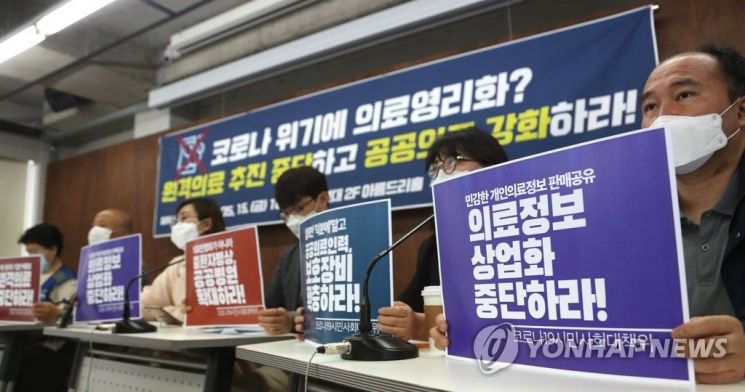 On the morning of the 15th, officials from the COVID-19 Civil Society Countermeasures Committee held a press conference at the People's Solidarity for Participatory Democracy in Jongno-gu, Seoul, urging the suspension of remote medical services and the strengthening of public healthcare. / Photo by Yonhap News
On the other hand, opponents argue that non-face-to-face medical care cannot replace the accuracy of face-to-face care, and even if such services are realized, there is concern that large hospitals with investment capacity will monopolize the market.
Choi Dae-jip, president of the Korean Medical Association, wrote on his Facebook on the 14th, "The purpose of patient care is to provide the best benefit, that is, the best treatment to the patient, so face-to-face care is the principle," adding, "It should only be exceptionally allowed in places where face-to-face care is impossible, such as deep-sea fishing vessels or a very small number of isolated areas in the country."
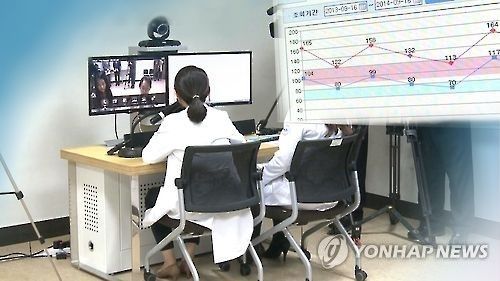
A 2016 report by the National Assembly Research Service titled 'Issues and Future Tasks of Introducing Remote Medical Care between Doctors and Patients' also pointed out similar problems. Due to technical issues such as unstable image quality, resolution, communication equipment errors, or connection instability in video medical systems, the possibility of misdiagnosis by doctors may increase. Furthermore, implementing non-face-to-face medical care requires building related equipment and systems, raising concerns that large hospitals with investment capacity may dominate the market.
Given this situation, the political and medical communities are sharply divided on the issue.
Heo Yoon-jung, head of the COVID-19 Crisis Overcoming Committee's Therapeutics Task Force of the Democratic Party of Korea, appeared on MBC Radio's 'Kim Jong-bae's Focus' on the morning of the 20th, stating, "Many aspects of our society are changing in the post-COVID era," and added, "There is a consensus that it is time to consider non-face-to-face medical care as a partial supplement in the medical field."
On the other hand, Bae Jin-kyo, a member of the Justice Party, said in a statement that day, "The problem is that the government has not properly explained the difference between non-face-to-face medical care and existing remote medical care," and criticized, "The continued public support for medical staff during the COVID-19 pandemic is not because of non-face-to-face medical care but thanks to the healthcare system that leads to accurate and prompt diagnosis, management, and treatment, as well as the dedication of medical personnel."
President Choi of the Medical Association previously stated that if the government pushes forward with remote medical care, the association would engage in "extreme struggle." The association also requested all members on the 18th to completely stop telephone consultations and prescriptions.
Experts suggest that various systems supporting non-face-to-face medical care should be established before its introduction.
Dr. Woo Suk-hoon, an economist and author of 'The 880,000 Won Generation,' advised on CBS Radio's 'Sisa Jaki,' "Both non-face-to-face medical care and remote medical care are called 'telemedicine' in English. They mean the same thing," and added, "Before introducing non-face-to-face medical care, various measures such as a primary care physician system should be prepared in advance."
Dr. Woo argued that without such systems, there is a risk that large hospitals will monopolize medical services. He explained, "The current government plan is to have the first consultation at (local hospitals) and then conduct follow-up visits through (non-face-to-face medical care). If that happens, demand will inevitably concentrate on large hospitals after the initial visit."
© The Asia Business Daily(www.asiae.co.kr). All rights reserved.
![Clutching a Stolen Dior Bag, Saying "I Hate Being Poor but Real"... The Grotesque Con of a "Human Knockoff" [Slate]](https://cwcontent.asiae.co.kr/asiaresize/183/2026021902243444107_1771435474.jpg)


















