Seoul Asia Financial Forum 2020 Hosted by Asia Economy Held on the 20th
[Asia Economy Reporter Kum Boryeong] Since the outbreak of the novel coronavirus disease (COVID-19), the keyword 'contactless (untact)' has been identified as a core concept in the financial investment industry. The untact economy has rapidly progressed due to COVID-19, and it is expected that the era of technology will open in the capital market as well.
At the '2020 Seoul Asia Financial Forum: Post-COVID, Financial Market Stabilization Measures' hosted by Asia Economy on the 20th, experts in the financial investment industry emphasized the need to prepare for the untact era while explaining 'post-COVID investment strategies.'
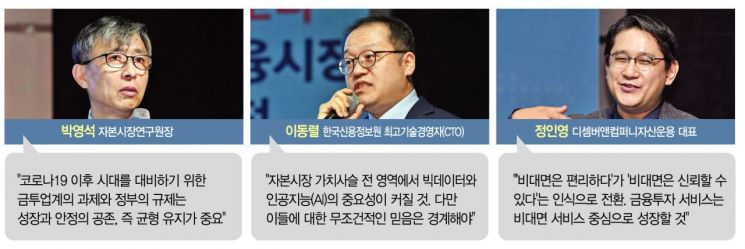
Jung In-young, CEO of December & Company Asset Management, predicted that asset management methods would change after COVID-19. He said, "After COVID-19, rather than individuals directly worrying about investments, they will spend that time on themselves and gradually increase indirect investments through contactless means." As evidence supporting this idea, he cited 'social distancing' and government disaster relief funds. Many people realized through the COVID-19 situation that they could accomplish more tasks contactlessly than expected, and it was confirmed that they were spending on leisure activities and personal expenses through the consumption of disaster relief funds.
CEO Jung explained, "Through a series of events, customers have sought new trusted means that can make investment decisions on their behalf, and in this process, the perception is shifting from 'contactless is convenient' to 'contactless is trustworthy.' In the future, financial investment services will grow centered on transparent, reliable, and convenient contactless services."
Park Young-seok, President of the Korea Capital Market Institute, also anticipated the acceleration of the contactless economy. President Park analyzed, "Although IT had developed before COVID-19, the contactless economy will progress at a much faster pace after COVID-19 than in the past decade. After the COVID-19 pandemic this year, as capital market crises increase, it will become an era of technology. Mobile, untact finance, and fintech businesses will increasingly play larger roles."
Regarding the challenges for the financial investment industry and government regulations to prepare for the post-COVID era, President Park believes that coexistence of growth and stability, that is, maintaining balance, is important. He stated, "To support high-risk innovative industries, the role of the capital market in risk diversification is crucial. We must secure a competitive edge in global innovation competition through the progressive succession of existing innovation growth policies." He added, "From the policy and regulatory perspective, the direction should be to pursue innovative growth through the efficiency of capital market intermediation functions, respond to new types of crises, maintain the soundness of financial investment companies, and strengthen investor protection."
Lee Dong-ryeol, Chief Technology Officer (CTO) of the Korea Credit Information Services, foresaw that the importance of big data and artificial intelligence (AI) would increase across the entire value chain of the capital market in the untact era. CTO Lee emphasized, "Due to COVID-19, there has been an increasing tendency to prefer contactless channels over face-to-face channels and online over offline. This will impact the financial industry through accelerated digitalization, strengthened contactless services, increased self-service, and increased use of big data including AI."
Investment using robo-advisors is already increasing in the advisory domain. The total assets under management by robo-advisors are expected to reach 1,700 trillion won this year, more than five times the amount three years ago. Currently, existing financial information companies such as Vanguard and Charles Schwab are also expanding their market share in the robo-advisor market. However, CTO Lee advised caution against unconditional trust in big data and AI. In the case of AI, if the input data is contaminated, there is a possibility of making wrong decisions. He pointed out, "There could also be attacks designed to induce AI misjudgments, so efforts to prevent this are necessary."
© The Asia Business Daily(www.asiae.co.kr). All rights reserved.
![Clutching a Stolen Dior Bag, Saying "I Hate Being Poor but Real"... The Grotesque Con of a "Human Knockoff" [Slate]](https://cwcontent.asiae.co.kr/asiaresize/183/2026021902243444107_1771435474.jpg)















