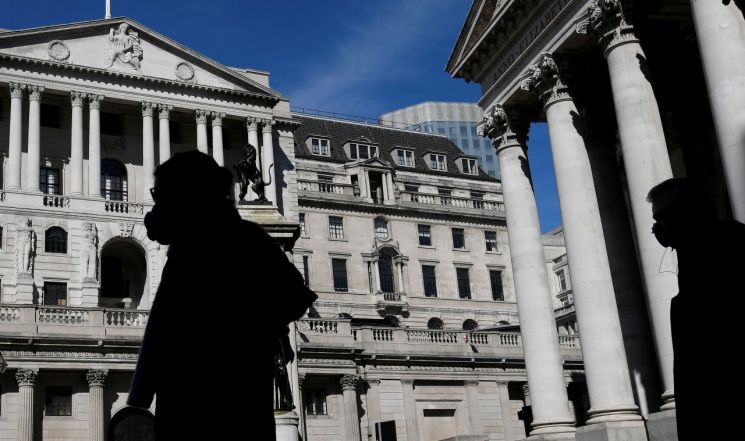
[Asia Economy Reporter Jeong Hyunjin] The UK long-term government bonds were issued with a 'negative (-)' interest rate for the first time in history. This means that investors pay interest to receive the bonds. While there have been cases where the yields on previously issued UK government bonds fell into negative territory, this is the first time, except for one-month short-term bills, that bonds have been issued with a negative interest rate from the outset.
The spread of the novel coronavirus disease (COVID-19) and the decline in oil prices have heightened deflation concerns, leading to expectations that the Bank of England (BOE) will deploy additional monetary policies. Amid debates over the effectiveness of negative interest rate policies introduced by major central banks such as the U.S. Federal Reserve (Fed), attention is focused on whether the UK will be the first to lower its benchmark interest rate below zero.
According to Bloomberg on the 20th (local time), the UK Debt Management Office announced that it issued a three-year government bond worth 3.75 billion pounds (approximately 5.6 trillion won) with a yield of -0.003%. As a result, investors will receive less money back at maturity than they initially invested.
In Europe, countries such as Germany, Austria, the Netherlands, and France have previously issued negative-yield bonds. However, the issuance of negative-yield bonds by the UK has attracted attention because it reflects expectations for additional monetary policy by the BOE. The market believes that the BOE is increasingly likely to introduce negative interest rates in response to the economic downturn caused by COVID-19. Since a decline in interest rates means a rise in bond prices, investors may prefer holding government bonds despite potential losses rather than holding other assets.
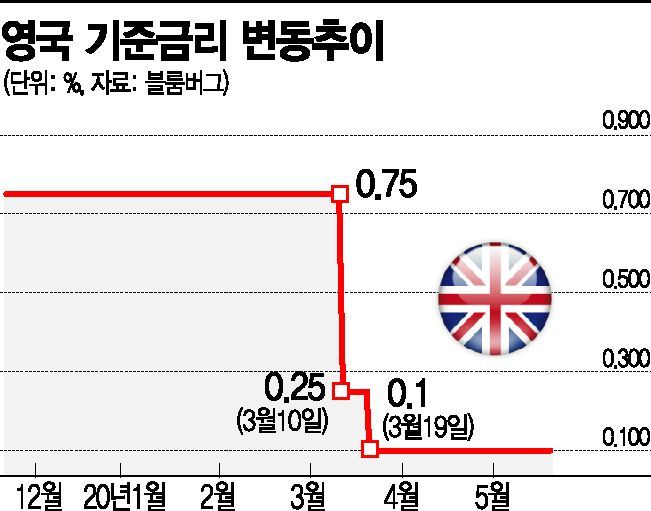
This sentiment is also evident in the current interest rate trends. The UK's benchmark interest rate is at a record low of 0.1%, and the yields on previously issued government bonds have already fallen into negative territory. According to the Wall Street Journal (WSJ), the yields on the UK's three-year and two-year government bonds have fluctuated around the zero line since last week.
In particular, growing concerns about deflation are considered a factor increasing the possibility of negative interest rates. The BOE targets an inflation rate of 2%, but the actual inflation rate has fallen below 1%. The market expects that additional monetary policies will be necessary to raise inflation. The UK's consumer price index (CPI) for April, released on the day, showed a year-on-year increase of 0.8%, down to half of March's 1.5%. This is the lowest level in four years. The UK's first-quarter gross domestic product (GDP) also decreased by 2% compared to the previous quarter, and the decline is expected to widen in the second quarter.
After the issuance of negative-yield bonds, Andrew Bailey, Governor of the BOE, appeared before Parliament and stated that the introduction of negative interest rates is not ruled out in principle. He said, "Considering the policies implemented over the past few weeks, we are continuously reviewing various tools in the current situation," adding, "To rule it out would be foolish." However, he added, "This does not mean that the policy will necessarily be implemented." Foreign media analyzed this statement as a change from his position a week ago, when he said, "We are not currently considering its introduction."
Recently, BOE officials including the Deputy Governor and Monetary Policy Committee members have issued positive messages regarding negative interest rates. In addition to lowering the benchmark interest rate, the scale of asset purchases, a representative quantitative easing (QE) policy tool, is expected to be further expanded to help distribute the government's COVID-19 cost burden.
© The Asia Business Daily(www.asiae.co.kr). All rights reserved.
![Clutching a Stolen Dior Bag, Saying "I Hate Being Poor but Real"... The Grotesque Con of a "Human Knockoff" [Slate]](https://cwcontent.asiae.co.kr/asiaresize/183/2026021902243444107_1771435474.jpg)
















