Unrivaled Global No.1 in Memory Market
System Semiconductor Market Twice the Size
Urgent Need to Accelerate Investment for Market Expansion
Leading Semiconductor Dominance in the Contactless Era
Investment Plan of 133 Trillion Won by 2030
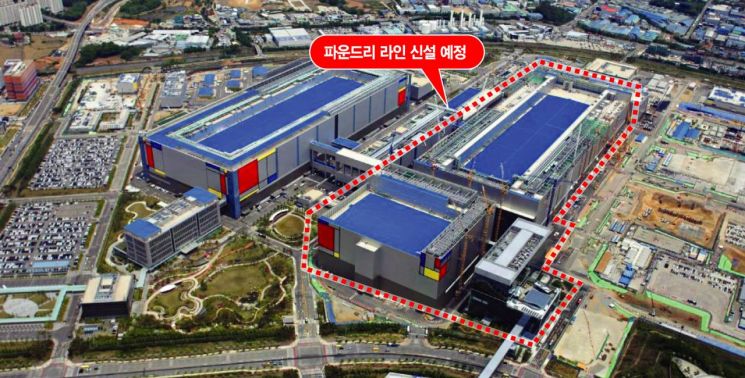 Samsung Electronics will begin construction this month of a foundry (semiconductor contract manufacturing) line in Pyeongtaek, following its sites in Giheung and Hwaseong, Gyeonggi Province. The photo shows an aerial view of the Samsung Electronics Pyeongtaek campus.
[Asia Economy reporters Changhwan Lee and Dongwoo Lee] Samsung Electronics' move to establish an extreme ultraviolet (EUV) foundry (semiconductor contract manufacturing) line in Pyeongtaek, following Hwaseong in Gyeonggi Province, is part of a strategy to surpass formidable competitors such as TSMC and Intel and become the world's number one in system semiconductors.
While Samsung Electronics holds an unrivaled global number one position in memory semiconductors such as DRAM and NAND flash, its presence in the system semiconductor market, which refers to non-memory semiconductors, is relatively small with a global market share of about 4%. Given that the system semiconductor market is roughly twice the size of the memory semiconductor market, expanding the foundry business is deemed essential for broadening Samsung's semiconductor operations.
The rapid growth potential of the system semiconductor market driven by the Fourth Industrial Revolution?including artificial intelligence (AI), the Internet of Things (IoT), autonomous vehicles, 5G, and untact (contactless) industries?is also fueling Samsung's increased investment. According to market research firm Omdia, the global system semiconductor market size is expected to expand from $25.6 billion (approximately 29.952 trillion KRW) in 2018 to $33 billion (approximately 38.61 trillion KRW) in 2022.
Another reason behind Samsung Electronics' increased investment is the relatively stable growth potential of system semiconductors compared to the cyclical memory semiconductor market. In fact, although Samsung's total semiconductor sales decreased in the first quarter, system semiconductor sales rose by about 50% year-on-year, reaching 4.5 trillion KRW.
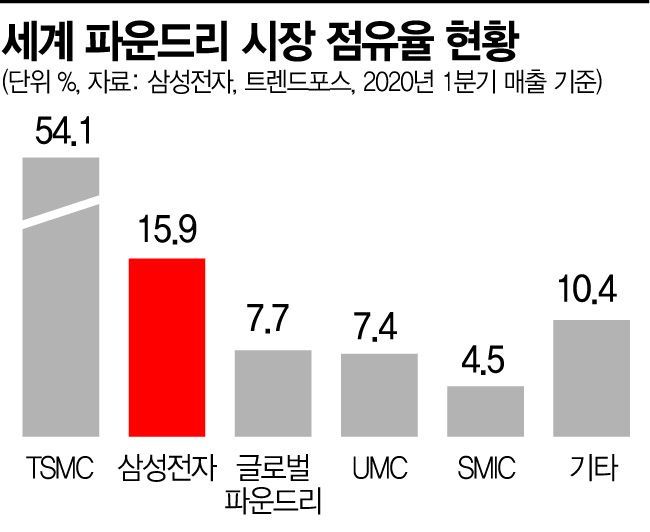
Notably, the newly established foundry line in Pyeongtaek is considered one of the core industries, accounting for about 15% of the system semiconductor market. The foundry market is dominated by Taiwan's TSMC with a 54% market share, while Samsung holds about 16%. Samsung Electronics is determined to overtake TSMC and capture the foundry market. To this end, Samsung plans to invest 133 trillion KRW and hire 15,000 specialized personnel by 2030 to grow its system semiconductor business.
The Pyeongtaek foundry line announced on this day will introduce EUV equipment, which is essential for overcoming the limits of fine process technology. EUV is a next-generation light source that can replace the existing argon fluoride (ArF). Its wavelength is less than one-fourteenth that of ArF, making it suitable for implementing more detailed semiconductor circuit patterns and reducing complex multi-patterning processes, thereby simultaneously ensuring high performance and productivity of semiconductors. Globally, EUV equipment is being used in the production of the latest semiconductors.
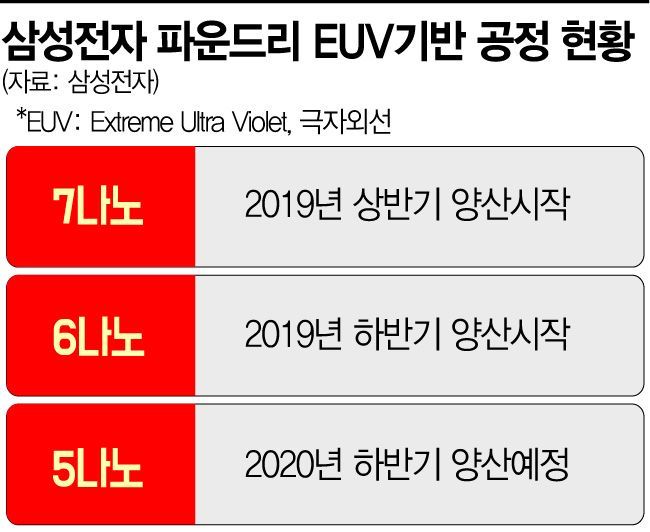
Last year, Samsung Electronics began mass production of 7-nanometer chips based on EUV technology at the Hwaseong S3 line, the first in the industry. In February, it started full-scale operation of the EUV-dedicated Hwaseong V1 line, continuously expanding production capacity. With the operation of the V1 line, the production scale of products below 7 nanometers is expected to increase more than threefold compared to 2019 by the end of this year.
Furthermore, with the Pyeongtaek foundry line coming online next year, the production scale of products below 7 nanometers is expected to grow even more steeply. Additionally, the 5-nanometer process, which maximizes productivity, was developed in the first half of last year, and products are planned to be mass-produced in the second half of this year.
Samsung Electronics' moves align with the government's intention to foster the system semiconductor industry. The government is actively promoting support measures for representative companies with advanced technologies like Samsung Electronics and mid-sized foundry companies to target niche markets.
Using the 'Industrial Structure Advancement Support Program,' the government plans to provide financial support for foundry companies' facility investments and is considering extending the sunset period for tax credits on foundry facility investments. Additional discussions are underway on providing incentives when large companies in the foundry industry cooperate with small and medium-sized enterprises. Through active support, the government aims to increase the global foundry market share from 20% in 2022 to 35% by 2030.
Oh Jung-geun, president of the Korea Financial ICT Convergence Society, said, "In the rapidly changing global semiconductor market landscape, it appears Samsung Electronics is accelerating its response. It is interpreted that Samsung is pursuing a strategy to strengthen domestic semiconductor production in preparation for the advent of the untact era and supply chain restrictions amid US-China conflicts."
© The Asia Business Daily(www.asiae.co.kr). All rights reserved.
![Clutching a Stolen Dior Bag, Saying "I Hate Being Poor but Real"... The Grotesque Con of a "Human Knockoff" [Slate]](https://cwcontent.asiae.co.kr/asiaresize/183/2026021902243444107_1771435474.jpg)

















