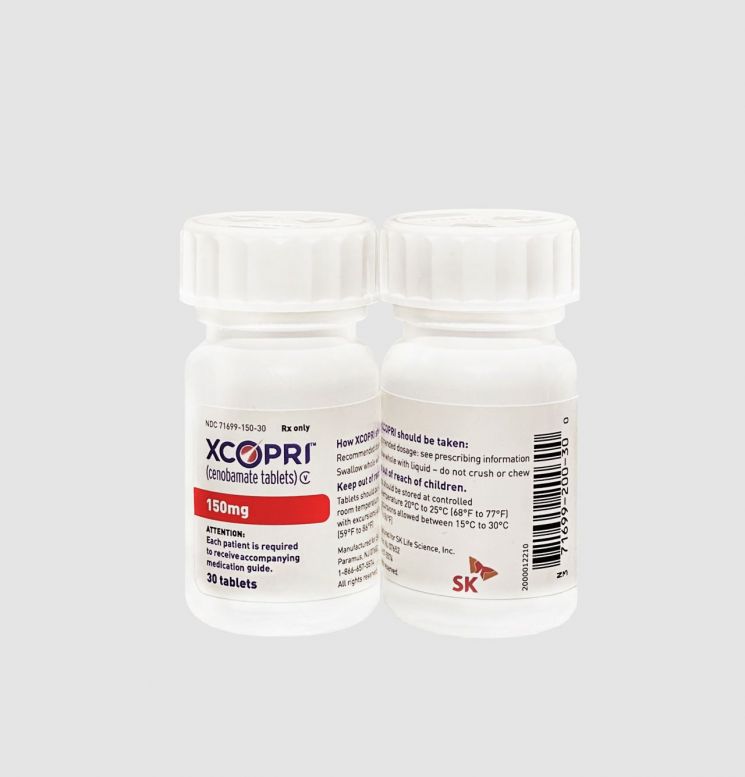
[Asia Economy Reporter Cho Hyun-ui] SK Biopharm announced on the 21st that the research results supporting the U.S. Food and Drug Administration (FDA) approval of the epilepsy drug candidate 'cenobamate' have been published in international academic journals. Cenobamate, which SK Biopharm independently developed from drug candidate discovery to clinical development and approval, was launched in the U.S. market under the name 'Xcopri' on the 11th (local time).
The results of the Phase 2 clinical trial evaluating the safety and efficacy of cenobamate were published in 'Neurology,' the official journal of the American Academy of Neurology (AAN), and the interim results of the Phase 3 clinical trial were published in 'Epilepsia,' the official journal of the International League Against Epilepsy (ILAE).
The Phase 2 clinical trial was conducted on 222 patients whose seizures did not stop despite taking 1 to 3 existing epilepsy treatments. According to the study, when cenobamate was administered as an adjunctive therapy, the frequency of seizures in patients significantly decreased compared to placebo. The median seizure frequency in patients taking cenobamate decreased by 56%, which is a meaningful result compared to the 22% decrease in the placebo group.
The number of patients achieving a seizure frequency reduction of 50% or more was 50% in the cenobamate group, which is 2.5 times higher than the 22% in the placebo group. Additionally, a post hoc analysis of the treatment maintenance period showed that the rate of 'complete seizure freedom' in the cenobamate group was 28%, higher than the 9% in the placebo group.
Steve Jung, M.D., the lead author of the study and director of the Neuroscience Research Institute and head of the Epilepsy Program at Banner University Medical Center in the U.S., explained, "Although several new epilepsy treatments have been launched over the past 25 years, a significant number of patients still experience seizures. The meaningful reduction in seizure frequency observed in patients taking cenobamate and the 28% of patients achieving complete seizure freedom during the maintenance period are encouraging research results."
The most common treatment-related adverse reactions in both the cenobamate and placebo groups were drowsiness (cenobamate: 22% vs. placebo: 12%), dizziness (22% vs. 17%), headache (12% vs. 13%), nausea (12% vs. 5%), and fatigue (11% vs. 6%).
The large-scale Phase 3 clinical trial was conducted to assess the safety of long-term adjunctive use of cenobamate and whether starting at a low dose and increasing the dose every two weeks could mitigate the risk of drug hypersensitivity. A total of 1,339 adult patients taking 1 to 3 seizure treatments started at a dose of 12.5 mg per day, with doses increased to 25, 50, 100, 150, 200, and 400 mg as needed during the maintenance period.
No drug hypersensitivity was observed among patients taking cenobamate. Patients who took the drug for more than six months accounted for 83% of the total. Long-term use was generally safe and well tolerated.
The most common treatment-related adverse reactions were drowsiness (28%), dizziness (24%), and fatigue (17%). Drug discontinuation due to adverse reactions was observed in 147 patients (11%). Serious adverse reactions occurred in 108 patients (8%), with seizures (19 patients) being the most common. No new safety issues were identified.
Mark Kaiman, Chief Medical Officer (CMO) of SK Life Science, SK Biopharm’s U.S. subsidiary, said, "The research results covered in the two recently published papers are the basis for the FDA approval of cenobamate in the U.S. We will continue to accumulate clinical research data on the safety and efficacy of cenobamate going forward."
© The Asia Business Daily(www.asiae.co.kr). All rights reserved.
![Clutching a Stolen Dior Bag, Saying "I Hate Being Poor but Real"... The Grotesque Con of a "Human Knockoff" [Slate]](https://cwcontent.asiae.co.kr/asiaresize/183/2026021902243444107_1771435474.jpg)















