Over 300,000 tons by April... 40% Increase YoY
High Electricity Costs Lead to Poor Fertilizer and Pesticide Production
Imports Up 9% from Last Year, 1.22 Million Tons in 2023
[Asia Economy Phnom Penh Correspondent An Gil-hyun] As Cambodia's rice exports increase, imports of fertilizers and pesticides have also risen accordingly.
According to local media on the 19th, the Ministry of Agriculture, Forestry and Fisheries of Cambodia announced that the import volume of fertilizers and pesticides last year reached 1.22 million tons, a 9% increase from the previous year. Among them, fertilizers accounted for 1.14 million tons, and pesticides 81,000 tons.
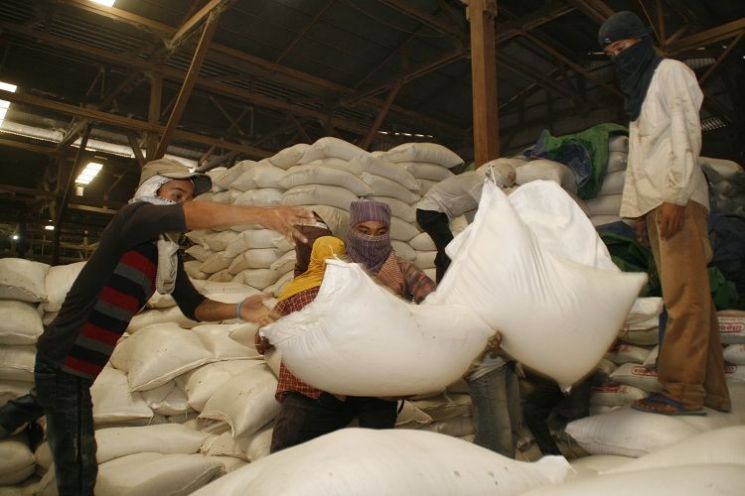
The increase in fertilizer and pesticide imports is related to the rise in rice exports. Cambodia exported 300,252 tons (worth 210 million USD) of rice from the beginning of this year until April. This is a 40% increase compared to the same period last year. Since the COVID-19 pandemic, the world has been cautious about exporting food such as rice under the banner of food security, so the increase in exports can be interpreted as an improvement in concerns over the food crisis. Cambodia ranks 13th in the world in rice production.
By country, 122,094 tons, accounting for 41% of the total, were exported to China, 97,337 tons (32.4%) to the European Union (EU), and 37,428 tons (12.5%) to the Association of Southeast Asian Nations (ASEAN) region. Exports to China increased by 28% compared to the same period last year, and exports to the EU increased by 48%. The significant increase in rice exports to the EU is particularly meaningful. The EU has imposed safeguard measures (emergency import restrictions) on Cambodian imported rice for three years and additional tariffs until next year. Last year, 175 euros (about 198 USD) per ton, this year 150 euros, and next year 125 euros will be added to the price of goods respectively. Despite the tariffs, it can be interpreted that Cambodian rice has gained competitiveness in the European market.
Cambodia's imports of fertilizers and pesticides are expected to increase further. Although the Cambodian government encourages domestic fertilizer production, conditions are reported to be very poor. Minister of Agriculture, Forestry and Fisheries Weng Sakon said, "Raw materials must be imported, and electricity costs are high, making domestic production difficult." There is only one chemical fertilizer factory in Cambodia with an annual capacity of 350,000 tons.
Despite this situation, the presence of Korean-made fertilizers and pesticides remains minimal. This is closely related to the fact that Cambodian farmers' purchasing power is not high, so low-priced fertilizers and pesticides, even if of low quality, are popular. The fact that counterfeit fertilizers or pesticides with stolen brand names are openly distributed is also a problem. A local company importing 2,000 tons of organic fertilizer annually from Japan lamented, "We are struggling with farmers who prefer low-priced products and the distribution of counterfeit products." The Ministry of Agriculture, Forestry and Fisheries of Cambodia has issued import permits for fertilizers and pesticides to 226 companies.
© The Asia Business Daily(www.asiae.co.kr). All rights reserved.
![Clutching a Stolen Dior Bag, Saying "I Hate Being Poor but Real"... The Grotesque Con of a "Human Knockoff" [Slate]](https://cwcontent.asiae.co.kr/asiaresize/183/2026021902243444107_1771435474.jpg)











