Samsung's All-Solid-State Battery with New Technology Chosen as Future Growth Engine
Successful Commercialization Expected to Lead Samsung SDI Batteries to Be Adopted by Global Automakers
[Asia Economy Reporters So-yeon Park and Chang-hwan Lee] March 10, 2020. The world-renowned academic journal Nature Energy published Samsung's newly developed next-generation electric vehicle battery technology. Amidst active research and development in the battery industry to secure a lead in all-solid-state batteries, Samsung became the first in the world to unveil a breakthrough technology that overcomes the challenges to commercializing all-solid-state batteries.
This development, which attracted attention from academia and the battery industry, also drew great interest from Chung Eui-sun, Vice Chairman of Hyundai Motor Group. Upon hearing the news, Samsung Electronics Vice Chairman Lee Jae-yong readily invited Vice Chairman Chung to the electric vehicle battery plant. This unprecedented visit by Vice Chairman Chung to a Samsung facility (Samsung SDI Cheonan Plant) was thus arranged.
Samsung is currently focusing on next-generation growth engines such as system semiconductors, biosimilars, quantum dot (QD) displays, and automotive electronics, dedicating efforts to technology development and expanding market share. Vice Chairman Lee’s consecutive visits since early this year to the semiconductor research center at the Hwaseong plant, the EUV-exclusive V1 line, the Asan display plant, and the Samsung Advanced Institute of Technology were aimed at directly checking and encouraging the progress of new growth engines.
The meeting of the two chairmen on the 13th confirmed that all-solid-state batteries are also a crucial business that will drive Samsung’s future growth. The most important thing Vice Chairman Lee revealed to Vice Chairman Chung was Samsung’s current status in developing all-solid-state batteries.
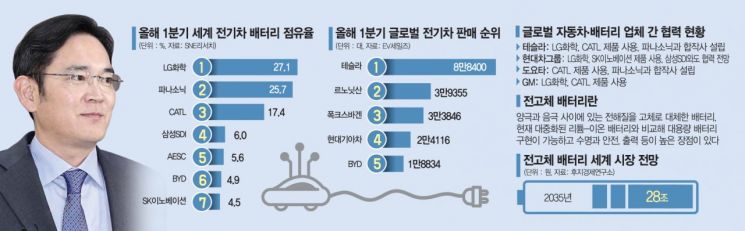
All-solid-state batteries are next-generation batteries known as the "dream battery." These batteries replace the liquid electrolyte inside lithium-ion batteries with a solid electrolyte. Conventional batteries can explode if exposed to excessive heat or impact because the liquid electrolyte leaks out, but all-solid-state batteries do not contain flammable liquid inside, so they do not explode. Additionally, all-solid-state batteries have no internal separator, allowing their size to be reduced to about half that of conventional batteries. They can also be made thin and flexible.
Theoretically, equipping electric vehicles with all-solid-state batteries would enable driving over 700 km on a single charge. For this reason, not only battery manufacturers but also automakers such as Japan’s Toyota and Panasonic, and Korea’s Hyundai Motor are focusing on development in this field. Japan’s Fuji Keizai Research Institute forecasts the global all-solid-state battery market to reach approximately 28 trillion KRW by 2035.
However, before commercialization, a problem that must be solved is the "dendrite," which reduces battery life and safety. Dendrites are tree-branch-shaped crystals that form when lithium accumulates on the anode surface during charging, damaging the battery and lowering its lifespan and safety.
The Samsung Advanced Institute of Technology applied the world’s first "precipitated lithium anode technology" to solve the dendrite issue and disclosed this in Nature Energy. If Samsung SDI commercializes all-solid-state batteries, Samsung’s super-gap strategy will be proven once again on the global stage. Hyundai Motor, which is also striving to lead the future car market, is increasingly likely to adopt Samsung SDI’s batteries.
A Samsung official explained, "The all-solid-state battery technology Samsung unveiled this year is a core source technology that will revolutionize the driving range of electric vehicles," adding, "Samsung is overcoming the limitations of next-generation batteries through research on all-solid-state battery materials and mass production technologies."
On this day, there was no sign of the past rivalry between Samsung and Hyundai Motor over ventures into the automobile business or bidding for Korea Electric Power Corporation (KEPCO) sites. The chairmen focused solely on future growth engines. Both leaders, realizing that vertical integration alone cannot win global competition in next-generation business areas such as electric and autonomous vehicles, shared their future strategies.
Given the rapidly changing domestic and international economic environment and the COVID-19 pandemic, this meeting was evaluated as an example of "open innovation"?where companies procure necessary technologies and ideas externally while sharing internal resources to create new products or services?between Samsung and Hyundai Motor.
After the technology tour, the chairmen also united their spirits in the VIP room of the plant cafeteria. Throughout the meal, they discussed the challenging management environment and future business concerns, agreeing on the goal of making Korea a leader ahead of China and Germany in future industries such as electric vehicle batteries and autonomous driving. They especially emphasized that Korea must not lose leadership in the all-solid-state battery sector, which China and Germany are fiercely developing as a "national industry."
A business community official commented, "The fact that the chairmen of Samsung and Hyundai Motor, who have long been competitors, met to discuss cooperation on next-generation technologies is significant in itself," and added, "If Samsung’s top-tier technology is applied to Hyundai Motor’s future vehicles, it will be a great national achievement."
© The Asia Business Daily(www.asiae.co.kr). All rights reserved.
![Clutching a Stolen Dior Bag, Saying "I Hate Being Poor but Real"... The Grotesque Con of a "Human Knockoff" [Slate]](https://cwcontent.asiae.co.kr/asiaresize/183/2026021902243444107_1771435474.jpg)















