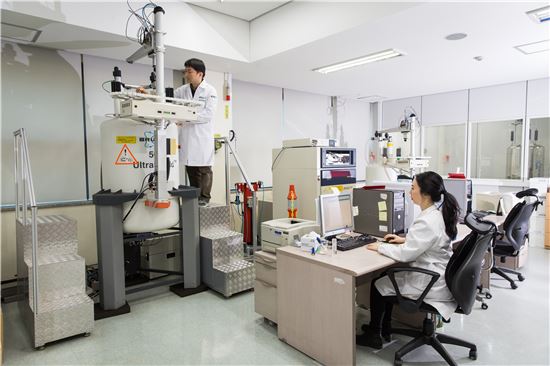
 ▲Researchers are conducting structural analysis of new substances after experiments at the center. [Photo by Korea Research Institute of Chemical Technology]
[Asia Economy Reporter Junho Hwang] When conducting government research projects, the requirement for paper receipt proof for research expenses, reimbursement of actual domestic travel expenses, and the time limit on research material expenditure will be abolished. Research and development funds can be advanced, and direct costs and indirect costs will be paid separately. The 'administrative burden,' considered the biggest challenge for researchers engaged in national source technology development, is expected to be significantly reduced.
On the 13th, the Ministry of Science and ICT finalized a regulatory improvement plan for research activities at the 10th review meeting of the National Science and Technology Advisory Council. The improvement plan was prepared to address 21 issues identified by the on-site regulatory inspection team formed in July last year. The inspection team found that although there are joint research management regulations across ministries, the absence of ministry-specific regulations led to many cases where outdated regulations were applied on-site. They also noted that unreasonable regulations arose not from written rules but due to requests from higher authorities or administrative convenience.
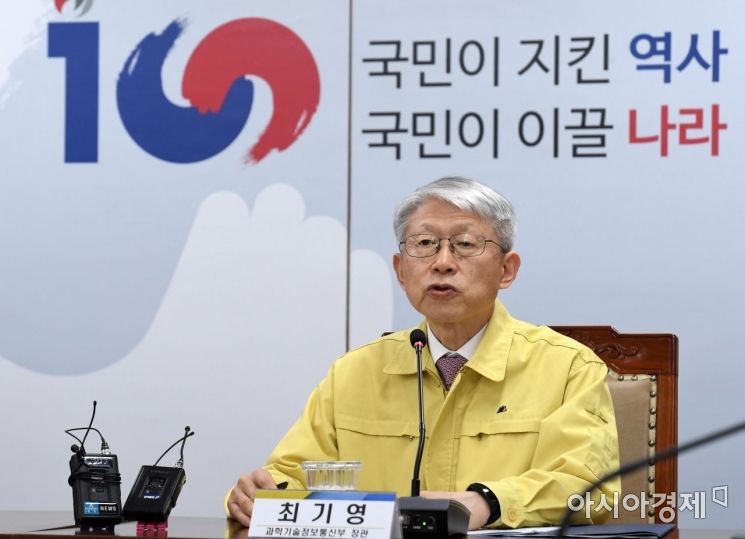 Minister of Science and ICT Choi Ki-young is delivering opening remarks on the 1st at the Government Seoul Office in Jongno-gu, Seoul, ahead of a meeting with Deputy Prime Minister and Minister of Education Yoo Eun-hye to discuss cooperation in building a remote education infrastructure. Photo by Kim Hyun-min kimhyun81@
First, the government will provide a fixed allowance for domestic travel expenses of researchers at government-funded research institutes. This measure aims to eliminate unnecessary administrative burdens by abolishing reimbursement of actual expenses. The fixed travel allowance will be determined by the National Research Council of Science and Technology, considering regional travel distances and means. However, actual expense reimbursement will still apply to lodging costs, which have relatively lower administrative burdens.
The time limit on research material expenditure will also be abolished. Some ministries currently only recognize material expenses purchased up to two months before the contract ends, so ministry-specific regulations will be revised to relax this restriction.
The paper receipt proof system will be eliminated. In addition to card sales slips and electronic tax invoices, documents proving research expense expenditures can be submitted electronically.
The government will also prevent delays in research and development fund deposits caused by administrative procedures after project selection. If it is deemed necessary for research to begin before the research agreement is signed or funds are disbursed, research institutions will be allowed to advance funds using their own resources.
The government will separately pay the proportion of direct costs used directly by researchers and indirect costs used by research institutions. Initially, this separate payment will be applied to basic research projects involving universities, with plans to expand to other projects.
 Photo by Getty Images Bank
Additionally, the government will support publication fees paid after project completion or not included in the research plan through indirect costs. Labor costs for student researchers will be disbursed by semester to support tuition fees.
Minister Choi Ki-young of the Ministry of Science and ICT stated, "Innovation that researchers and the public can feel is important," and added, "This improvement plan is a meaningful case where the government actively reflected voices from the field to promote institutional reform, and we expect significant results that can be felt on the research site."
He continued, "We plan to hold on-site briefing sessions and conduct follow-up inspections of the agenda in the second half of this year," emphasizing, "We will continue efforts to identify and improve mid- to long-term tasks and additional on-site regulations not covered in this improvement plan."
© The Asia Business Daily(www.asiae.co.kr). All rights reserved.

















