Forced and Voluntary Closures of Businesses in Itaewon Area
Unusually Quiet Even at Regular Clubs... Human Traffic Drops at Lounges
Hundreds Queue Outside Gangnam Clubs... Dancing with Masks Down
ID Checks and Guest Lists Done, but Verification Neglected, Creating Quarantine 'Gaps'
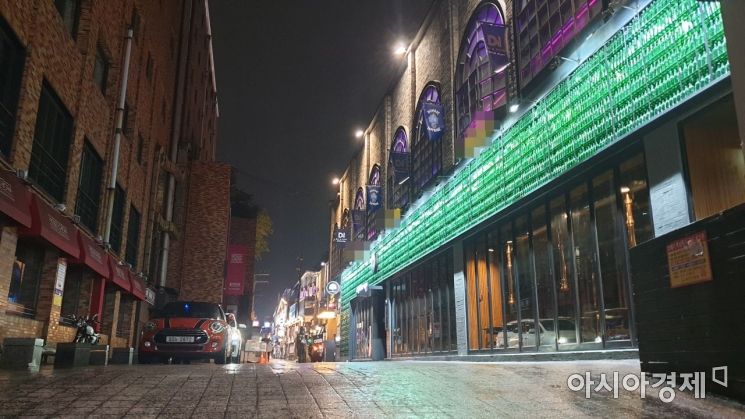 Around 11 p.m. on the 8th, a quiet atmosphere lingered in an alley in Itaewon, Yongsan-gu, Seoul. At least 19 people had been confirmed positive by the evening of the previous day due to a COVID-19 cluster infection at an Itaewon club and subsequent family transmissions.
 /Photo by Byungdon Yoo tamond@
[Asia Economy Reporters Song Seung-yoon and Yoo Byung-don] Around 11 p.m. on the 8th, a visit to a street in Itaewon-dong, Yongsan-gu, Seoul. Known as ‘Gay Hill,’ this area was enveloped in silence. All establishments, including gay clubs and gay bars, which are mainly frequented by sexual minorities, were closed.
◆Itaewon turned into a 'ghost town,' nightlife area deserted=After Patient A (29), the 66th confirmed case in Yongin, Gyeonggi Province, visited clubs and pubs in this area, a series of COVID-19 cluster infections occurred, leading most businesses to voluntarily close. Normally bustling under bright neon lights with a steady flow of visitors, the area resembled a ‘ghost town’ that day. Only nearby residents occasionally passed through the alley. The King Club, Club Queen, and Trunk Club, all visited by Patient A from Yongin, were firmly closed.
Mr. Lee (44), who runs a pub near the infected clubs, said, “This was the first weekend after social distancing shifted to everyday distancing, so I expected customers, but it felt like a bolt from the blue,” adding, “With the COVID-19 situation causing all nearby clubs to close, life has become difficult, and now this has happened again, leaving me at a loss.”
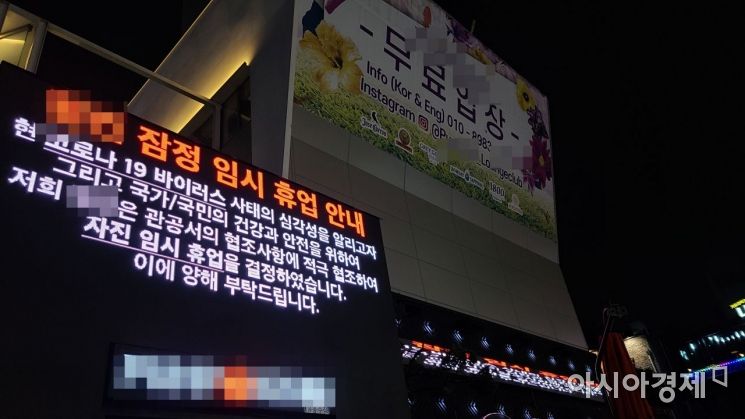 At least 19 people have been confirmed positive due to a COVID-19 cluster infection and subsequent family transmissions originating from an Itaewon club. Meanwhile, a club in Itaewon is seen firmly closing its doors during a voluntary shutdown.
 /Photo by Song Seung-yoon kaav@
On a Friday night, the start of the weekend, Itaewon, which is usually packed with people, was eerily quiet. Most regular clubs were also closed. Some clubs had planned to continue operating until the government’s administrative order recommending suspension of operations was issued, but anticipating the lack of customers, all decided to close.
The P Lounge Bar, usually packed with customers every weekend and requiring at least an hour’s wait to enter, was deserted. This popular venue, where reservations must be made weeks in advance to secure a good seat, had only one table occupied by two customers that night. Passersby occasionally peered inside, seemingly surprised by the unusual scene. Nearby G Lounge Bar and T Lounge Bar were in similar situations.
Park (23), an employee at a nearby pub, said, “I’ve never seen Itaewon like this before,” adding, “I expected a drop in customers after hearing about the confirmed case, but I didn’t expect it to be this severe.”
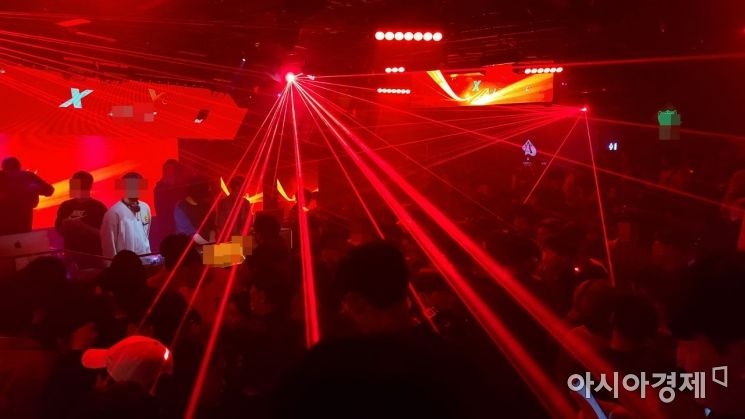 On the 8th, when most businesses in Itaewon, Yongsan-gu, Seoul decided to voluntarily close due to a cluster infection of the novel coronavirus disease (COVID-19), the club district in Gangnam, about 7 km away from here, remained bustling with young people despite the rainy and gloomy weather.
 Photo by Song Seung-yoon kaav@
◆‘Normal’ Friday night in Gangnam clubs, 20s and 30s still flocking=In contrast, the club scene about 7 km away in Gangnam was a different world. Despite concerns about cluster infections inside clubs and the all-day rainy weather, young people flocked to the clubs under the lights.
Just after midnight on the 9th, the front of Gangnam’s R Club was packed with young people enjoying ‘Friday night fever.’ This club had just reopened the previous night. Perhaps due to the ‘opening buzz,’ hundreds of people, including those waiting in line for an hour, had entered the club within that hour.
The sidewalk in front of the club was so crowded with people waiting to enter, chatting in small groups, or smoking that it was difficult to pass without squeezing through. Staff members, seemingly club employees, frequently walked by urging people to wear masks and keep distance in line, but it was only momentary. Many were seen taking off masks to talk with friends or spitting on the street.
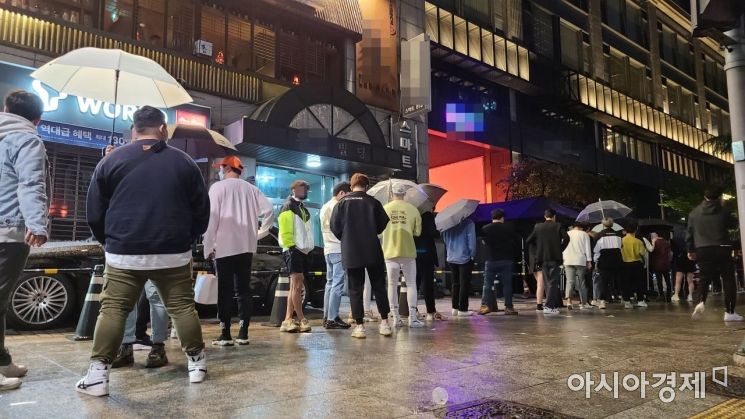 On the 8th, when most businesses in Itaewon, Yongsan-gu, Seoul decided to voluntarily close due to a cluster infection of the novel coronavirus disease (COVID-19), the club district in Gangnam, about 7 km away from here, remained bustling with young people despite the rainy and gloomy weather.
 Photo by Song Seung-yoon kaav@
The situation inside the club was even more serious. In the packed space, many people were dancing, but numerous individuals were not wearing masks. Even those wearing masks often pulled them down below their chins or took them off, seemingly because they felt uncomfortable.
The nearby F Club was similar. Around 2 a.m. that day, the front of F Club was crowded with young people waiting to enter despite the late hour. A long line stretched from the basement first floor entrance to outside the club. At the lobby before entering, ID checks were conducted. After the ID check, visitors wrote their personal information on a list, but there was no separate procedure to verify the authenticity. If false information was provided, it would be practically impossible to accurately identify visitors that day.
‘Social distancing’ seemed like a story from another country at this club as well. Some customers took off masks and shouted, while others freely shared their drinks with others. The club only paid attention to mask-wearing and quarantine measures at the entrance and did not strongly enforce rules inside. A club official said that over 1,000 people visited that day.
Ms. Shin (22, female), who came with friends, said, “Since the confirmed case was from an Itaewon gay club, which seems unrelated to here, I came without much thought,” adding, “If you’re going to get infected, you’ll get infected no matter what you do.”
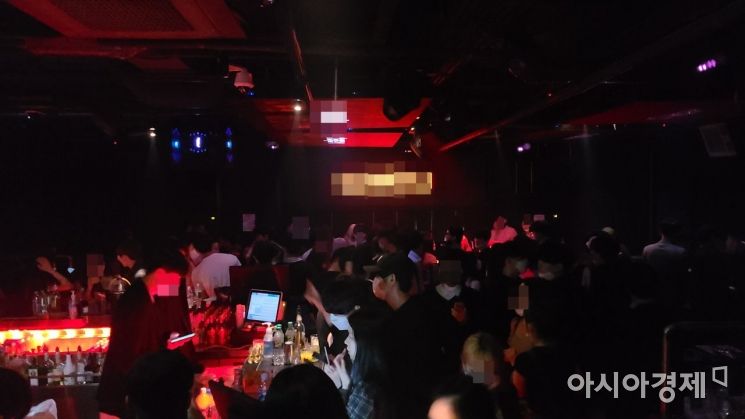 On the 8th, when most businesses in Itaewon, Yongsan-gu, Seoul decided to voluntarily close due to a cluster infection of the novel coronavirus disease (COVID-19), the club district in Gangnam, about 7 km away from here, remained bustling with young people despite the rainy and gloomy weather.
 Photo by Song Seung-yoon kaav@
◆Health authorities on high alert again over COVID-19 cluster infections=Meanwhile, at least 20 people had been confirmed infected by the evening of the previous day due to cluster infections and secondary infections linked to the Itaewon clubs.
According to Seoul, Gyeonggi Province, Incheon, and Chungbuk Province, as of 10 a.m. that day, 15 people had been confirmed infected in relation to the Itaewon clubs?11 in Seoul and 4 in Gyeonggi Province. Subsequently, additional confirmed cases included Patient No. 7 in Jung-gu, Seoul; Patient No. 68 in Yongin, Gyeonggi Province; Patient No. 19 in Bupyeong-gu, Incheon; and Patient No. 14 in Cheongju, Chungbuk.
There are currently 12 confirmed cases related to the Itaewon clubs visited by Patient A (29), the 66th confirmed case in Yongin. All are men in their 20s and 30s. Approximately 1,500 people are estimated to have visited the three clubs Patient A visited. This estimate is based on the visitor logs, but there may be more who were not recorded.
It was confirmed that Patient A and other visitors did not wear masks inside the clubs on the day of their visit.
As cluster infections occurred at the Itaewon clubs, the government issued an administrative order the previous day recommending suspension of operations for clubs and other entertainment facilities.
Accordingly, all entertainment facilities nationwide, excluding karaoke bars, such as clubs, emotional pubs, and colatecs, must strictly comply with quarantine rules if they open from that day onward.
This measure is at the same level as the administrative orders issued for multi-use facilities during the ‘relaxed social distancing’ period from the 20th of last month to the 5th of this month. However, except when eating after entering the facility, wearing masks is mandatory in principle. Each facility must designate a quarantine manager and verify IDs when recording visitor information.
© The Asia Business Daily(www.asiae.co.kr). All rights reserved.



















