[Planning-Middle] Political Landscape Where 'Everything Decided by Will' Is Possible... "Only When 'Minsheng' Results Are Shown Can Political Reform Tasks Gain Momentum" Advice
President Moon Jae-in, who will begin the fourth year of his four-year term on the 10th, is drawing attention as to whether he can overcome the 'impregnable fortress' that no one in Korean politics has ever surpassed. Previous presidents, who maintained high approval ratings early in their terms, failed to break through the '50% approval rating wall' in their fourth year. A 50% approval rating is a benchmark that allows for stable governance free from concerns of a 'lame duck.' This three-part series?'Upper, Middle, Lower'?explores the political significance and challenges surrounding the so-called 50% presidential approval rating rule. -Editor’s note
(Upper) The impregnable fortress of the 50% approval rating in the president’s fourth year
(Middle) The ruling party’s unprecedented concentration of power... the dilemma of 'overpace' in governance
(Lower) The rise of future power and insider corruption, the reefs of the fourth year of the term
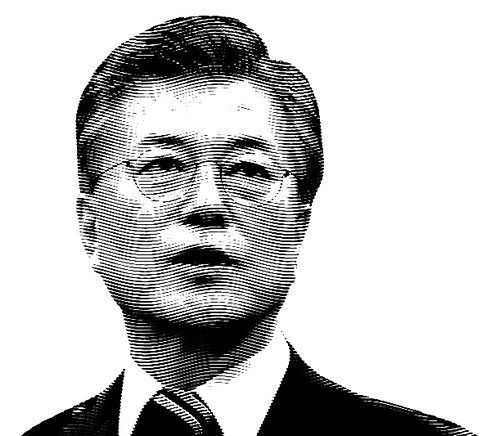
[Asia Economy Reporter Son Seon-hee] The arrival of the 'post-COVID-19' era, which no one anticipated. In the April 15 general election, public sentiment overwhelmingly granted the ruling party a commanding number of seats with the mission of 'overcoming the national crisis.' The high approval rating in the 60% range for President Moon Jae-in also provided strong support. The approval rating, which had fallen to the low 40% range last year amid the so-called 'Cho Kuk incident,' reversed due to the successful containment of the novel coronavirus disease (COVID-19).
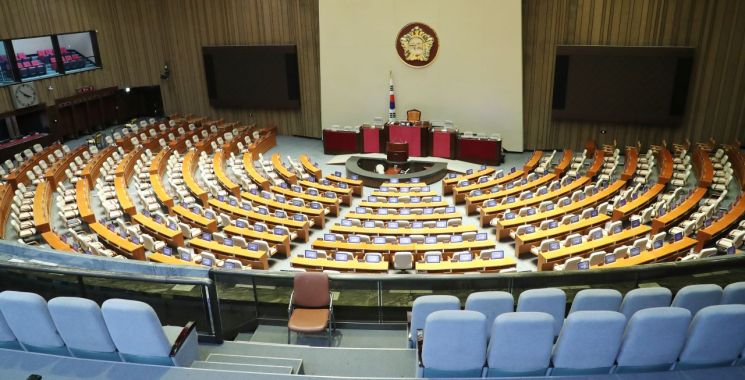
With consecutive landslide victories in the 2018 local elections and this general election, power has been overwhelmingly concentrated in the government and ruling party, including central and local authorities as well as parliamentary power. It is a political landscape where literally 'everything decided upon' can be determined. Expectations swelled inside and outside the ruling party immediately after the general election. This is why major issues such as 'constitutional amendment' surfaced.
Currently, the 'People’s Constitutional Amendment Proposal System,' which allows a constitutional amendment proposal if a certain number of citizens agree, is being discussed mainly by ruling party members. The National Assembly is scheduled to hold a plenary session on the 8th to proceed with the approval process, but it is highly likely to fail due to insufficient quorum.
In reality, the core agenda of the constitutional amendment is the restructuring of power, such as the presidential two-term system, but concrete discussions have not yet begun. Especially regarding the presidential two-term system, there is caution within the ruling party because pushing forward without national consensus or deliberation could again sow seeds of division in public opinion. On the 20th of last month, Lee Hae-chan, leader of the Democratic Party of Korea, issued a 'constitutional amendment taboo' by stating, "Talks about constitutional amendment or the fate of the Prosecutor General are emerging, but what is most important to us now is overcoming the COVID-19 national crisis." This reflects concerns that a forced constitutional amendment could lead to loss of control over governance.
Nevertheless, constitutional amendment is expected to remain a 'live issue' in the next 21st National Assembly. When the Moon Jae-in administration launched in 2017, it set the promotion of a 'people’s sovereignty constitutional amendment' reflecting the spirit of the times, including the candlelight protests, as a national agenda. In fact, a presidential constitutional amendment proposal was submitted in March the following year. Although it is currently on the verge of being discarded due to the failure of simultaneous voting with local elections, the momentum is expected to continue in the next National Assembly, which has secured an unprecedented number of ruling party seats.
Unfinished economic issues such as chaebol reform, fair economy, regulatory innovation, and tax reform also remain. As concerns about economic recession due to the COVID-19 crisis arise, attention to economic policy has become much higher than political issues. In particular, the comprehensive real estate tax (종부세, Jongbu-se) and corporate tax are points where conflicts between core supporters and moderate voters are expected, and hardline lawmakers within the ruling party are also anticipated to oppose. As seen in the recent emergency disaster relief fund discussions, friction between the party and government in pushing forward reform policies is a variable. There is a call for caution against 'over-speeding' in governance that only emphasizes scale. Within the Democratic Party, there is a consensus not to repeat the mistakes of the Uri Party era, which aligns with this perspective.
Yoon Tae-gon, head of the political analysis office at The Moa, analyzed, "Looking back on President Moon’s past three years, his approval rating was good when he took a 'depoliticized' approach, but not good during partisan issue phases." He added, "The regional economic tours from late 2018 for about two months and the current COVID-19 situation are classified as depoliticized issues." He advised, "Rather than expecting the economy to improve solely from the president’s actions, the issue is where the focus lies. Only by showing results along with the 'people-first' message will political reform tasks gain momentum."
The diagnosis is that if reform is emphasized alone and partisan conflicts are triggered, governance could fall into the dilemma of 'overpace.' Even as the fourth year of the administration approaches, President Moon still enjoys high approval ratings, and the super ruling party born from the overwhelming general election victory holds immense power. These two pillars, which can wield absolute power, are also highly explosive powder kegs. If swept up in partisan logic, it would be like a house of cards ready to collapse. It is no coincidence that 'pragmatism' has recently become a key topic in the political sphere.
© The Asia Business Daily(www.asiae.co.kr). All rights reserved.
![Clutching a Stolen Dior Bag, Saying "I Hate Being Poor but Real"... The Grotesque Con of a "Human Knockoff" [Slate]](https://cwcontent.asiae.co.kr/asiaresize/183/2026021902243444107_1771435474.jpg)

















