Korea Productivity Center Announces 2019 Labor Productivity Trends
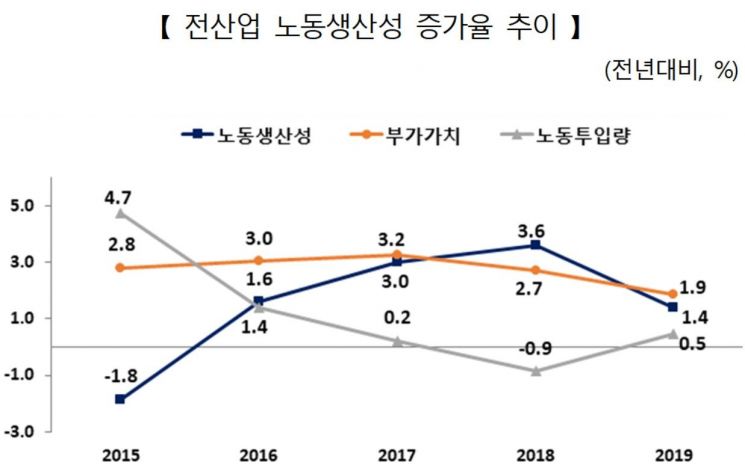
[Asia Economy Reporter Kim Cheol-hyun] Last year, South Korea's labor productivity index across all industries (based on value added) increased by 1.4% compared to the previous year. The Korea Productivity Center (KPC, Chairman Noh Kyu-sung) announced the '2019 Labor Productivity Trends' including this information on the 6th.
The labor productivity index for all industries was recorded at 110.0, a 1.4% increase from the previous year. This was due to a 1.9% increase in value added and a 0.5% increase in labor input. Despite an expansion in the government consumption growth rate, value added was affected by a slowdown in private consumption and export growth rates, as well as decreases in construction and facility investment. Labor input rebounded as the growth rate of the number of workers increased and the reduction rate of working hours decreased. While the number of workers decreased in manufacturing, it continuously increased in the service sector, resulting in an overall increase in the employment share of the service sector in the economy.
The manufacturing labor productivity index was 116.6, up 2.7% from the previous year. Value added increased by 1.4%, while labor input decreased by 1.3% due to simultaneous decreases in the number of workers and working hours. Examining 12 medium-sized industries classified as materials, parts, and equipment within manufacturing, labor productivity increased in 4 industries last year but decreased in 8 industries.
The industries with increases include Computer, Electronics, and Optical Equipment; Automobiles and Trailers; Textiles; and Primary Metals. Computer, Electronics, and Optical Equipment and Automobiles and Trailers led productivity improvements in manufacturing in 2019, although the productivity growth rate slowed compared to the previous year. Textiles and Primary Metals saw simultaneous decreases in value added and labor input, with a larger decrease in labor input leading to productivity increases. Meanwhile, Chemicals and Chemical Products is an industry where support policies such as localization of materials were implemented in response to Japanese export restrictions since August 2019. In the fourth quarter, value added and labor productivity rebounded, indicating that policy effects led to productivity improvements.
The service sector labor productivity index was recorded at 108.8, a 1.4% increase from the previous year. Value added increased by 2.5%, and despite a decrease in working hours, labor input increased by 1.1% due to a larger increase in the number of workers. The Korea Productivity Center stated, "In some industries such as machinery and equipment, and automobiles and trailers, both value added slowdown and labor input decrease were observed," and emphasized, "Due to the impact of COVID-19 this year, these phenomena are expected to spread across industries, making expansion of domestic demand through improved consumer sentiment and proactive employment measures urgently necessary."
© The Asia Business Daily(www.asiae.co.kr). All rights reserved.
![Clutching a Stolen Dior Bag, Saying "I Hate Being Poor but Real"... The Grotesque Con of a "Human Knockoff" [Slate]](https://cwcontent.asiae.co.kr/asiaresize/183/2026021902243444107_1771435474.jpg)















