Naver Expands AI-Related Teams
Plans Developer Recruitment in Second Half
Kakao Expands Techfin Business
Large-Scale Internship Recruitment Linked to Hiring
Youth Influx Due to Open Labor Culture
Contrasts with Manufacturing Like Automobiles
[Asia Economy Reporter Jin-gyu Lee] Naver and Kakao have increased their number of employees by 2 to 3 times over the past five years. They have contributed to job creation in various fields such as artificial intelligence (AI), mobility, and TechFin. This contrasts with the stagnant annual employment numbers in manufacturing industries like automobiles and shipbuilding. Despite the COVID-19 crisis, Naver and Kakao plan to proceed with large-scale new hiring based on stable performance.
◆ Naver Pursues AI Talent Acquisition = On the 6th, Asia Economy analyzed the business reports of Naver and Kakao and found that over the past five years, the number of employees at Naver and Kakao increased more than threefold and twofold, respectively. Naver expanded related organizations while securing global AI technology capabilities, and Kakao grew through large-scale mergers and acquisitions (M&A).
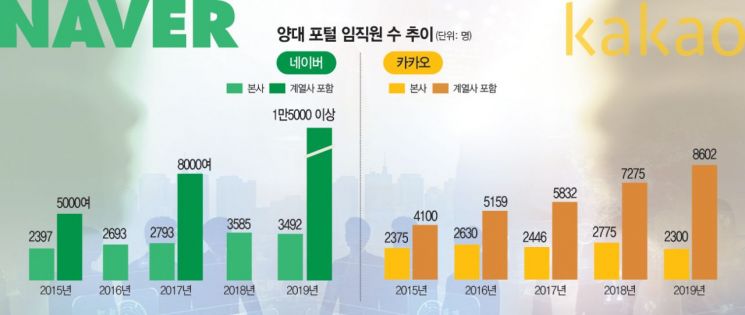
The number of employees at Naver headquarters increased from 2,397 in 2015 to 2,693 in 2016, 2,793 in 2017, 3,585 in 2018, and 3,492 last year. This represents a 45.6% increase over five years. Including employees at major domestic and overseas subsidiaries such as Line, Naver Webtoon, and Naver Business Platform (NBP), the total hiring scale grew from around 5,000 in 2015 to over 15,000 last year, more than tripling. It is analyzed that recruitment of research and development (R&D) personnel in AI fields played a significant role. Naver decided to create a global AI R&D belt to strengthen its global AI competitiveness. Additionally, through Naver Labs, which possesses AI technology such as the AI platform 'Clova,' various technologies are being researched. The R&D personnel at Naver and Naver Labs approach 6,000, accounting for more than 35% of the total employees. A Naver official stated, "Experienced developer recruitment is ongoing, and following the internship selection this summer, we plan to conduct new developer recruitment in the second half of the year."
◆ Kakao Expands Through M&A = Kakao contributes to job creation through large-scale M&A. The number of employees in the Kakao community increased from 4,100 in 2015 to 5,159 in 2016, 5,832 in 2017, 7,275 in 2018, and 8,602 last year, more than doubling over five years. The Kakao community has recently expanded its reach from mobility sectors such as Kakao Mobility to TechFin businesses like Kakao Bank and Kakao Pay Securities. The number of Kakao affiliates increased to 92 earlier this year, making it the second-largest number of affiliates among 59 domestic large business groups. Meanwhile, the number of employees at Kakao headquarters has remained between 2,300 and 2,700 since 2015. Kakao explained, "Although the number of headquarters employees decreases due to spin-offs after M&A, new hiring continues, maintaining similar numbers," adding, "After the merger with Kakao M in 2018, some business units spun off, and Kakao Commerce and Kakao Enterprise also spun off, causing fluctuations in personnel numbers." Kakao, which achieved external growth and improved profitability in the first quarter, is conducting its largest-ever recruitment-linked internship program until the 6th of next month.
◆ "Different from Rigid Labor-Management Culture in Automobiles" = This job creation trend by the two major portals contrasts with general manufacturing industries. According to the Statistics Korea's 'Annual Employment Trends,' the number of employees in general manufacturing has remained stagnant at around 4.42 million last year, down slightly from about 4.48 million in 2015. This is because traditional manufacturing industries such as automobiles and shipbuilding are struggling due to ongoing recessions, and rigid labor-management cultures hinder the proper supply of young talent. Professor Jeong-hyun Wi of Chung-Ang University's Business Administration Department explained, "Portal companies that used to provide only search services have expanded their business areas to AI and big data, increasing the need for personnel," adding, "Unlike the rigid labor-management culture in the automobile industry, the IT industry has a freer labor-management culture, which also works favorably for securing young talent."
© The Asia Business Daily(www.asiae.co.kr). All rights reserved.
![Clutching a Stolen Dior Bag, Saying "I Hate Being Poor but Real"... The Grotesque Con of a "Human Knockoff" [Slate]](https://cwcontent.asiae.co.kr/asiaresize/183/2026021902243444107_1771435474.jpg)
















