4 out of 9 Locations Last Year Exceed 100 Million on Average... Up 1.29% from a Year Ago
[Asia Economy Reporter Kwon Haeyoung] Among the nine financial public enterprises known as "God's workplace," the average annual salary of four exceeded 100 million KRW. KDB Industrial Bank and IBK Industrial Bank saw their starting salaries for new employees surpass 50 million KRW for the first time. Despite the declining profit-generating capacity in the financial sector due to economic recession and low interest rates, the trend of high salaries in financial public enterprises continued steadily.
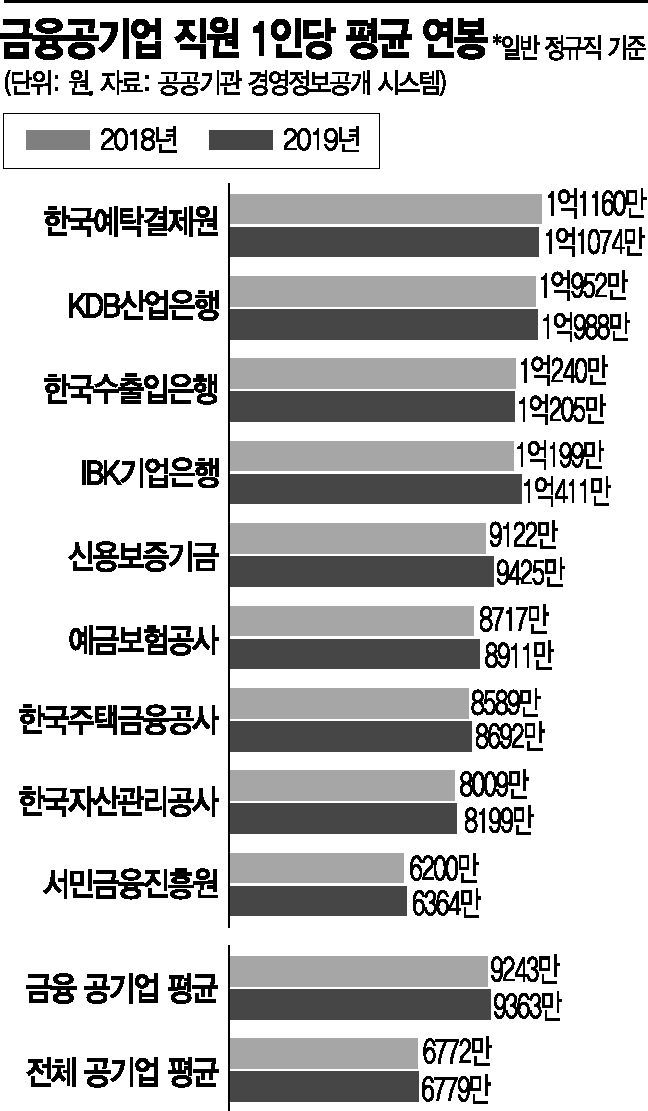
According to the Public Institution Management Information Disclosure System Alio on the 6th, the average annual salary per regular employee last year at nine financial public enterprises?including eight public institutions under the Financial Services Commission (Korea Securities Depository, Industrial Bank, Industrial Bank of Korea, Korea Credit Guarantee Fund, Korea Deposit Insurance Corporation, Korea Housing Finance Corporation, Korea Asset Management Corporation (KAMCO), and the Korea Inclusive Finance Agency) and the Export-Import Bank of Korea?was 93.63 million KRW. This is 38.1% higher than the average salary per person (67.79 million KRW) across all 362 public institutions.
The average annual salary of the nine financial public enterprises increased by 1.29% compared to the previous year (92.43 million KRW). This is 13 times the average salary increase rate of all public institutions (0.1%). While many public institutions recorded low average salary growth due to increased new hiring, financial public enterprises relatively limited new recruitment, which is considered a factor in their higher salary growth.
The highest average salary was at the Korea Securities Depository, where employees earned 110.74 million KRW last year. Following were the Industrial Bank with 109.88 million KRW, Industrial Bank of Korea with 104.11 million KRW, and the Export-Import Bank of Korea with 102.05 million KRW, making four financial public enterprises with average salaries exceeding 100 million KRW out of the nine.
Next in line were the Korea Credit Guarantee Fund with 94.25 million KRW, Korea Deposit Insurance Corporation with 89.11 million KRW, Korea Housing Finance Corporation with 86.92 million KRW, and KAMCO with 81.99 million KRW. The Korea Inclusive Finance Agency had the lowest average salary at 63.64 million KRW.
However, some major financial public enterprises, especially special banks, saw a decrease in average salaries last year due to deteriorating performance. The Korea Securities Depository and the Export-Import Bank of Korea experienced declines of 0.77% and 0.34%, respectively, while the Industrial Bank's average salary rose by only 0.32%.
This was due to the noticeable slowdown in performance caused by economic downturn and provisions for loan losses related to corporate support. The Industrial Bank's net income shrank by 60.4%, from 705.9 billion KRW in 2018 to 279.1 billion KRW last year, and the Export-Import Bank's net income plunged by 36.6%, from 685.8 billion KRW to 434.7 billion KRW. The Korea Securities Depository's net income halved from 83.1 billion KRW to 48.9 billion KRW during the same period.
Starting salaries for new employees at the Industrial Bank and Industrial Bank of Korea surpassed 50 million KRW for the first time, at 51.41 million KRW and 50.45 million KRW, respectively. The average starting salary across all financial public enterprises rose by 1.9%, from 44.20 million KRW in 2018 to 45.05 million KRW in 2019. Although new hires in financial public enterprises slightly increased from 935 in 2018 to 957 last year, five institutions?including the Industrial Bank, Export-Import Bank, Korea Deposit Insurance Corporation, Korea Housing Finance Corporation, and KAMCO?reduced their new recruitment, making entry into these "God's workplaces" more competitive.
© The Asia Business Daily(www.asiae.co.kr). All rights reserved.
![Clutching a Stolen Dior Bag, Saying "I Hate Being Poor but Real"... The Grotesque Con of a "Human Knockoff" [Slate]](https://cwcontent.asiae.co.kr/asiaresize/183/2026021902243444107_1771435474.jpg)
















