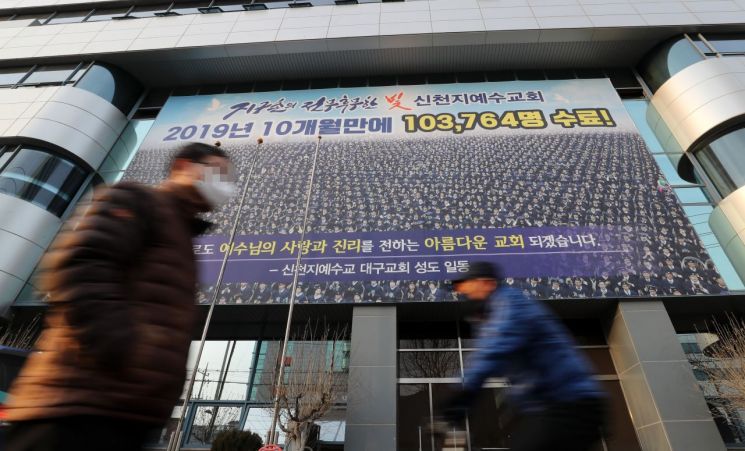
[Asia Economy Reporter Cho Hyun-ui] Patient A, the 31st confirmed case in South Korea and the first confirmed COVID-19 patient in the Daegu region, was discharged after 68 days of hospitalization on the 24th of last month. This duration is nearly three times the average treatment period (25 days) for recovered patients in the country, making it a representative case of long-term hospitalization. We look back on A’s 68 days.
A, a Shincheonji Church member in her 60s, was hospitalized at a Korean medicine hospital in Suseong-gu, Daegu, on February 7th after a traffic accident on the 6th. Three days later, she developed a fever. On the 14th, she was diagnosed with pneumonia at a medical institution, but the next day she visited a hotel in Dong-gu, Daegu, for lunch.
As her pneumonia symptoms worsened, she visited the Suseong-gu Public Health Center on the 17th of the same month for testing and was transferred to Daegu Medical Center that afternoon. Over the next two months, she repeatedly tested positive before finally testing negative on the 22nd of last month. The second test also confirmed the negative result, leading to a final negative diagnosis.
Despite having suspected COVID-19 symptoms such as fever and pneumonia, A attended worship services twice (February 9th and 16th) at the Daegu Church of the Shincheonji Jesus Temple of the Tabernacle of the Testimony in Nam-gu, Daegu, while still hospitalized. Additionally, CCTV analysis later revealed that she had visited the Shincheonji Daegu Church on February 5th, before her hospitalization, sparking controversy over false statements.
A is recognized as the country’s first “super-spreader.” Before A’s diagnosis, there were only 30 confirmed cases in South Korea, but the number exploded afterward, centered around Shincheonji Church members in Daegu. Contact tracing at the Korean medicine hospital where A was admitted identified 128 contacts, and over 1,000 people were present at the Shincheonji Daegu Church at the same time as A.
Over the past two months, A repeatedly tested positive in genetic tests. Jung Eun-kyung, head of the Central Disease Control Headquarters, stated, “Although symptoms improved, the virus secretion tests continued to show positive results, which delayed the release from isolation.” She added, “It will require immunological and clinical research to understand whether the virus secretion period is longer after recovery and how antibody formation occurs.”
A’s medical expenses are estimated to be up to 50 million KRW. The daily cost for a single negative pressure room at Daegu Medical Center, where A was hospitalized, is in the 400,000 KRW range, totaling about 27 million KRW for 67 days of hospitalization alone. The government covers the costs for COVID-19 testing, isolation, and treatment based on the Infectious Disease Control and Prevention Act, sharing expenses with the National Health Insurance Service and local governments.
© The Asia Business Daily(www.asiae.co.kr). All rights reserved.
![Clutching a Stolen Dior Bag, Saying "I Hate Being Poor but Real"... The Grotesque Con of a "Human Knockoff" [Slate]](https://cwcontent.asiae.co.kr/asiaresize/183/2026021902243444107_1771435474.jpg)
















