[Asia Economy Reporter Yuri Kim] The Seoul Metropolitan Government is set to actively promote a project to create 'Compact Cities' by developing high-density, mixed-use areas near transit stations, addressing housing, transportation, and infrastructure all at once. The five selected pilot project sites will begin construction in the first half of next year, and the city plans to select about 10 additional sites (Phase 1 project sites) this year. The goal is to achieve regional balanced development by selecting transit station areas in the relatively less developed non-Gangnam districts.
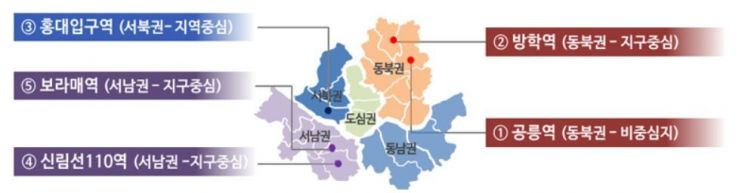
On the 28th, Seoul announced the basic plan for transit station revitalization projects at five pilot sites: around Gongneung Station, Banghak Station, Hongdae Entrance Station, Sinlim Line 110 Station area, and Boramae Station. These are the first projects to concretely realize the 'Transit Station Revitalization Project' announced by the city last June, which focused on customized mixed-use development for each transit station. These locations are suitable for young people and newlyweds, as they are near universities or planned new subway stations. A total of 1,471 housing units (public and private) and living SOC facilities will be newly supplied at these pilot sites.
The transit station revitalization project is an initiative to create compact cities by spatially concentrating residential and non-residential functions in transit station areas, which are good places to live due to concentrated public transportation. It is a new urban planning strategy to revitalize downtown areas and solve urban problems such as traffic congestion, fine dust, and depletion of developable land by simultaneously expanding public rental facilities, shared parking lots, and other amenities like offices, commercial spaces, and housing that are lacking in the city center.
The project is promoted by increasing floor area ratio through zoning upgrades (e.g., from general residential to commercial areas) and receiving public contributions of 50% of the increased floor area ratio for essential facilities such as public rental facilities and shared parking lots. The city explained that this is a win-win strategy where private developers can improve profitability while the public sector can expand necessary living SOC in the area.
The five pilot sites were selected through a local government competition in September last year. The selection comprehensively considered regional balance and narrowing the gap between Gangnam and non-Gangnam areas (by region and district), the willingness of local governments and landowners to promote the project, and the ripple effects of regional revitalization through the expansion of necessary facilities such as rental housing. The city stated that since the transit station revitalization project is a newly launched initiative, pilot sites were selected through procedures including local government briefings and candidate site competitions to build consensus between the city and districts.
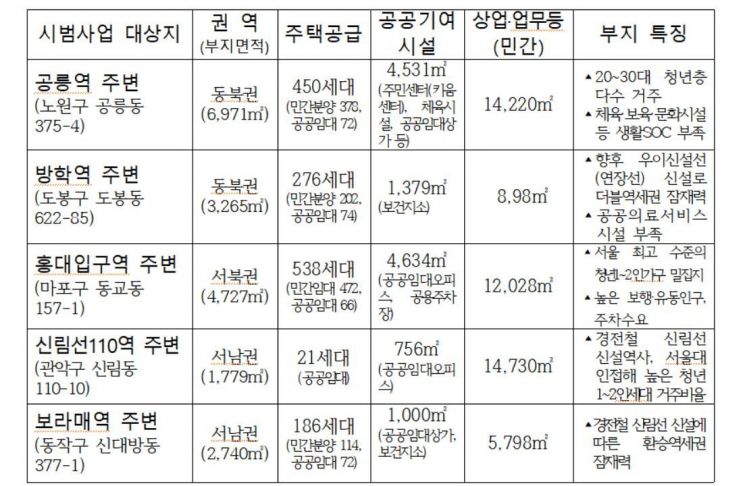
According to the basic plan, a total of 1,471 housing units will be supplied at the five transit station areas, including 1,166 private units and 305 public rental units. Through public contributions from increased floor area ratio, 305 public rental housing units, 3,097㎡ of public rental office space (gross floor area), 1,743㎡ of public rental commercial space, 4,757㎡ of locally needed facilities, and 2,703㎡ of shared parking lots will be secured, expanding various necessary facilities in the area. Private developers are expected to secure 1,166 multi-family housing units and 55,574㎡ of office and commercial space.
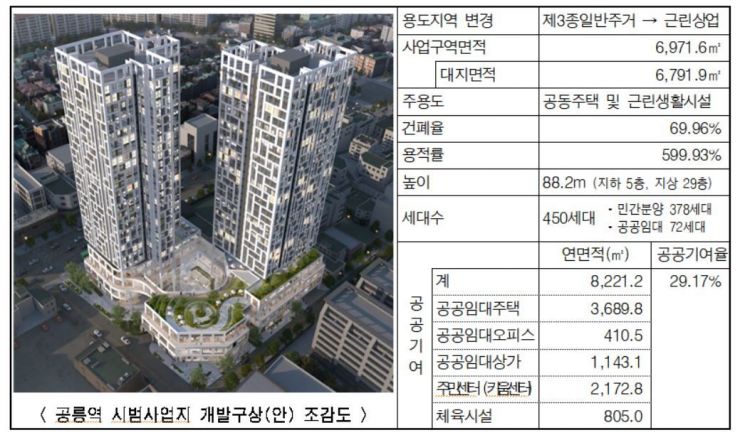
Near Gongneung Station (site area 6,971㎡), there are five universities and a large population of young people in their 20s and 30s. Considering these local characteristics, a total of 450 housing units, mainly small-sized, will be expanded. A youth startup support center, where planning, production, and sales of youth startups are conducted in a one-stop manner in connection with nearby university resources, and public rental commercial spaces will be established. Living convenience facilities that were lacking in the area, such as neighborhood childcare centers and sports facilities, will also be created.
The area around Banghak Station (site area 3,265㎡) is currently used as a taxi garage. This area also has many nearby universities. It has potential as a double transit station area due to the planned new Ui-Sinseol Line (extension). To supply housing tailored for young people, all residential units (a total of 276 units) will be built as small-sized units, and a health center will be expanded to strengthen public medical services for pregnant women, infants, and chronic disease patients.
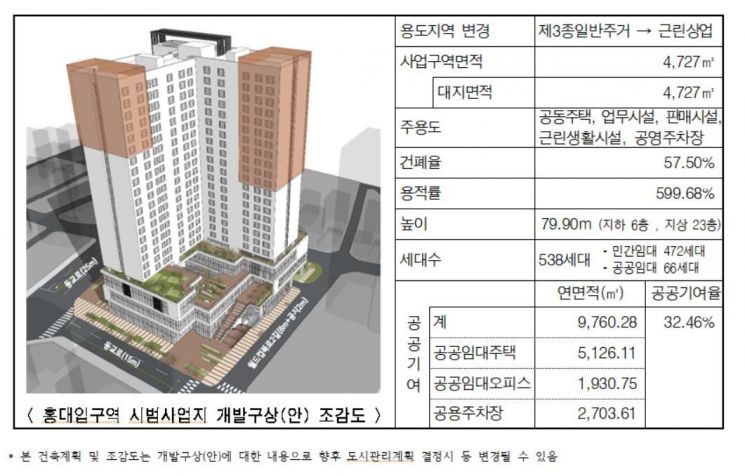
The area around Hongdae Entrance Station (site area 4,727㎡) is one of the most densely populated areas for young one- and two-person households in Seoul. It will be developed into a space where young people can live, work, and rest harmoniously. A total of 538 high-quality housing units, mainly small-sized units and share houses, will be supplied, and startup, cultural, and activity spaces where young people can stay and be active 24 hours a day will be expanded. Considering the high pedestrian and floating population around Hongdae Entrance Station, pedestrian spaces will be secured by utilizing front and open spaces, and public parking lots will be installed to address illegal street parking issues.
The area around Sinlim Line 110 Station (site area 1,779㎡) is adjacent to the planned new station on the light rail Sinlim Line and is located near Seoul National University, with a high proportion of young one- and two-person households. A youth-tailored mixed-use building including educational facilities, offices supporting youth startups, and public rental housing in the form of share houses (21 units) will be constructed here.
The area around Boramae Station (site area 2,740㎡) is expected to see an influx of 3- to 4-person households with infants and young children and an increase in floating population due to the potential as a transfer station area from the new light rail Sinlim Line. Considering this, mid- to small-sized housing (186 units), neighborhood living facilities such as hospitals for infants and young children, retail facilities, and academies will be expanded, and public facilities needed in the area, such as health centers, will be built.
Seoul plans to initiate urban management plan change procedures, including zoning changes and district unit plan decisions, for the five sites in the first half of the year and complete them within the year, with construction starting in the first half of next year. Zoning changes and district unit plan decisions will be finalized after public inspection notices in the districts where the project sites are located, opinions from district councils, advice from district urban planning committees, followed by opinions from the city council, and reviews by the Seoul City Urban Planning Committee and the Joint Urban Architecture Committee.
Additionally, about 10 more sites (Phase 1 project sites) will be selected this year. While the five pilot sites aim to start construction next year, Phase 1 project sites will also proceed with urban management plan changes, permits, and other procedures.
© The Asia Business Daily(www.asiae.co.kr). All rights reserved.
![Clutching a Stolen Dior Bag, Saying "I Hate Being Poor but Real"... The Grotesque Con of a "Human Knockoff" [Slate]](https://cwcontent.asiae.co.kr/asiaresize/183/2026021902243444107_1771435474.jpg)


















