[Asia Economy Reporter Hwang Junho] Domestic researchers have developed a technology to improve the efficiency of quantum dot solar cells, which convert sunlight into electricity using quantum dots.
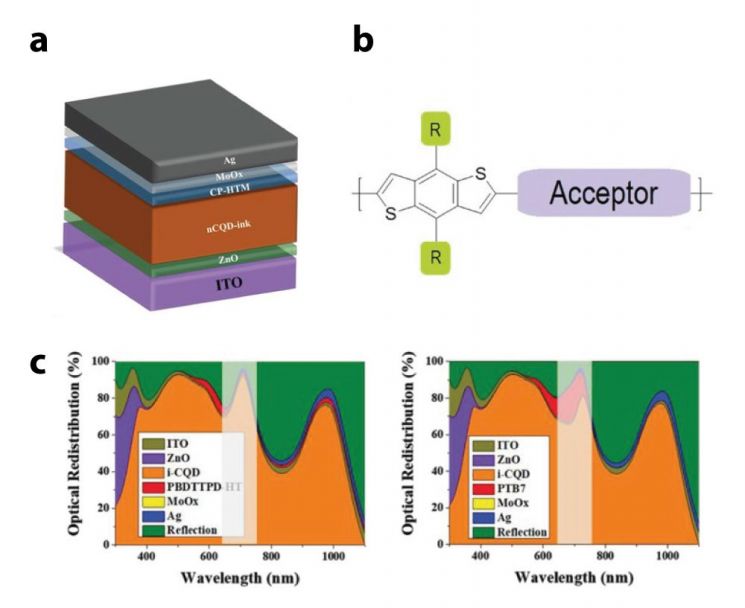
On the 23rd, the research team led by Professor Jang Sung-yeon from the Department of Energy and Chemical Engineering at Ulsan National Institute of Science and Technology announced that they developed a 'quantum dot-organic polymer junction solar cell' that maximizes the performance of quantum dot solar cells using organic polymer materials.
Quantum dot solar cells utilize the property of a material that absorbs sunlight (photoactive layer) to generate electrons and holes. Due to sunlight, electrons move from the photoactive layer to the cell's cathode, and the vacancies left by electrons move to the anode, producing electric power. To increase the cell's efficiency, the number of electron-hole pairs must increase, and these must be well transported to the electrodes.
The research team succeeded in improving performance by replacing some materials of quantum dot solar cells, which use inorganic semiconductors (quantum dots), with organic polymers. They fabricated a solar cell with one side replaced by an organic polymer, enhancing hole extraction capability. This material also prevents electrons and holes from recombining, improving the holes' ability to move to the electrode. The team reported that the efficiency of the newly developed cell increased by 11.53% compared to existing cells.
Professor Jang Sung-yeon said, "This research solves the hole transport problem, which has been a major obstacle in current generation of quantum dot solar cells," and added, "By further studying polymer materials and optimizing the structure, it will be possible to develop hole transport materials with even better properties."
This research was published in the academic journal in the field of energy materials, 'Advanced Energy Materials.'
 Professor Jang Sung-yeon
© The Asia Business Daily(www.asiae.co.kr). All rights reserved.
![Clutching a Stolen Dior Bag, Saying "I Hate Being Poor but Real"... The Grotesque Con of a "Human Knockoff" [Slate]](https://cwcontent.asiae.co.kr/asiaresize/183/2026021902243444107_1771435474.jpg)















