Gimpo and Gimhae Airport Duty-Free Shops' Monthly Rent Extremes
Lotte Pays 5 Billion KRW vs Shilla's Minimum Fixed Cost
Different Calculation Methods Based on 2018
Lotte Faces Fixed Rent, 5 Billion KRW Monthly Even Without Sales
Unfair Calculation Method
Duty-Free Industry Calls for Change
Giving Up Participation in Incheon Airport Bids
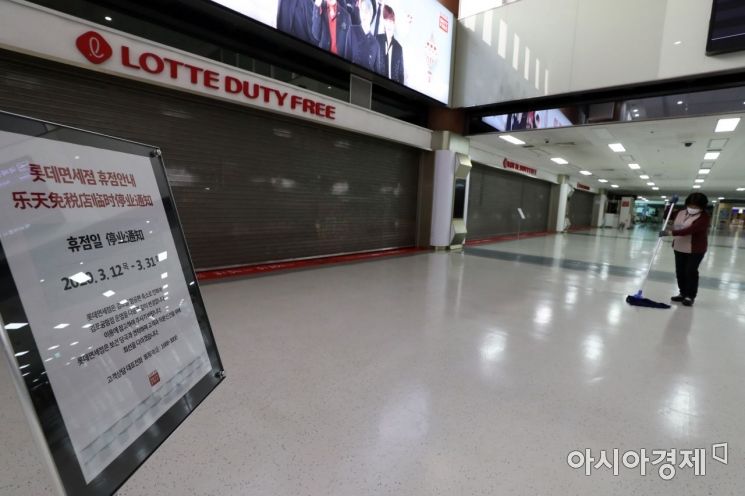 Lotte Duty Free temporarily suspended operations at the international terminal duty-free store of Gimpo International Airport on the 12th. This decision was made due to the sharp decline in flights and passengers at Gimpo Airport caused by the global spread of COVID-19. Photo by Mun Ho-nam munonam@
[Asia Economy Reporters Hye-seon Lim, Seung-jin Lee] Duty-free shops, whose sales have plummeted due to the impact of the novel coronavirus disease (COVID-19), have demanded changes to rental fee policies, but the Korea Airports Corporation remains silent. In particular, there are criticisms that the rental fee calculation methods differ depending on the contract timing, increasing the burden and causing unfairness.
◆Rent is charged even if the store is closed= According to the duty-free industry on the 17th, international flights at Gimpo International Airport and Gimhae International Airport were consolidated to Incheon Airport, leading to closures as of the 6th. Accordingly, Lotte and Shilla Duty-Free Shops and food and beverage outlets located inside the international terminals also shuttered.
Unlike Incheon International Airport, the international airports operated by Korea Airports Corporation have been calculating sales-linked rental fees based on monthly sales fluctuations since 2018. Since 2018, leased stores pay only minimum fixed costs if sales are zero. However, businesses like Lotte Duty-Free Shop that signed contracts before 2018 continue to pay fixed rent based on previous standards.
This is why Lotte Duty-Free Shop pays about 5 billion KRW per month in rent combined for Gimpo and Gimhae Airports, despite both being closed. It has been confirmed that Korea Airports Corporation demanded rent from Lotte Duty-Free Shop even this month, when international flights are not operating at all.
A Lotte Duty-Free Shop official said, "We had to pay rent even in February and March when sales were almost zero, and being asked to pay rent this month when international flights are not operating at all is somewhat excessive." Lotte Duty-Free Shop requested a 'temporary rent reduction' from Korea Airports Corporation. However, Korea Airports Corporation has consistently responded that only the government guideline of a 20% rent reduction applies, showing no willingness to negotiate. Furthermore, the reopening schedule for international flights at Gimpo and Gimhae Airports remains uncertain due to the COVID-19 situation.
Lotte Duty-Free Shop has paid rent according to contracts even though rental fee calculation methods differ from competing duty-free shops. This was supported by sales sufficient to cover the 'seat rent.' The number of international passengers at Gimpo Airport exceeded 4 million last year.
Since the COVID-19 outbreak, international airport terminals have been in a 'temporary closure' state. In March alone, the number of international passengers at Gimpo Airport shrank from 380,000 in the same period last year to about 10,000. From March 29 to April 4, there were zero international passengers, including transfer passengers, at Gimpo Airport. The same period last year saw 89,189 passengers. This situation is similar at regional airports such as Gimhae, Jeju, Cheongju, Daegu, Muan, and Yangyang.
A duty-free industry insider said, "It is contradictory to demand full rent payments while Gimpo and Gimhae Airports have effectively shut down international flights. Applying fixed cost methods to businesses operating since before 2018 and sales-based methods to those after is also unfair."
◆Incheon, even lower-ranked companies give up= The bidding for the 4th term duty-free business rights at Incheon International Airport Terminal 1 remains uncertain. After the companies selected as preferred bidders consecutively gave up their status, even the lower-ranked negotiation candidates have withdrawn from the bidding. Lotte and Shilla Duty-Free Shops, the lower-ranked negotiation candidates for DF3 (liquor and tobacco) and DF4 (liquor and tobacco) business rights, informed Incheon Airport Corporation last week of their intention to relinquish their lower-ranked negotiation status.
A duty-free industry insider explained, "The priority and lower-ranked companies for DF3 and DF4 are essentially the same companies operating in different zones, but Incheon Airport Corporation showed no willingness to negotiate, citing legal issues. They judged that negotiating with lower-ranked candidates without resolving the fundamental issue of rent was meaningless, so all gave up their lower-ranked negotiation status."
With Lotte and Shilla Duty-Free Shops giving up even lower-ranked negotiations, the selection of operators for four out of five zones targeting large corporations must be redone. Previously, DF2 (cosmetics and perfumes) and DF6 (fashion and others) failed to attract competition and were canceled, and re-bidding notices have not been issued for over a month.
However, even if re-bidding proceeds, the duty-free industry is unlikely to participate. Incheon Airport Corporation offered a 20% rent reduction for six months for large corporate duty-free shops due to COVID-19 but stipulated no rent reduction linked to next year's airport passenger numbers. Although international passengers decreased this year, allowing up to a 9% rent reduction next year, this condition was removed, leading to criticism that it is a case of rearranging deck chairs on the Titanic.
© The Asia Business Daily(www.asiae.co.kr). All rights reserved.

















