Temporary Agreement on Largest Ever Production Cut
Disagreement Over Audit Scale in Mexico
Concerns Over Insufficient Measures to Resolve Oversupply
[Asia Economy Reporter Naju-seok] The oil-producing countries, including Saudi Arabia and Russia, are facing last-minute difficulties in agreeing on production cuts. The oil-producing countries had tentatively agreed to reduce daily oil production by 10 million barrels in response to the decline in oil demand caused by the novel coronavirus (COVID-19), but the final decision was postponed again due to Mexico, a member of OPEC+ (a coalition of OPEC member countries and non-member countries), causing disruptions.
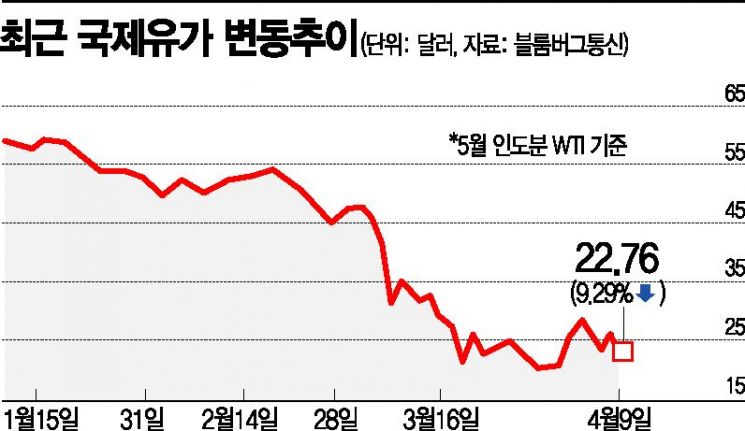
According to CNN and others on the 9th (local time), OPEC countries such as Saudi Arabia and non-OPEC members including Russia held a video conference to discuss oil supply and demand issues including production cuts, but no agreement was reached due to Mexico's opposition. Bloomberg reported that Mexico was asked to cut daily oil production by 400,000 barrels, but Rocio Nahle Garcia, Mexico's Minister of Energy, indicated that they could only accept a 100,000-barrel cut. It was also reported that other OPEC+ countries are trying to persuade Mexico. OPEC+ plans to hold another meeting on the 10th to reach a final agreement.
On the same day, some reports suggested that a tentative agreement to cut 10 million barrels per day had effectively been reached. Some foreign media mentioned specific figures, stating that Saudi Arabia plans to reduce its current daily oil production from 12 million barrels to 8.7 million barrels, and Russia will lower its production from 10.4 million barrels to 8 million barrels. Additionally, the other 21 OPEC+ countries, excluding Saudi Arabia and Russia, agreed to reduce daily oil production by 5 million barrels, while Iran, Libya, and Venezuela, considering their sanctions status, decided not to participate in additional cuts. The OPEC Secretariat reportedly announced plans to reduce daily oil production by 10 million barrels in May and June, maintain a cut of about 8 million barrels from July to the end of the year, and then reduce cuts to 6 million barrels until April 2022.
In the oil market, rumors circulated that the OPEC+ production cut could reach up to 20 million barrels per day on that day alone. Because of this, oil prices surged sharply right after the market opened. However, after news of a tentative agreement to cut 10 million barrels per day was reported, prices fell again. On the New York Mercantile Exchange (NYMEX), May delivery West Texas Intermediate (WTI) crude oil prices rose as much as 12% intraday to $28.36 per barrel but closed at $22.76 per barrel, down 9.3%, after the 10 million barrel cut news was announced.
Bjonar Tonhaugen, Vice President of Rystad Energy, a Norwegian energy consulting firm, said after the news of the 10 million barrel cut, "It will help the market in the short term, but it is disappointing for those hoping for a resolution to the oil oversupply." He added, "It may only bring a short-term price increase, but eventually, the supply-demand imbalance will affect the market."
On the 10th, separate from the OPEC+ talks, a meeting of energy ministers from the Group of Twenty (G20) will also be held. At this meeting, plans to stabilize the global oil market will be discussed.
© The Asia Business Daily(www.asiae.co.kr). All rights reserved.
![Clutching a Stolen Dior Bag, Saying "I Hate Being Poor but Real"... The Grotesque Con of a "Human Knockoff" [Slate]](https://cwcontent.asiae.co.kr/asiaresize/183/2026021902243444107_1771435474.jpg)















