Jeong Eun-kyung, Head of the Central Disaster and Safety Countermeasures Headquarters for COVID-19 Briefing
"Warning of Large-Scale Community Transmission, Social Distancing Needed"
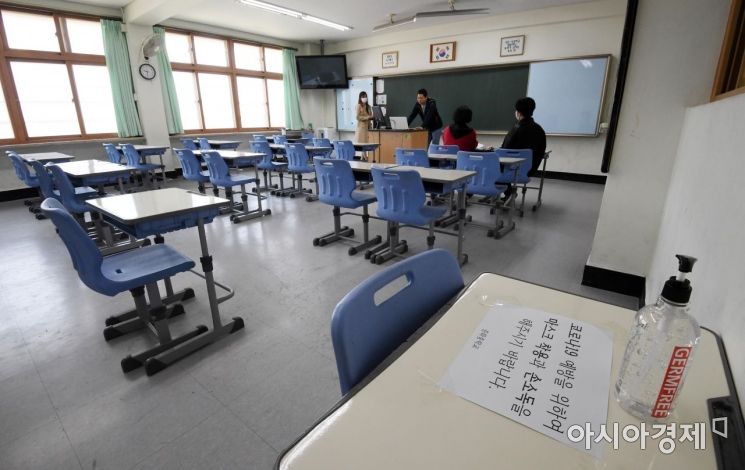 On the 9th, when middle and high schools nationwide began online classes starting with 3rd-year high school and 3rd-year middle school students, teachers and students held an online opening ceremony at Junghwa Middle School in Jungnang-gu, Seoul. Photo by Hyunmin Kim kimhyun81@
[Asia Economy Reporter Choi Dae-yeol] 31 → 30 → 29 → 16. This is the trend of new confirmed cases of the novel coronavirus infection (COVID-19) presumed to have been infected in local communities nationwide over the past four days. This figure excludes patients infected overseas from the total number of patients.
Considering that there were hundreds of new cases daily at one point, the downward trend is clear. However, the quarantine authorities remain vigilant. Although the number of cases detected within the surveillance network has decreased, it is still too early to say that the actual spread has been completely contained. This is partly because, as seen in the precedent where only one or two new cases occurred daily until mid-February, but after the 'super spreader' event related to Shincheonji Church of Jesus, a large-scale cluster infection was confirmed, they have directly experienced that the virus can spread widely at any time if vigilance is lost.
The number of patients related to Shincheonji totals 5,210, accounting for half of the cumulative confirmed cases in the country. The 31st patient, who was the first confirmed case in this cluster, was diagnosed on February 18, but ongoing epidemiological investigations have revealed that there were church members with symptoms as early as late January. This means that although patient number 31 was the first to be confirmed, it is highly likely that many members were exposed to the infection source during gatherings or within facilities several weeks prior.
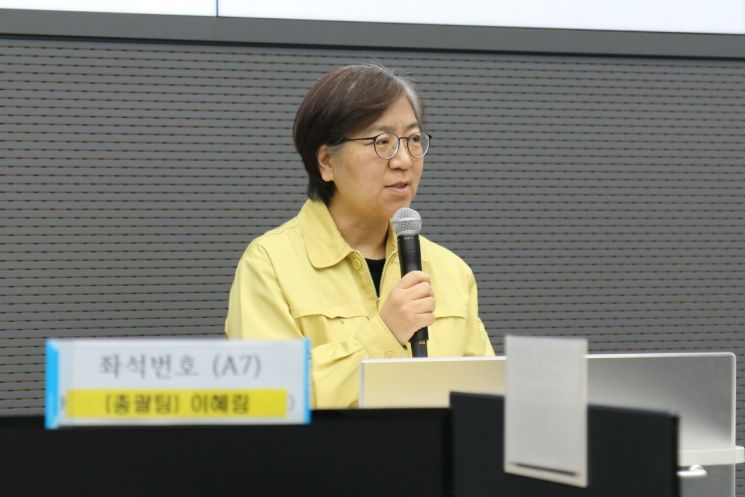 Jung Eun-kyung, head of the Central Disease Control Headquarters (Director of the Korea Disease Control and Prevention Agency), is speaking on the morning of the 7th at the emergency situation room of the Korea Disease Control and Prevention Agency in Osong-eup, Cheongju.
 Experts consider the fact that many patients are asymptomatic or have mild symptoms, and that the virus is shed well even in such states, as one of the characteristics of COVID-19. This is the most troublesome aspect for quarantine authorities who must prevent the spread of infectious diseases. Unlike influenza and other common infectious diseases where patients typically feel too ill or uncomfortable to be active, COVID-19 often spreads to others because patients do not feel severe symptoms.
Director Jeong Eun-kyung said at a briefing on the 9th, "We are tense that this period might be a 'silent transmission period,'" adding, "We judge that this is a time to be cautious of large-scale community transmission and to more thoroughly implement social distancing, proactive diagnostic testing, early detection, and epidemiological investigations."
She also urged, "As we have experienced several times, large-scale community transmission can occur anywhere where enclosed and close contact spaces exist," emphasizing, "Social distancing is important for your own and your family's health, and ultimately for the safety of our society."
© The Asia Business Daily(www.asiae.co.kr). All rights reserved.