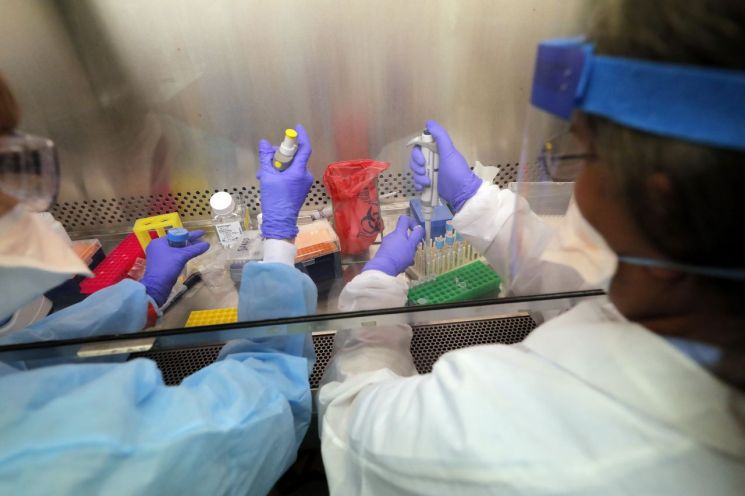
 Researchers at Tulane University in New Orleans, USA, are conducting COVID-19 diagnostic tests. <이미지:연합뉴스>
[Asia Economy Reporter Choi Dae-yeol] Our quarantine authorities and diagnostic medical staff have developed a pooled testing protocol (standard format) to more efficiently determine infection status of the novel coronavirus disease (COVID-19).
On the 9th, the Korea Disease Control and Prevention Agency (KDCA) announced that, in collaboration with the Korean Society for Laboratory Medicine and three medical institutions affiliated with the society, they created a protocol tailored to domestic experimental conditions. Pooled testing is a method that mixes specimens from multiple individuals into one sample for testing. If the test result is positive, the remaining specimens are retested individually. The authorities explained that this method is useful for screening infection status in high-risk groups such as residents of long-term care facilities who are asymptomatic but require periodic testing for infection prevention.
The KDCA and medical institutions affiliated with the Korean Society for Laboratory Medicine conducted 650 evaluation tests together to develop a protocol suitable for domestic conditions. Even when mixing 10 specimens for testing, sensitivity (the ability to detect positive cases) can be maintained at over 96% compared to individual specimens. The method was also introduced in the Journal of the American Medical Association (JAMA) as an efficient way to use limited resources.
Pooled testing is not intended to determine COVID-19 confirmation but will be used solely for disease surveillance purposes in asymptomatic high-risk groups. It is expected to help identify hidden community patients and prevent the spread of infection in advance. Kwon Gye-cheol, director of the Korean Society for Laboratory Medicine, stated, "Symptomatic individuals who definitely need testing should undergo individual tests, and for proactive testing of asymptomatic individuals, using pooled testing can significantly reduce the cost and time consumed for testing while maintaining test accuracy."
© The Asia Business Daily(www.asiae.co.kr). All rights reserved.

















