Duty-Free Shops Return 10-Year Business Rights for the First Time in History
Judged "Cannot Endure Any Longer" Despite Zero Sales, Paying Hundreds of Billions in Rent
Industry: "20% Rent Reduction Is Meaningless, Must Switch to Sales-Linked Rent"
Incheon Airport Needs Win-Win Measures, Not Deceptive Tactics
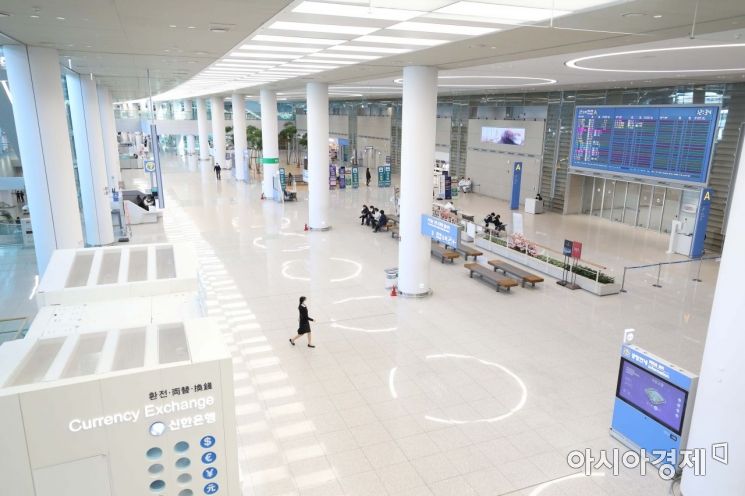 Terminal 2 of Incheon International Airport is quiet on the 8th. On this day, Prime Minister Chung Sye-kyun announced at the Central Disaster and Safety Countermeasures Headquarters (CDSCHQ) meeting held at the Government Sejong Complex regarding the response to the novel coronavirus infection (COVID-19), "We will temporarily suspend visa exemptions and visa-free entry for countries that have banned the entry of our citizens, and expand restrictions on the entry of foreigners for non-essential purposes." / Photo by Moon Ho-nam munonam@
[Asia Economy Reporters Lim Hye-seon, Cha Min-young] An unprecedented situation has arisen where Lotte Duty Free and Shilla Duty Free have returned the duty-free business rights they won at Incheon International Airport, intensifying the rent controversy. The reason behind giving up their home ground at Incheon Airport, which they had maintained for 18 years, just 80 days after the first confirmed case of COVID-19, is the sharp drop in sales leading to the judgment that "it is no longer possible to endure under these conditions."
◆Duty-Free Industry Calls for "Drastic Measures"= According to the duty-free industry on the 9th, Hotel Lotte and Hotel Shilla, which operate Lotte Duty Free and Shilla Duty Free respectively, have returned the duty-free business rights for Terminal 1 at Incheon International Airport. Last month, Lotte Duty Free was selected as the preferred negotiator for DF4 (liquor and tobacco), and Shilla Duty Free for DF3 (liquor and tobacco). This is the first time a large corporation duty-free shop has given up operating a store due to rent issues after acquiring duty-free business rights. The small and medium-sized Grand Duty Free also returned the DF8 (all items) business rights.
Despite the lease period being 10 years, the reason for returning the business rights lies in the rent issue. They must pay hundreds of billions in rent even if sales are zero. With duty-free shops expecting their lowest-ever sales in the first half of this year, they judged it difficult to meet the rent increase criteria proposed by Incheon Airport. The impact of a 90% drop in passenger numbers at Incheon Airport compared to the previous year after the COVID-19 pandemic declaration has been fully reflected in the duty-free shops. In April, Incheon Airport duty-free shops' sales fell by 98% compared to the daily average last year, meaning they must pay 20 to 30 times their sales in rent. Duty-free companies forecast a loss of over 100 billion won in April as well, due to almost no sales and fixed costs including rent.
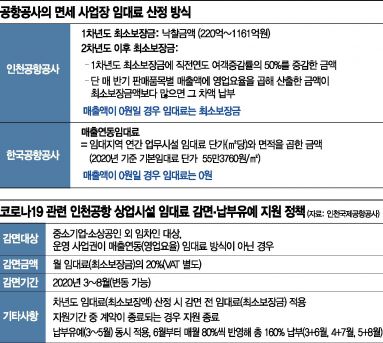
The first-year rent for Incheon Airport duty-free business rights is the bid amount, but from the second year of operation, they must pay an amount adjusted by 50% of the previous year's passenger change rate. The annual minimum guarantee adjustment limit is within 9%. Duty-free companies say the difference from the originally estimated business plan is so large that operation under the existing contract terms is impossible. The minimum guarantees for DF3 and DF4 are 69.7 billion won and 63.8 billion won respectively. An industry insider explained, "Passenger numbers are expected to surge next year due to the base effect, but even if duty-free sales do not increase, rent can rise up to 9%, which is a heavy burden."
◆Rent Snowball Effect When Airport Normalizes= If the number of passengers at Incheon Airport recovers to last year's level (71.77 million) next year, the increase rate compared to the previous year will be significant. This is because passenger numbers are expected to hit an all-time low until the first half of this year. Last month, Incheon Airport had 609,489 passengers, an 89.3% decrease compared to the same period last year (5,882,519). This month, the daily average passenger number at Incheon Airport is about 6,869. Especially on the 6th, the passenger count was only about 4,500. Based on this, the industry expects the 2022 rent increase rate to reach the maximum 9%. Accordingly, companies have requested Incheon Airport to flexibly adjust rent when passenger numbers decrease due to unexpected situations like the COVID-19 crisis. However, Incheon Airport has maintained the position of "We will comply as stated in the bidding announcement."
The government's measure of a "20% rent reduction" is also analyzed as virtually meaningless. Incheon Airport offered rent reductions from March to August on the condition that tenants forgo the rent reduction benefits for the first six months of the contract year. Due to the decrease in international passengers this year, duty-free shops could have received up to a 9% rent reduction next year. According to the commercial facility rent reduction and payment deferral applications submitted to Incheon Airport, duty-free shops whose minimum guarantee changes from August 2022 must pay the previous year's rent for the first six months (August 2021 to January 2022). This means if they paid 30 billion won in rent during the same period last year, the same applies next year. Meanwhile, duty-free shops must pay up to a 9% increase on 2022 rent. In effect, there is no rent reduction benefit. Duty-free shops that have not made decisions have requested Incheon Airport to extend the application deadline to the 24th. This move by Incheon International Airport contrasts with overseas international airports such as Singapore Changi Airport and Hong Kong Chek Lap Kok Airport, which have taken measures like rent reductions for commercial facility tenants.
An industry insider said, "With Incheon Airport duty-free sales virtually at zero, what is needed is not superficial or deceptive measures but drastic win-win measures to overcome the crisis," adding, "Now is the time to protect the world's number one duty-free industry."
◆"Rent Should Be Linked to Sales"= Korea Airports Corporation, which operates regional international airports, exempts basic rent and calculates sales-linked rent reflecting monthly sales fluctuations during the operation period. If sales are zero, rent is zero. Entas Duty Free, selected as the preferred negotiator for the Gimhae International Airport arrival duty-free business, plans to operate for five years upon approval from the Korea Customs Service. Based on the expected sales and minimum acceptable rate presented by the airport corporation, Entas Duty Free will pay about 1.3 billion won in rent annually.
Food and beverage companies within Incheon Airport have also risen up over rent issues. Domestic food and beverage companies such as Ourhome, Pulmuone Food & Culture, Paris Croissant, Amoje Food, CJ Foodville, SK Networks Walkerhill, and Lotte GRS recently delivered a plea to Hong Nam-ki, Deputy Prime Minister and Minister of Strategy and Finance, asking for rent exemption at Incheon Airport until customer usage normalizes. The food and beverage companies said, "The total food and beverage business sales were only about 6 billion won in March, but rent exceeds 7 billion won," adding, "After paying rent, losses exceed 10 billion won, and even if rent is fully exempted, losses are 3 billion won after deducting other costs."
According to the plea, food and beverage stores that have already found normal operation difficult account for about 90% of the total 220 stores, with about 130 operating on reduced hours and about 60 temporarily closed. Additionally, some stores are beginning to plan closures.
The food and beverage companies stated, "The total food and beverage business sales in March were only about 6 billion won, but rent exceeds 7 billion won," adding, "After paying rent, losses exceed 10 billion won, and even if rent is fully exempted, losses are 3 billion won after deducting other costs." They further criticized, "Incheon Airport focuses only on benefits for small and medium-sized enterprises and small business owners, while neglecting areas with greater employment creation and economic ripple effects."
Accordingly, the food and beverage companies urged for rent exemption as a recovery measure and requested that Incheon Airport be designated as an employment crisis area. They also asked for contract period extensions for stable future operations.
© The Asia Business Daily(www.asiae.co.kr). All rights reserved.


















