[Asia Economy Sejong Team] The government will inject an additional KRW 36 trillion+α in trade finance to support export companies struggling due to the novel coronavirus infection (COVID-19). It has also prepared a support plan worth KRW 17.7 trillion to boost domestic demand. For about 7 million individual business owners affected by COVID-19, the government will further ease tax burdens worth KRW 12.4 trillion and the public sector will support the private-led 'Good Consumption' movement.
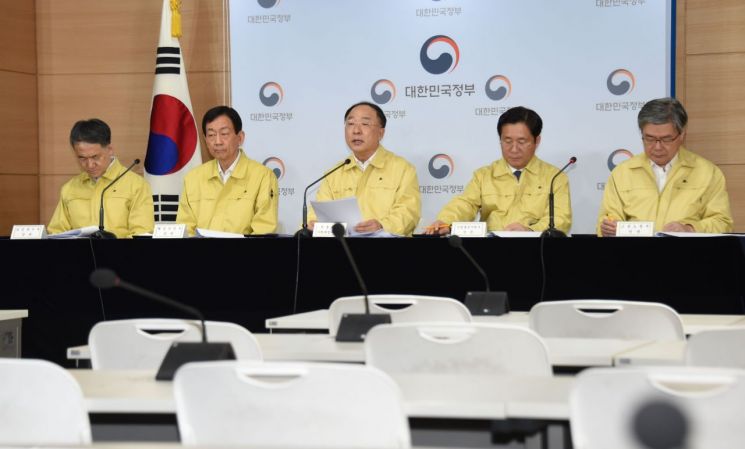
On the 8th, at the 4th Emergency Economic Meeting chaired by President Moon Jae-in, the government announced plans to prepare and implement measures such as the 'Export Vitality Enhancement Plan' and 'Domestic Demand Supplement Plan through Advance Payment and Pre-purchase.'
◆ Additional supply of trade finance 'KRW 36 trillion+α' = The government will provide an additional KRW 36 trillion+α in trade finance to Korean export companies. Adding about KRW 36 trillion to the KRW 260.3 trillion announced at the end of February's 'Expanded Trade Strategy Adjustment Meeting,' support will exceed KRW 296.3 trillion.
This export support is broadly divided into three categories: ▲ resolving export difficulties ▲ stabilizing global supply chains ▲ reducing corporate research and development (R&D) burdens. The government places emphasis on supporting export companies' financial difficulties. Since most key markets are within the COVID-19 visibility range, supply chains and demand could collapse simultaneously, prompting extraordinary measures.
Notably, for the first time ever, the government decided not to reduce the amount when extending the maturity of export insurance and guarantees for export companies. KRW 30 trillion will be supported accordingly. Export companies in the U.S., China, and the European Union (EU) can extend insurance and guarantee limits for one year without reduction. KRW 28.7 trillion will be allocated for this. To enable small and medium-sized enterprises (SMEs) and mid-sized companies to extend maturity for one year without reduction as pre-shipment guarantees, KRW 1.3 trillion will be invested. Since more than 10,000 buyer-related institutions in the U.S., China, and EU may face mass credit rating downgrades, the government strengthened guarantees to ensure Korean export companies do not face difficulties in financing.
Additionally, KRW 5 trillion+α will be supplied to support overseas economic stimulus project orders. Korea Trade Insurance Corporation will provide KRW 5 trillion in guarantees and loans to overseas clients, and if demand increases, KDB Industrial Bank and Export-Import Bank will supply additional funds. To prevent insolvency despite profitability, KRW 9 billion in emergency liquidity support will be injected. Specifically, export stabilization fund guarantees (KRW 100 billion), expansion of early cash conversion support for export receivables (from KRW 500 billion to KRW 700 billion), guarantees for production funds based on delivery contracts (KRW 500 billion), and guarantees for overseas subsidiaries (KRW 100 billion) will be provided.
The expansion of early cash conversion for export receivables is a policy emphasized by the Ministry of Trade, Industry and Energy as a direct support measure for liquidity crises of SMEs and mid-sized companies by doubling the cash conversion limit for auto parts and shipbuilding equipment companies. A ministry official explained, "Due to the global COVID-19 crisis, if financial institutions recall loans, companies may face temporary liquidity difficulties leading to insolvency despite profitability, so this policy was implemented."
Furthermore, KRW 26.5 billion will be provided to reduce insurance and guarantee fees by 50% for export SMEs and mid-sized companies. From next month, credit standards will be relaxed and online trade insurance and guarantees will be introduced. KRW 50 billion will be invested to support companies that have export capacity but had difficulty receiving support to obtain insurance and guarantees through screening.
◆ Tax burden reduction for 7 million individual business owners = The government will provide unprecedented tax benefits for the private sector's 'Good Consumption' movement to overcome COVID-19 damage.
For affected industries such as food and lodging, tourism, performance-related businesses, and passenger transportation, income deduction rates for credit and debit card use will be uniformly expanded up to 80% for April to June.
The Financial Services Commission has been requested for an official interpretation to allow advance payment of planned purchases of goods and services using corporate cards, and a 1% tax credit will be applied to income tax and corporate tax when prepayment or pre-purchase of goods and services from small business owners is made.
For about 7 million individual business owners subject to comprehensive income tax and local income tax filing this year, the National Tax Service and local governments will extend the payment deadline by three months from June 1 to August 31 by their own authority. For COVID-19 special disaster areas and affected taxpayers, extensions of up to three months will be granted.
To participate in the private 'Good Consumption' movement, government ministries, local governments, public institutions, and local public enterprises will create demand of more than KRW 3.3 trillion through advance payment and pre-purchase.
Initially, focusing on assets that can be stockpiled, the government plans to make early purchases worth KRW 800 billion in the first half of the year for 10,000 smart devices to support vulnerable students preparing for online school openings, old desks and chairs, blackboards, school supplies, quarantine and hygiene materials, medicines, and supplies and consumables necessary for safety, testing, inspection, and maintenance related to public institutions' core projects.
Similarly, KRW 90 billion in business promotion expenses will be prepaid to dining establishments, and 80% (KRW 160 billion) of remaining international travel tickets will also be prepaid. The tickets without designated routes will be used within this year, with balances settled by year-end.
Contracts for postponed or second-half planned international events, meetings, and local festivals will be signed early with up to 80% (KRW 140 billion) prepaid, and outsourced service contracts for public institution maintenance and repair will be signed early to spend KRW 510 billion in advance. The central government plans to expand the full execution of customized welfare points used in culture, leisure, and dining sectors to local governments and public institutions. This cost is expected to be KRW 190 billion.
Additionally, to support the automobile industry facing demand decline and other difficulties, about 1,600 business vehicles planned for the second half will be purchased in the first half (KRW 50 billion), and 150,000 barrels of domestically produced diesel and 490,000 barrels of crude oil will also be pre-purchased in the first half (KRW 31 billion).
© The Asia Business Daily(www.asiae.co.kr). All rights reserved.
![Clutching a Stolen Dior Bag, Saying "I Hate Being Poor but Real"... The Grotesque Con of a "Human Knockoff" [Slate]](https://cwcontent.asiae.co.kr/asiaresize/183/2026021902243444107_1771435474.jpg)















