12,000 Direct and Indirect Employment Effects
Continued Labor-Management Confrontation
Unavoidable Disruptions in Hiring and Production Schedules
If 'Win-Win' Purpose Is Not Realized, Corporate Participation and Investment Will Shrink
"Impact on Nationwide Win-Win Projects... Need to Create a Successful Model"
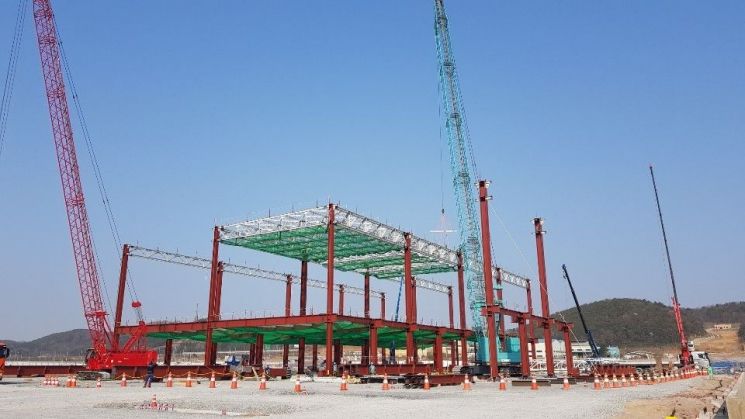 The Gwangju Global Motors automobile plant has been under construction since the groundbreaking ceremony in December last year, on a site of 604,000㎡ within the Gwangju Bitgreen National Industrial Complex, with a total building floor area of 109,000㎡. The construction progress rate is 9.5%.
[Asia Economy Reporters Kim Bo-kyung and Moon Chae-seok] The average starting annual salary for workers at Gwangju Global Motors, which is promoting the Gwangju-type jobs initiative, is 35 million KRW, about half the level of large corporations. Even the current office staff joined the company with lowered wage expectations. The company plans to hire an additional 200 employees this year and will begin large-scale recruitment of technical staff from the first half of next year. Including the factory construction process, the direct and indirect jobs created by the Gwangju-type jobs initiative are estimated to be 12,000. Amid worsening youth outflow due to job shortages, this is expected to bring positive prospects to the Gwangju regional economy and employment conditions.
However, if the confrontation between labor and management continues, disruptions to recruitment and production schedules are inevitable. Experts emphasize that instead of making unreasonable demands, the labor sector should establish a governance structure fitting the purpose of the 'win-win job model' to create a successful example.
◆Labor "President should intervene" vs Management "Factory establishment as planned"= The labor sector, which abruptly declared the termination of the Gwangju-type jobs agreement, maintains a firm stance, stating "there will be no further negotiations." Park Sang-mo, former policy director of the Kia Motors Gwangju branch, told Asia Economy, "Labor was mobilized only when the project was being packaged with all kinds of rhetoric to secure the budget, but in the end, they were just used as a prop," criticizing that "this is no longer a job that realizes social integration and joint growth of labor and management but has degenerated into a job centered on existing conglomerates."
The Federation of Korean Trade Unions also stated in their termination declaration, "The win-win job model is ending up as jobs that guarantee corporate profits and pour in taxes, blinded by performance," and argued, "Even from the perspective of regional balanced development, detailed inspections and innovative measures are urgently needed before it is too late." Currently, the labor sector demands include ▲introduction of labor directors ▲dismissal of unqualified and non-expert executives ▲adjustment of executive salaries to within twice the employee wages ▲win-win cooperation among companies, subcontractors, and local communities ▲formation of a citizen advisory committee.
The management side (Gwangju Global Motors) also shows no sign of backing down. Oh Soon-chul, head of management at Gwangju Global Motors, said, "It is difficult to accept because there is an underlying logic of participating in company management," and drew a line by stating, "Regarding executive dismissal, if there is a reason for dismissal, it will be handled at the shareholders' meeting, but otherwise, it is impossible."
The management plans to proceed with the establishment schedule of the complete car factory regardless of the labor sector. Currently, the automobile factory under construction in the Gwangju Bitgreen National Industrial Complex has a progress rate of 9.5%. The goal is to install production equipment by September, start trial production in April next year, and mass-produce complete cars by September. This will be the first complete car factory established in Korea in 23 years amid a trend of relocating automobile production facilities overseas due to labor cost issues. Oh said, "There is absolutely no problem with the construction progress," and predicted, "Once the factory is built, the labor sector may return." He added, "The company was established on the condition of labor-management communication and transparent management," and "Once the union is formally formed, we will explain the management status monthly and proceed together."
◆Gwangju City "Ready to talk anytime... Do not violate investment agreement"= Gwangju City urges labor participation but also plans to proceed with the complete car factory construction as scheduled. A Gwangju City official said, "Regardless of the labor sector's termination declaration, recruitment is ongoing, and factory construction is progressing rapidly." However, the official added, "Although the labor sector declared termination, we are ready to talk anytime," and "We are willing to accept everything as long as it does not violate the essential contents of the investment agreement between Gwangju City and Hyundai Motor."
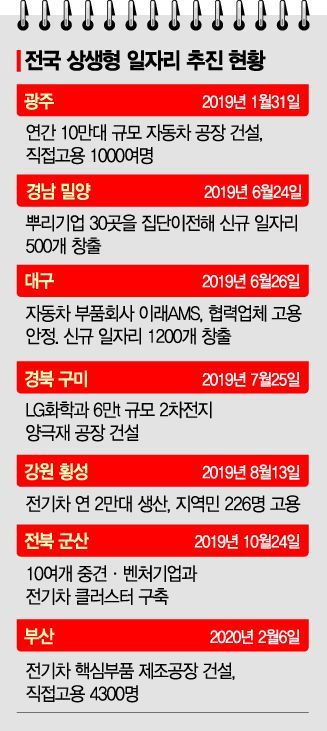
Meanwhile, there are pessimistic views that if the Gwangju-type jobs initiative fails, the nationwide win-win job projects may also shrink. If the first project fails, uncertainty will increase and investment will shrink. It is also pointed out that it will be difficult to attract companies that are turning their eyes overseas where labor costs are cheaper.
Experts advise that the labor sector should refrain from demanding the introduction of labor directors and participation in management as a priority. Professor Choi Young-gi of Hallym University said regarding the labor sector's demand for labor directors, "Instead of appointing union representatives, it should shift to appointing businesspeople well-versed in labor issues as directors to give legitimacy to 'labor directors,'" and added, "Strengthening trust between labor and management and establishing a good governance structure for the win-win job model is essential to succeed in the project."
© The Asia Business Daily(www.asiae.co.kr). All rights reserved.