Experts: "Korean-style Quantitative Easing is Symptomatic Treatment... The Key is Stability of the Government Bond Market"
Monetary Policy Committee on the 9th... Attention on Additional Measures Beyond the Base Interest Rate
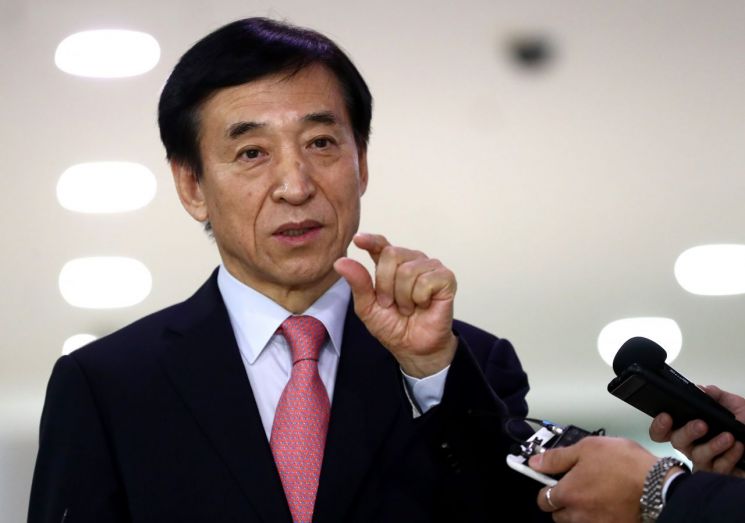
[Asia Economy Reporter Kim Eunbyeol] "If the novel coronavirus infection (COVID-19) situation prolongs further, the Bank of Korea should consider lowering the base interest rate more and transitioning to full-scale quantitative easing (an unconventional monetary policy where the central bank purchases government bonds, etc., to inject money into the market to stimulate the economy)."(Ham Junho, Professor at Yonsei University Graduate School of International Studies, former member of the Bank of Korea Monetary Policy Committee)
"Simply declaring the introduction of traditional quantitative easing sends a clear signal to the market that the central bank will maintain long-term interest rates stably. Korea should also introduce quantitative easing to stabilize the corporate bond and bank bond markets." (Kang Hyunju, Research Fellow at the Korea Capital Market Institute)
As the COVID-19 pandemic continues for a prolonged period, there are increasing calls that if the situation worsens, the Bank of Korea should prepare for traditional quantitative easing. This is because even after the Bank of Korea sharply lowered the base interest rate to the 0% range, the 3-year government bond yield has remained above 1%. So far, the Bank of Korea has introduced liquidity measures affecting short-term bonds, but to influence government bond yields, additional measures are ultimately necessary.
◆ "After slightly lowering interest rates further, consider paying interest on excess reserves" = According to the panel discussion "Where to Go in the Zero Interest Rate Era?" released by the Korea Institute of Finance on the 8th, Professor Ham stated that if financial conditions tighten further and consumption and investment contract, the Bank of Korea should consider lowering the base interest rate further and fully transitioning to an unconventional regime. Professor Ham served as a Monetary Policy Committee member from May 2014 to May 2018.
He said, "The prerequisite for quantitative easing is to separate the central bank's interest rate target from its balance sheet." He explained, "In Korea's case, after lowering the base interest rate to the effective lower bound, the Bank of Korea should pay interest on banks' excess reserves to separate the balance sheet and allow the central bank to freely expand its balance sheet." Given Korea's economic characteristics, it is not possible to lower rates to 0% like in the U.S., so quantitative easing can start after lowering rates as much as possible to the effective lower bound. He added, "In the UK, quantitative easing was implemented at a base rate of 0.5% after the global financial crisis."
However, he noted, "There is still a slight room to adjust the base interest rate further, and since the neutral interest rate is trending downward, it is efficient to lower rates accordingly." He added, "At this stage, monetary policy tools are still effective, but given the crisis situation, it is important to secure preemptive liquidity supply channels and enhance trust in the central bank's functions." The Bank of Korea should send a message to the market that it can act not only as the 'lender of last resort' but also as the 'market maker (purchaser) of last resort."
There are also claims that the base interest rate has already reached the effective lower bound. Professor Ha Jun-kyung of Hanyang University’s Department of Economics said, "Personally, I believe the current base interest rate of 0.75% has already reached the effective lower bound." He added, "In a situation where low inflation persists, lowering rates further risks falling into a liquidity trap, so it is better to keep rates as they are and expand the balance sheet by paying interest on banks' excess reserves."
◆ Despite the Bank of Korea's 'big cut,' government bond yields remain in the 1% range... "So far, measures are symptomatic" = The reason experts continue to argue for "lowering rates to the effective lower bound → paying interest on excess reserves → expanding the balance sheet" is that despite recent measures by the Bank of Korea, government bond yields remain high. On the previous day in the Seoul bond market, the 3-year government bond yield closed at 1.047%, down 0.5 basis points (1bp = 0.01 percentage points) from the previous trading day. Even after the Bank of Korea cut rates on the 16th of last month, the 3-year government bond yield has consistently stayed above 1%.
With expectations that the government's supplementary budget (additional budget) may be further expanded, additional government bond issuance is inevitable, but the Bank of Korea's measures targeting government bond yields are insufficient. Gong Dong-rak, a researcher at Daishin Securities, pointed out, "If government bonds are not stabilized, the credit market will inevitably show volatility. Even looking at the Bank of Korea's 'Korean-style quantitative easing' measures, government bonds remain a blind spot."
In the case of the U.S. Federal Reserve (Fed), even though the Commercial Paper Funding Facility (CPFF) has not been activated, the U.S. commercial paper market is already stabilizing. Researcher Gong attributed this phenomenon to the Fed's aggressive balance sheet expansion. He said, "Since the third week of March, the Fed has been actively purchasing government bonds worth $110 billion, $330 billion, and $360 billion weekly." He added, "The central bank's strong commitment to lowering market interest rates has been reflected in the government bond market, leading to stabilization."
Ultimately, the market views that "after the general election, large-scale fiscal support measures → expanded government bond issuance → government bond yield rise (or limited decline)" will continue, so the central bank should aim to stabilize not only short-term bonds but also long-term government bonds.
The Bank of Korea conducted a simple purchase of government bonds worth 1.5 trillion won (face value) on the 19th of last month. The Bank of Korea also conducted simple government bond purchases during the 2008 financial crisis and when Donald Trump was elected U.S. president in 2016. However, these short-term simple purchases of government bonds to stabilize the market during crises are difficult to consider as quantitative easing.
© The Asia Business Daily(www.asiae.co.kr). All rights reserved.
![Clutching a Stolen Dior Bag, Saying "I Hate Being Poor but Real"... The Grotesque Con of a "Human Knockoff" [Slate]](https://cwcontent.asiae.co.kr/asiaresize/183/2026021902243444107_1771435474.jpg)

















