Doosan Heavy Industries and Ssangyong Motor Receive Financial Support Amid Liquidity Crisis Due to COVID-19
Increase in Non-Performing Loans Worsens Soundness... Concerns Over Paralysis of Policy Finance Functions
[Asia Economy Reporter Kangwook Cho] Following Doosan Heavy Industries, Ssangyong Motor is also facing a liquidity crisis amid the novel coronavirus disease (COVID-19) outbreak, intensifying concerns among state-run banks such as the Korea Development Bank (KDB), the Export-Import Bank of Korea (KEXIM), and the Industrial Bank of Korea (IBK), which serve as 'breakwaters' for industries and companies. These policy banks are already handling nearly half of the total 100 trillion won in financial support mandated by government policies, making additional financial burdens inevitable to fulfill their role in corporate rehabilitation. While the policy banks are committed to fully supporting corporate normalization, there are growing worries that if large-scale corporate insolvencies materialize, it could not only deteriorate their financial soundness but also weaken their restructuring capabilities.
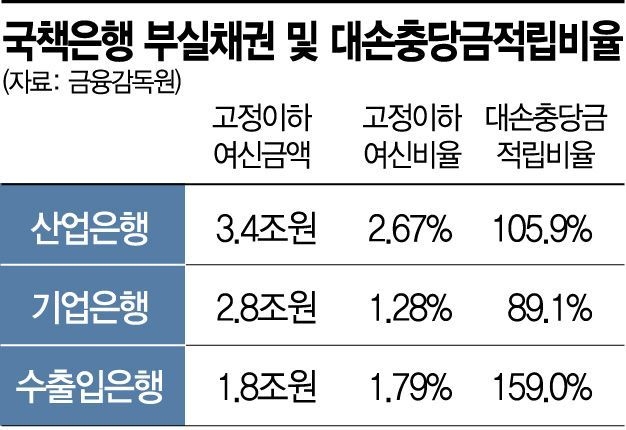
According to the Financial Supervisory Service and financial authorities on the 7th, as of the end of last year, KDB's non-performing loan (NPL) ratio stood at 2.67%, ranking first among 19 domestic banks. Following KDB, KEXIM recorded 1.79%, ranking second, and IBK had 1.28%, ranking fourth. Excluding K Bank (1.41%), which is effectively in a dormant state, the three policy banks occupy the top three positions among the 19 domestic banks. The NPL ratio is a key soundness indicator showing the proportion of non-performing loans within the total loan portfolio. Typically, policy banks handle corporate restructuring, which increases the likelihood of non-performing loans. Nevertheless, the average NPL ratio of these three policy banks is 1.91%, nearly five times higher than the average of commercial banks at 0.41%.
Meanwhile, the total amount of general corporate bonds and commercial papers (CPs) maturing from this month through December reaches 36 trillion won. Among these, high-grade bonds rated AA or higher and CPs rated A1 amount to 25.1 trillion won, while the remaining 11 trillion won consists of lower-rated bonds and CPs.
Currently, the policy banks are acting as emergency rooms for companies. On the 27th of last month, KDB and KEXIM decided to provide 1 trillion won in emergency funds to Doosan Heavy Industries. Additionally, since the government's announcement of financial support for low-cost carrier (LCC) airlines on the 3rd of last month, KDB's financial support to LCC airlines has totaled 126 billion won as of the 31st. This month, KDB plans to provide up to 28 billion won to Air Busan through Asiana Airlines and will also offer additional support to T'way Air. Regarding Jeju Air's acquisition of Eastar Jet, KDB plans to jointly provide 150 to 200 billion won with other banks this month after the Fair Trade Commission completes its corporate merger review.
Moreover, HDC Hyundai Development Company's acquisition of Asiana Airlines remains pending. HDC Hyundai Steel is reported to have recently requested support from KDB and others concerning Asiana Airlines' borrowings. Last year, KDB acquired 500 billion won in perpetual bonds issued by KEXIM and Asiana Airlines and provided 800 billion won in credit lines and 300 billion won in standby letters of credit, totaling 1.6 trillion won in support.
On top of this, Ssangyong Motor is also seeking assistance due to the refusal of financial support from its major shareholder, India's Mahindra Group. Ssangyong's borrowings exceed 400 billion won, including 190 billion won in loans from KDB. Notably, 70 billion won of KDB loans will mature in July this year.
The problem is that the capital capacity of policy banks like KDB is insufficient not only to absorb government measures but also to actively engage in corporate resuscitation. As of the end of last year, KDB and IBK's common equity tier 1 (CET1) capital ratios based on Basel III standards were 12.3% and 10.3%, respectively.
Kiwoom Securities analyst Youngsoo Seo pointed out, "Assuming a tolerable capital ratio of 9%, the risk-weighted assets that KDB and IBK can absorb are only about 5 trillion won and 2.3 trillion won, respectively."
Furthermore, as of the end of last year, the total capital ratios of KDB, KEXIM, and IBK based on Basel III were 13.97%, 14.48%, and 14.45%, respectively, all lower than the domestic bank average of 15.25%. Their simple tier 1 capital ratios were 11.28% for KDB, 10.37% for KEXIM, and 6.14% for IBK, decreasing by 0.27, 0.36, and 0.05 percentage points from the previous year, respectively. Meanwhile, the loan loss reserve ratios increased for KDB and KEXIM but slightly decreased for IBK. Recently, the international credit rating agency Moody's has begun reviewing a downgrade of IBK's credit rating, considering that although the government backs IBK, its ability to independently repay debt may be limited.
Concerns about future insolvencies are also growing within the policy banks themselves.
An official from a policy bank said, "There is simultaneous pressure to prevent a collapse of the entire market and concerns about deteriorating soundness. Under these circumstances, other roles of policy banks such as supporting new growth industries, promoting overseas expansion, and investment-type policy financing inevitably come to a halt."
© The Asia Business Daily(www.asiae.co.kr). All rights reserved.
![Clutching a Stolen Dior Bag, Saying "I Hate Being Poor but Real"... The Grotesque Con of a "Human Knockoff" [Slate]](https://cwcontent.asiae.co.kr/asiaresize/183/2026021902243444107_1771435474.jpg)















