Ministry of Economy and Finance Publishes April 2020 Monthly Fiscal Trends
February Fiscal Execution Accelerates While Revenue Decreases
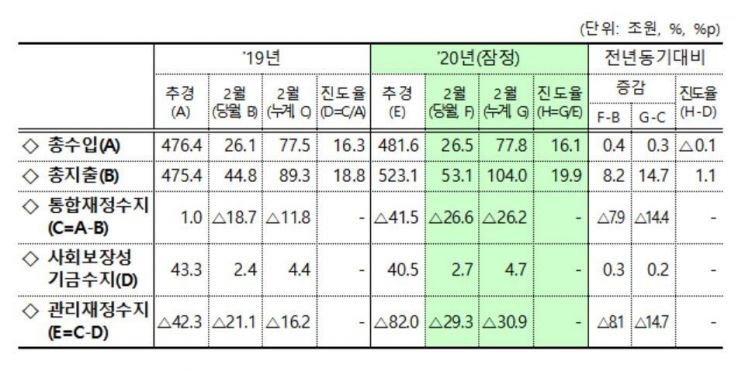
[Asia Economy Reporter Kim Hyunjung] In February this year, the government's managed fiscal balance, which reflects the actual fiscal condition, recorded the largest deficit since monthly statistics began in 2011. Despite a decrease in tax revenue, the expansionary fiscal policy continued, resulting in a negative fiscal balance for two consecutive months, including last month.
According to the 'April Fiscal Trends' released by the Ministry of Economy and Finance on the 7th, total revenue as of the end of February was 26.5 trillion KRW, an increase of 400 billion KRW compared to the same month last year. The cumulative total including January reached 77.8 trillion KRW, up 300 billion KRW from last year.
National tax revenue in February was 10.3 trillion KRW, down 1.8 trillion KRW from the previous year. In particular, due to an increase in value-added tax (VAT) refunds in February, VAT revenue recorded a deficit of 4.8 trillion KRW, decreasing by 2.2 trillion KRW compared to the same month last year. This was largely influenced by the Lunar New Year holidays (January 24-27), which delayed related refunds to February.
Income tax revenue amounted to 9.7 trillion KRW, increasing by 1.2 trillion KRW from last year, while corporate tax revenue sharply declined by 600 billion KRW to 400 billion KRW. During the same period, non-tax revenue was 5.2 trillion KRW, and fund revenue was 11.1 trillion KRW. A Ministry of Economy and Finance official explained, "This year, the VAT filing deadline coincided with the Lunar New Year, and corporate tax was significantly affected by correction claim refunds," adding, "Institutional factors such as the extension of comprehensive real estate tax payments from two months to six months (for amounts over 2.5 million KRW) and contingent factors overlapped."
Total expenditure in February surged by 8.2 trillion KRW to 53.1 trillion KRW compared to the same month last year, driven by proactive early fiscal spending. The cumulative total reached 104 trillion KRW, an increase of 14.7 trillion KRW over the same period. This was due to increased spending in the general account (8.5 trillion KRW), special accounts (2.7 trillion KRW), and funds (3.7 trillion KRW).
As a result, the integrated fiscal balance, calculated by subtracting total expenditure from total revenue, recorded a deficit of 26.6 trillion KRW, worsening by 7.9 trillion KRW compared to January this year. The managed fiscal balance, which excludes social security fund balances (2.7 trillion KRW) from the integrated fiscal balance, deteriorated by 8.1 trillion KRW to 29.3 trillion KRW, marking the largest deficit for February since statistics began in 2011. Although the integrated fiscal balance has been tracked since 1999, the Ministry of Economy and Finance stated that figures prior to 2011 are not used due to accuracy issues. On a cumulative basis, deficits of 26.2 trillion KRW and 30.9 trillion KRW were recorded, respectively.
Additionally, as of the end of February, the performance of managed projects amounted to 66.8 trillion KRW, executing 21.7% of the annual plan. Central government ministries and public institutions spent 61.3 trillion KRW and 5.5 trillion KRW, respectively.
The national bond balance at the end of February was 722.4 trillion KRW, increasing by 13.4 trillion KRW from the previous month, while the current value of national property rose by 2.5 trillion KRW to 1,126.1 trillion KRW. Revenue related to national property was 197.2 billion KRW, with total acquisitions amounting to 1.9014 trillion KRW and total disposals at 65 billion KRW.
© The Asia Business Daily(www.asiae.co.kr). All rights reserved.
![Clutching a Stolen Dior Bag, Saying "I Hate Being Poor but Real"... The Grotesque Con of a "Human Knockoff" [Slate]](https://cwcontent.asiae.co.kr/asiaresize/183/2026021902243444107_1771435474.jpg)
















