[Direct Talk - Asia Invitation] Park Won-soon, Mayor of Seoul
Leveraging MERS Experience from 5 Years Ago for Proactive COVID-19 Containment
Proposed Social Distancing and Banned Large Gatherings
Seoul-style Emergency Disaster Relief Fund Provided Quickly, Comprehensively, and Immediately
Support Timing... Combined with Government Aid to Eliminate Blind Spots
The everyday life, economy, and society that we took for granted have come to a halt. Although a bright spring has arrived, school gates remain closed, weddings are postponed, and cherry blossoms begin to shed their petals without welcoming crowds. On January 20, the first confirmed case of the novel coronavirus infection (COVID-19) was reported in South Korea, and after the infectious disease alert was raised to the 'serious' level on February 23, just a month later, citizens have been living cautiously day by day, as if treading on thin ice. Park Won-soon, the Mayor of Seoul, who stands at the forefront of Seoul's quarantine efforts, holds an online regular briefing almost every day at 11 a.m. to disclose the status of COVID-19 cases and explain response measures. The city has banned all urban rallies that used to be held in front of City Hall and around Gwanghwamun, and has taken a strong stance against Shincheonji Church of Jesus and Sarang Jeil Church, which were identified as sources of mass infections and violated government quarantine guidelines by forcibly holding worship services, making every effort to prevent further spread of infections.
When I met Mayor Park at Seoul City Hall on the 1st, he referred to the time when Hurricane Katrina struck New Orleans in the United States in 2005, saying, "Disasters leave the deepest and earliest wounds on the poor and vulnerable." He added, "Although Seoul City's emergency disaster living expenses support is limited to alleviating the urgent needs of households below the median income, combined with government support, it will provide layered and thorough assistance to citizens in crisis." The following is a Q&A.
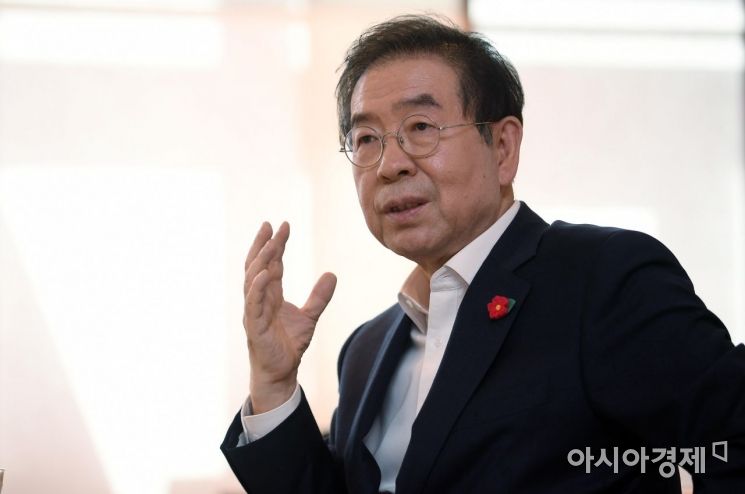 Seoul Mayor Park Won-soon urged the prosecution to actively investigate, stating in an interview with Asia Economy on the 1st, "Shincheonji Jesus Church disrupted the national quarantine network by concealing information such as the list of believers and making false statements, which was a decisive cause of the initial failure in responding to COVID-19." Photo by Kim Hyun-min kimhyun81@
- How has Seoul City been working on COVID-19 quarantine efforts?
▲ Based on the experience from the Middle East Respiratory Syndrome (MERS) outbreak five years ago, we have strictly applied the infectious disease response manual of 'rapid testing and identification of confirmed cases through screening clinics, epidemiological investigation, and self-quarantine,' proactively blocking sources of infection. When a confirmed case appears, we use mobile phone location data, communication access records, and CCTV to track movements and disclose them, conducting thorough investigations of nearby residents, acquaintances, and family members who had close contact. Especially with COVID-19, which has high transmissibility, we have focused all efforts on eliminating and minimizing environments where close contact and droplet infections can easily occur simultaneously. Seoul City was the first to propose 'social distancing,' and citizens have actively participated with mature civic awareness. Large-scale urban rallies have been banned, and strong investigations and prosecutions have been taken against specific groups uncooperative with quarantine measures, such as Shincheonji. We also conducted thorough investigations of 15,200 high-risk places with close contact concerns, such as call centers, karaoke rooms, and PC rooms. Now, the core of quarantine measures is to block sporadic group infections, manage overseas arrivals, and protect hospitals. Following Seoul City's recommendation, mandatory self-quarantine for all arrivals began this month, and the 'walk-through screening clinic' dedicated to overseas arrivals at Jamsil Sports Complex can now conduct an average of 1,000 diagnostic tests per day.
- The strict measures against Shincheonji have sparked controversy. What is your view?
▲ It is an objective fact, supported by numbers, that Shincheonji was the epicenter and a vector of nationwide spread in this COVID-19 crisis. As of the end of March, over 5,000 confirmed cases, accounting for more than 55% of all cases nationwide, were related to Shincheonji, reaching 70% in the Daegu and Gyeongbuk regions. Above all, their concealment of information and false statements disrupted the national quarantine network, causing a critical failure in the initial response. If the prosecution had searched Shincheonji earlier to secure the list of members and intervened more actively, it would have greatly aided the government and local governments in their COVID-19 quarantine activities. It would also have prevented massive administrative manpower and cost waste. Seoul City has repeatedly urged the prosecution to investigate, and since the National Shincheonji Victims Solidarity has filed a complaint against Chairman Lee Man-hee at the Suwon District Prosecutors' Office, I expect an investigation to proceed. However, it must not be delayed. Even to tighten quarantine until the end of COVID-19, a swift investigation is necessary.
- Some argue that while investigation and punishment for quarantine obstruction are justified, canceling the corporation status is an excessive response.
▲ It is already known that Shincheonji's front organizations have violated our constitutional order through illegal acts and engaged in anti-personality activities that deny family and society itself. Seoul City intends to hold Shincheonji's responsible leadership accountable. The members are also our citizens and nationals; this is not about harboring hostility or persecution against them. Sometimes, Shincheonji members are also victims and casualties. Having come to know the true nature of the Shincheonji religious group, we judged it as an antisocial organization seriously harming public interest and decided to cancel its corporate status. This decision proves the reason for the existence of the state and government.
- What is the current status of applications for Seoul City's emergency disaster living expenses?
▲ To avoid congestion and practice social distancing, applications have been accepted online through the Seoul Welfare Portal on a five-day rotation system since the 30th of last month. The process is proceeding smoothly, with over 91,000 applications received in two days. There have also been 125 applications for 'visiting application' services for citizens with mobility difficulties. The first beneficiaries appeared just two days after applications opened: a single-person household in their 40s and a five-person household in their 50s received 330,000 won and 550,000 won respectively in 'Seoul Love Gift Certificates.' Citizens facing a livelihood cliff are in urgent and desperate situations. Therefore, Seoul City designed this policy emphasizing speed, comprehensiveness, and immediacy to cover disaster blind spots where no support is available and provide tangible help as quickly as possible. The beneficiary households are expected to be 1,177,000 out of 1.91 million households in Seoul, excluding 730,000 households receiving government support. This is roughly one in three households.
- What considerations were made regarding selective payment or universal payment?
▲ It is the political duty to solve Korea's serious inequality and unfairness. From the perspective of a fair starting line, the gap of inequality must be bridged. Especially in disasters like COVID-19, the poor and vulnerable suffer the most. At such times, the government must firmly protect citizens' lives and address problems more fiercely. Seoul City proposed 'a fair starting line' as this year's theme. After disasters, economic inequality and polarization can leave deeper wounds. This is why policies to reduce inequality and ensure a fair starting line must be pursued more strongly.
- Still, there are citizen complaints about selective support, and Gyeonggi Province proposed disaster basic income for all residents...
▲ Giving the same amount to everyone does not resolve inequality and will continue. Of course, there is a way to collect more taxes from the wealthy, but such a system is not sufficiently established now, so it is important to ensure that the taxes people have worked hard to pay are not wasted. Governor Kim Kyung-soo of Gyeongnam Province also initially proposed universal disaster basic income but eventually switched to the selective payment method like Seoul City's.
- The central government has also decided to provide emergency disaster relief funds. How do you evaluate this?
▲ I welcome the president's bold decision to embrace the people's suffering. Seoul City had already proposed supporting 8 million households nationwide with 600,000 won over two months before the supplementary budget. The government expanded on Seoul City's proposal. The emergency disaster relief fund shares Seoul City's concern and direction of 'prioritizing support for those in difficulty' and is expected to have the effect of covering a broader range of groups that Seoul City could not include.
- What are the tasks for economic recovery and revitalization after COVID-19?
▲ The whole world is rolling out astronomical-scale economic stimulus packages. Seoul City must also focus its capabilities on boosting the sinking economy and restoring pre-COVID-19 normalcy with an unprecedented super budget and super measures. Following the largest-ever budget of 39.5 trillion won this year, a supplementary budget of 861.9 billion won was prepared in March for the first time in 11 years. Since timing is crucial, we will prioritize spending in the first half of the year. Through Seoul City's emergency disaster living expenses and the government's emergency disaster relief funds, we will thoroughly cover newly emerging disaster blind spots due to COVID-19 and provide timely customized measures tailored to the characteristics of affected companies to reduce immediate damage and suffering, while turning this into an opportunity to strengthen crisis response and immunity. We will prepare customized measures for industries directly hit, such as 660,000 small business owners and self-employed workers who form the backbone of Seoul's economy, as well as the culture and arts, tourism, lodging and restaurants, and startups whose growth engines have been cut off. We will also prepare measures for labor blind spots revealed by 'call center cluster infections.'
Interview by Shin Beom-su, Head of Social Affairs Department
Compiled by Jo In-kyung, Reporter ikjo@
© The Asia Business Daily(www.asiae.co.kr). All rights reserved.
![Clutching a Stolen Dior Bag, Saying "I Hate Being Poor but Real"... The Grotesque Con of a "Human Knockoff" [Slate]](https://cwcontent.asiae.co.kr/asiaresize/183/2026021902243444107_1771435474.jpg)















