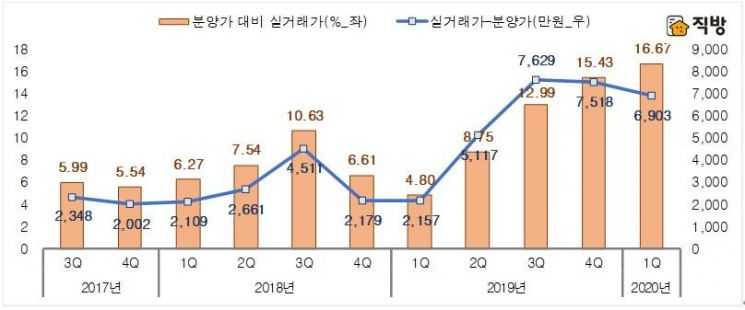
Q1 Nationwide Sale Price vs. Transaction Price Increased by 69.03 Million KRW
Increase Narrowed Compared to 76.29 Million KRW in Q3 and 75.18 Million KRW in Q4 Last Year
Seoul Increase Limited to 255.4 Million KRW Due to 12·16 Measures
Decrease of 131.04 Million KRW Compared to Previous Quarter
[Asia Economy Reporter Onyu Lim] In the first quarter, the increase in transaction prices compared to the pre-sale prices of newly built apartments nationwide decreased. In particular, in Seoul, the increase shrank by more than 130 million KRW compared to the previous quarter. This is attributed to the combined effects of the December 16 real estate measures and the COVID-19 pandemic, which have dampened the transaction market.
On the 6th, Zigbang conducted a survey targeting newly built apartments less than one year old nationwide and found that the transaction price in the first quarter rose by 69.03 million KRW compared to the pre-sale price. Zigbang explained, "The trend of decreasing increases in transaction prices compared to pre-sale prices continues," adding, "In the third quarter of last year, it was 76.29 million KRW, and in the fourth quarter, 75.18 million KRW."
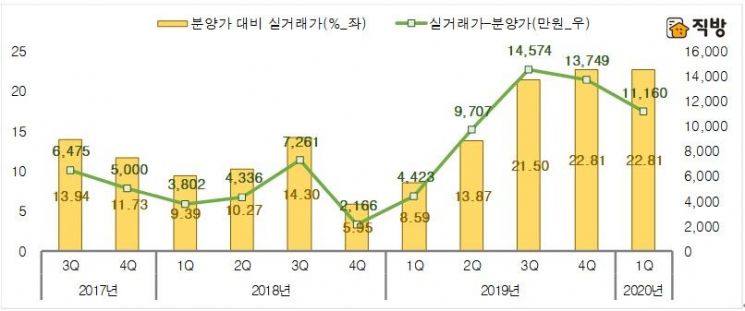
Among these, the increase in transaction prices compared to pre-sale prices in the metropolitan area was about 111.6 million KRW. This is a decrease of 25.89 million KRW from 137.49 million KRW in the fourth quarter of last year.
The region leading the reduction in the increase was Seoul. The increase in transaction prices compared to pre-sale prices in Seoul was about 255.4 million KRW, down by 131.04 million KRW from 306.44 million KRW in the previous quarter. Ham Young-jin, head of Zigbang Big Data Lab, analyzed, "Seoul has seen a decrease in the increase for two consecutive quarters," adding, "The December 16 measures and the spread of COVID-19 have shrunk the transaction market, which seems to have influenced the stabilization of newly built apartment prices."
On the other hand, Incheon and Gyeonggi showed opposite movements compared to Seoul. In Incheon, the increase in transaction prices compared to pre-sale prices rose from 19.72 million KRW in the previous quarter to 23.90 million KRW in the first quarter, and in Gyeonggi, it increased from 63.85 million KRW to 85.39 million KRW. Ham explained, "Since the government's real estate measures mainly targeted high-priced housing in Seoul, areas in the metropolitan region unaffected by the policy actually saw an increase in the price rise."
In the provinces, the increase in transaction prices compared to pre-sale prices is expanding mainly in Daegu and Sejong. The increase in the first quarter was 39.12 million KRW, up 3.53 million KRW from 35.59 million KRW in the previous quarter. In Daegu and Sejong, the increase surpassed 200 million KRW. Daegu recorded 201.73 million KRW, and Sejong 206.37 million KRW. Daejeon was also high at 100.85 million KRW.
Conversely, Gwangju, Chungnam, and Jeju saw decreases in the increase compared to the previous quarter by 54.39 million KRW, 4.16 million KRW, and 1.34 million KRW, respectively. In Chungnam, the transaction price was actually 3.91 million KRW lower than the pre-sale price.
Ham said, "As the real economy continues to stagnate, uncertainty in the apartment transaction market has increased," adding, "While demand contraction is expected, the steady inflow of demand into the subscription market could be a factor preventing a sharp price drop."
© The Asia Business Daily(www.asiae.co.kr). All rights reserved.


















