Electric Vehicles Up 97.9% Year-on-Year... Hydrogen Passenger Cars Up 455.3%
Seoul, Gyeonggi, Jeju in Order... Civic Movements and Supply Target System Promoted
[Asia Economy Reporter Kim Bo-kyung] In the first quarter of this year, 12,140 future vehicles, including electric and hydrogen cars, were distributed, marking a 110% increase compared to the same period last year.
The Ministry of Environment announced on the 6th that an analysis of the future vehicle distribution project performance for the first quarter of 2020 showed that 12,140 future vehicles were distributed during this period, a 110% increase compared to the same period last year.
Electric vehicles saw a 97.9% increase with 11,096 units distributed. In particular, the distribution of electric cargo vehicles surged from 3 to 2,890 units. Hydrogen passenger cars were distributed at 1,044 units, a 455.3% increase compared to the previous year.
The increase in future vehicle distribution performance is attributed to ▲ the full-scale launch of electric cargo vehicles ▲ improved hydrogen refueling conditions ▲ expansion of imported vehicle distribution volumes.
Electric cargo vehicles gained competitiveness in price and performance with the release of domestic vehicles starting December last year, and with benefits such as freight transport business permits, demand from small business owners and self-employed individuals increased significantly.
Hydrogen passenger cars saw a significant increase in distribution as the construction of hydrogen refueling stations became more active, alleviating some of the charging inconveniences.
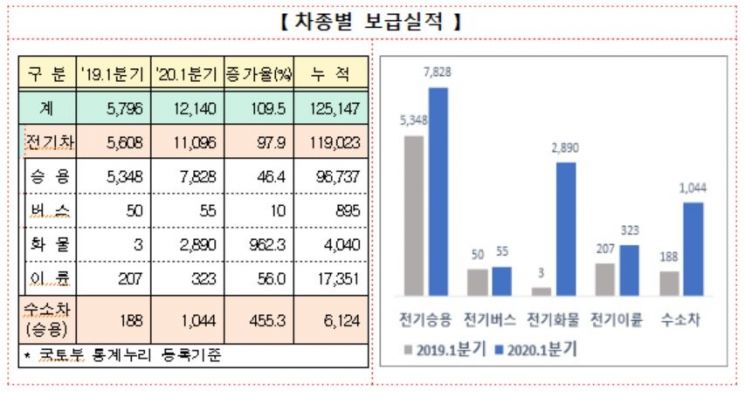
For electric passenger cars, while domestic vehicle distribution slightly decreased (from 4,976 to 3,600 units), the increase in imported vehicle distribution (from 372 to 4,228 units) led to an overall increase in distribution performance.
By local government, Seoul ranked first in future vehicle distribution for the first quarter of this year (2,512 units), followed by Gyeonggi Province (2,396 units), and Jeju Province (1,011 units). Based on cumulative performance, Jeju Province ranked first (22,088 units), Seoul second (21,641 units), and Gyeonggi Province third (18,076 units).
The government faces the challenge of overcoming conditions that reduce future vehicle demand, such as the consumption slump caused by the COVID-19 pandemic and plans to increase electric vehicle charging fees.
Accordingly, the Ministry of Environment plans to increase future vehicle distribution through existing policies such as the "1000 Million Citizens Riding Eco-friendly Cars" campaign and the low-emission vehicle distribution target system, aiming to achieve a cumulative total of 200,000 vehicles.
Geum Han-seung, Director of Air Environment Policy at the Ministry of Environment, stated, "The government will continue to expand future vehicle distribution to open the era of 200,000 future vehicles within this year," urging active participation from citizens and companies.
© The Asia Business Daily(www.asiae.co.kr). All rights reserved.
![Clutching a Stolen Dior Bag, Saying "I Hate Being Poor but Real"... The Grotesque Con of a "Human Knockoff" [Slate]](https://cwcontent.asiae.co.kr/asiaresize/183/2026021902243444107_1771435474.jpg)

















