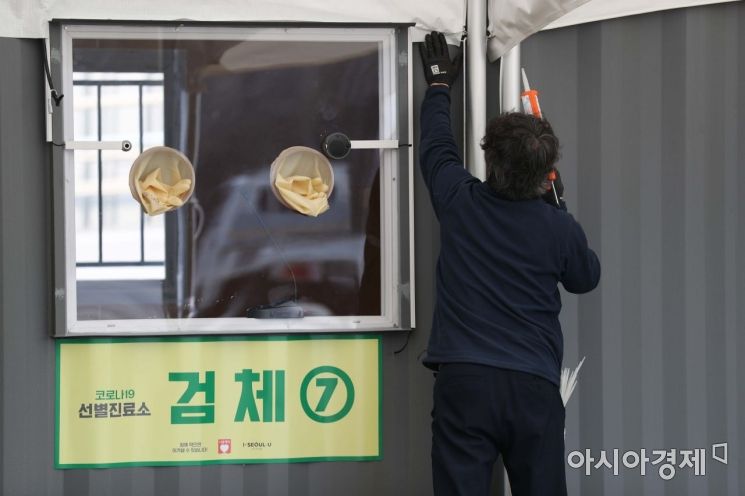
 On the 3rd, officials are inspecting the facility at the COVID-19 screening clinic exclusively for overseas arrivals, set up in the West Gate 1 parking lot of Jamsil Sports Complex, Songpa-gu, Seoul. Photo by Mun Ho-nam munonam@
[Asia Economy Reporter Choi Dae-yeol] Among the confirmed cases of the novel coronavirus infection (COVID-19), a total of 241 medical institution workers (as of the 3rd) have been identified. This accounts for about 2.4% of all patients, which is lower than the levels seen in Italy (9.1%) or Spain (15.5%), where cases surged rapidly.
According to the Central Disaster and Safety Countermeasures Headquarters on the 5th, among medical institution workers counted up to the 3rd, there were 25 doctors, 190 nursing staff, and 26 other personnel infected. More than 40% of these cases, totaling 101, were infected in the community. Sixty-six were infected while providing general medical care to patients not diagnosed with COVID-19, and 32 were exposed due to cluster infections within medical institutions.
There have been no reported cases of infection during the treatment of confirmed patients so far. However, after the 3rd, two nurses were additionally confirmed positive, and since it is suspected that they were exposed to the infection source during the treatment of confirmed patients, an epidemiological investigation is currently underway.
The government, judging that infection control in hospitals and other medical institutions is important along with healthcare workers, has introduced additional measures. First, for patients with mild colds or chronic diseases, non-face-to-face medical services such as telephone consultations, prescriptions, proxy prescriptions, and video consultations are being actively utilized. For patients suspected of COVID-19, such as those with pneumonia or fever, the plan is to have them undergo diagnostic testing before entering the hospital to prevent possible nosocomial infections in advance. If pneumonia is present, patients are required to be tested before entering inpatient rooms or intensive care units, and emergency rooms have established pre-patient classification stations and isolation treatment zones so that patients with respiratory symptoms among severe emergency cases can receive emergency treatment and diagnostic testing simultaneously.
Additionally, guidelines to minimize infection will be established for screening clinics, confirmed patient treatment institutions, and public relief hospitals. To reduce contact between medical personnel and potential confirmed patients at screening clinics, standard models and guidelines regarding movement paths and structures will be developed and applied. To strengthen infection control capabilities in medical institutions, infection prevention consulting tailored to each institution’s conditions will be promoted, and institutions lacking capacity will receive one-on-one advice. Special infection control education and on-site inspections will be conducted, and infection prevention education for medical personnel will be recognized as continuing education credits.
Yoon Tae-ro, head of the COVID-19 Central Accident Response Headquarters’ quarantine team, said at a briefing that day, "We have prepared management plans so that dedicated healthcare workers can work more safely and healthily in a safer environment," adding, "We focused on minimizing infection risks during the process of entering medical institutions and during treatment within medical institutions, and on strengthening the infection control capabilities of medical institutions."
© The Asia Business Daily(www.asiae.co.kr). All rights reserved.
![Clutching a Stolen Dior Bag, Saying "I Hate Being Poor but Real"... The Grotesque Con of a "Human Knockoff" [Slate]](https://cwcontent.asiae.co.kr/asiaresize/183/2026021902243444107_1771435474.jpg)















