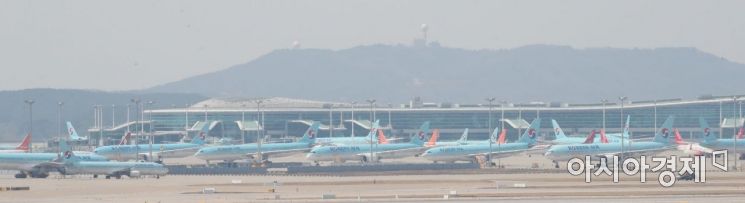
[Asia Economy Reporter Kwangho Lee] The government is preparing support measures for key industries that have been pushed into crisis due to the novel coronavirus infection (COVID-19) outbreak. This is a separate track from the 100 trillion won livelihood and financial stability package program.
According to the Ministry of Economy and Finance and the Ministry of Trade, Industry and Energy on the 5th, the government is preparing support plans for national key industries such as aviation, machinery, shipbuilding, shipping, and automobiles. If the COVID-19 situation prolongs, liquidity problems as well as impacts on financial conditions could lead to the risk of bankruptcy. In such cases, it could escalate into a national disaster including job issues.
The government is conducting an in-depth analysis of support measures taken by other countries for key industries. Measures to prevent moral hazard arising from support are also being prepared. The government plans to promptly announce policy support measures for key industries.
The United States allocated $500 billion (618 trillion won) out of approximately $2 trillion in fiscal support legislation to loans and loan guarantees for companies. Among this, loans to specific industries such as airlines and national security companies amount to $46 billion (57 trillion won).
Beneficiary companies are prohibited from repurchasing their own shares and paying bonuses to executives for one year after the government support period, and must maintain employment of workers at 90% or more of the current level.
Germany is providing bank loan guarantees worth 400 billion euros (534 trillion won) through the Economic Stabilization Fund (WSF), and plans to directly acquire shares of companies in management crises with 100 billion euros (133 trillion won) to prevent companies from being acquired by foreign capital.
The aviation industry is currently assessed as the most urgent key industry requiring emergency support. According to the National Assembly Legislative Research Office, the revenue loss scale of airlines from March to June is projected to be at least 6.3 trillion won.
The contribution of the aviation industry to the Korean economy is about $47.6 billion (60 trillion won), accounting for 3.4% of the Gross Domestic Product (GDP). It provides as many as 838,000 jobs.
In an appeal letter sent to the government, the Korea Air Transport Association stated, "Without large-scale government support, the aviation industry cannot survive by self-help measures alone," adding, "With almost no income, fixed costs of 900 billion won per month accumulate as deficits, and debts maturing within the year amount to about 5.3 trillion won."
The Korea Air Transport Association is requesting expansion of unsecured low-interest loans for all airlines, payment guarantees for corporate bond issuance, and exemption from aircraft property tax.
In addition, difficulties are intensifying in the refining industry, where product prices after refining have fallen below raw material prices due to the sharp drop in oil prices, and in the shipping industry, which has been directly hit by a decrease in cargo volume.
Kim Yong-beom, First Vice Minister of the Ministry of Economy and Finance, said at the macroeconomic and financial meeting on the 3rd, "We will ensure that normal and competitive companies do not close due to temporary liquidity shortages," and "We are reviewing various policy support measures necessary for key industries important to the national economy to overcome the crisis."
© The Asia Business Daily(www.asiae.co.kr). All rights reserved.
![Clutching a Stolen Dior Bag, Saying "I Hate Being Poor but Real"... The Grotesque Con of a "Human Knockoff" [Slate]](https://cwcontent.asiae.co.kr/asiaresize/183/2026021902243444107_1771435474.jpg)















