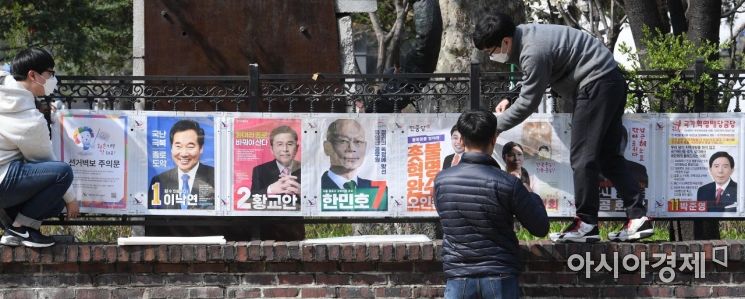
 On the 2nd, the official election campaign for the 21st National Assembly election began, and election commission staff were attaching election posters to the fence of the Artists' House in Jongno-gu, Seoul. Photo by Hyunmin Kim kimhyun81@
[Asia Economy Reporter Jo In-kyung] The number of voters participating in the upcoming general election on the 15th has increased by 4.5% compared to the 2016 general election. With the lowering of the voting age, 548,900 voters aged 18, participating in the election for the first time, accounted for 1.2% of the total voters.
The Ministry of the Interior and Safety announced on the 5th that the number of registered voters for the 21st National Assembly election, as of the finalization date of the voter list on April 3, was counted at a total of 43,994,247.
This figure includes 43,961,157 voters in constituencies (including proportional representation) electing 253 members, including overseas voters, and 33,090 voters participating only in the proportional representation election.
The number of voters in this National Assembly election increased by 4.5% (1,893,849 people) compared to the 42,100,398 voters in the 20th National Assembly election.
In particular, with the voting age lowered to 18 for the first time in the 21st general election, the number of 18-year-old voters attracted attention, totaling 548,986, accounting for 1.2% of the total voters.
By gender, based on the number of voters in the constituency National Assembly election, males numbered 21,787,210 (49.6%) and females 22,173,947 (50.4%), showing that female voters outnumbered males by 386,737.
By age group, based on the number of voters in the constituency National Assembly election, those aged 60 and over were 12.01 million (27.3%), those in their 50s were 8.65 million (19.7%), 40s were 8.36 million (19.0%), 30s were 6.99 million (15.9%), 20s were 6.8 million (15.5%), and teenagers (aged 18-19) were 1.15 million (2.6%).
By region, based on the number of voters in the constituency National Assembly election, Gyeonggi-do had the highest number with 11,061,850 (25.2%), followed by Seoul with 8,465,419 (19.3%), and Busan with 2,956,637 (6.7%). The smallest was Sejong City with 263,338 (0.6%).
Meanwhile, the number of voters in the by-elections and re-elections held simultaneously with the 21st National Assembly election is 3,139,093 across 55 constituencies (8 basic local government heads, 17 metropolitan council members, 30 basic council members), of which 5,413 are foreigners, accounting for 0.17% of the by-election voters.
Voters can check their voter registration number and polling station location in advance through the websites or notices of each city, county, and district, and participate in voting on the 15th by bringing their ID.
Lee Jae-gwan, Director of Local Autonomy and Decentralization at the Ministry of the Interior and Safety, said, "The government will cooperate with the National Election Commission to thoroughly prepare safety measures at polling stations, including disinfection and providing hand sanitizers and sanitary gloves, so that citizens can vote with peace of mind."
© The Asia Business Daily(www.asiae.co.kr). All rights reserved.
![Clutching a Stolen Dior Bag, Saying "I Hate Being Poor but Real"... The Grotesque Con of a "Human Knockoff" [Slate]](https://cwcontent.asiae.co.kr/asiaresize/183/2026021902243444107_1771435474.jpg)















