Moody's Revises Outlook on Domestic Banks' Credit Ratings from 'Stable' to 'Negative'
South Korea's Fiscal and Monetary Policies Increase Asset Risks for Domestic Banks
Funding Costs and Government Bonds Negatively Impacted... Concerns Over Stability of Domestic Financial System
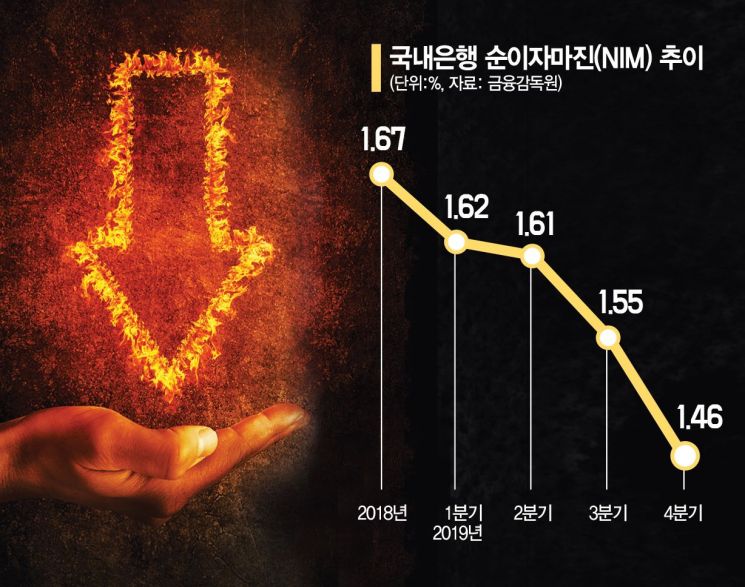
[Asia Economy Reporter Jo Gang-wook] As the international credit rating agency Moody's downgraded the credit outlook for the domestic banking sector, concerns are growing that the overall stability of the domestic financial system could weaken. The adjustment of bank ratings by foreign credit rating agencies can lead to an increase in bond issuance costs for banks and negatively impact the government bond market. Amid rising risks of loan defaults due to a surge in marginal companies, there are even pessimistic forecasts that the downgrade in credit ratings could exacerbate rather than resolve the crisis.
According to the financial sector on the 3rd, Moody's lowered the credit outlook for the banking sectors of 12 countries, including South Korea, China, Australia, India, Indonesia, Malaysia, New Zealand, the Philippines, Singapore, Taiwan, Thailand, and Vietnam, to "negative" on the 1st (local time). Most countries, including South Korea, had maintained a "stable" rating until now but were downgraded by one notch this time.
Moody's warned, "The spread of the novel coronavirus (COVID-19) will increasingly pressure banks' operating environments and loan performance," adding, "If this situation is not resolved by the second quarter, it will have a significant impact on banks' creditworthiness."
Moody's viewed South Korea's fiscal and monetary policies as factors that would increase asset risk for domestic banks and pressure profitability. Although the number of COVID-19 cases in South Korea is stable, Moody's expects economic contraction to continue due to unstable sentiment and reduced external demand. In particular, Moody's cited the government's support measures, which include principal and interest repayment deferrals for policy banks and commercial banks, as a negative factor for banks, as the quality of loans is deteriorating due to COVID-19. Loans to sectors directly affected by COVID-19, such as food service, lodging, transportation, and manufacturing, are increasing, which could adversely affect banks. Additionally, the decline in global demand impacting the performance of large domestic companies in the automobile, aviation, construction, shipping, and shipbuilding industries is also seen as leading to a deterioration in loan asset quality.
For these reasons, Moody's expressed concerns about the deterioration of capital soundness in domestic banks, as risk-weighted assets, mainly corporate loans, could increase. The Bank of Korea's decision to lower the base interest rate was also cited as a negative factor, as it reduces the net interest margin (NIM).
Due to Moody's downgrade of credit ratings, there are concerns that a COVID-19-induced financial crisis could spread. In South Korea, which has a bank-centered financial system, a downgrade in bank ratings implies a weakening of the overall system's stability.
Seo Young-soo, a researcher at Kiwoom Securities, explained, "From the perspective of investors who invest in short-term government bonds (including Monetary Stabilization Bonds) for fiscal gains, the default risk of banks, which are the trading entities, increases," adding, "The 2008 financial crisis also began when Fitch downgraded bank rating outlooks in July, followed by Standard & Poor's (S&P) and Moody's downgrades in October, which intensified the crisis."
Unlike the 2008 financial crisis, the downgrade in credit ratings now raises concerns about the potential spread of the crisis. Researcher Seo diagnosed, "During the 2008 liquidity crisis, the situation quickly stabilized through a currency swap between Korea and the U.S., so outlook downgrades did not lead to rating downgrades. However, the current downgrade in outlook caused by COVID-19-related loan defaults is occurring in a context where banks' profit resilience is weakened and the number of marginal debtors is increasing, raising concerns about deteriorating soundness."
A representative from a commercial bank said, "The market situation is unfavorable, and large-scale capital injections are inevitable regarding the government's financial market stabilization measures," adding, "Even commercial banks cannot guarantee their safety."
© The Asia Business Daily(www.asiae.co.kr). All rights reserved.
![Clutching a Stolen Dior Bag, Saying "I Hate Being Poor but Real"... The Grotesque Con of a "Human Knockoff" [Slate]](https://cwcontent.asiae.co.kr/asiaresize/183/2026021902243444107_1771435474.jpg)
















