[Monthly Aviation Editor-in-Chief Kim Jae-han] This year’s defense budget is well known to be the largest ever at 50 trillion won, and the most notable part is the aviation projects. Among the 16.6915 trillion won allocated for defense capability enhancement, aviation projects account for the largest share of 6.3804 trillion won. This is more than twice the size of the second largest share, the naval shipbuilding projects. This indicates that there are many significant projects. In particular, this year, these major aviation projects are expected to face important decision-making points, which is a key point to watch.
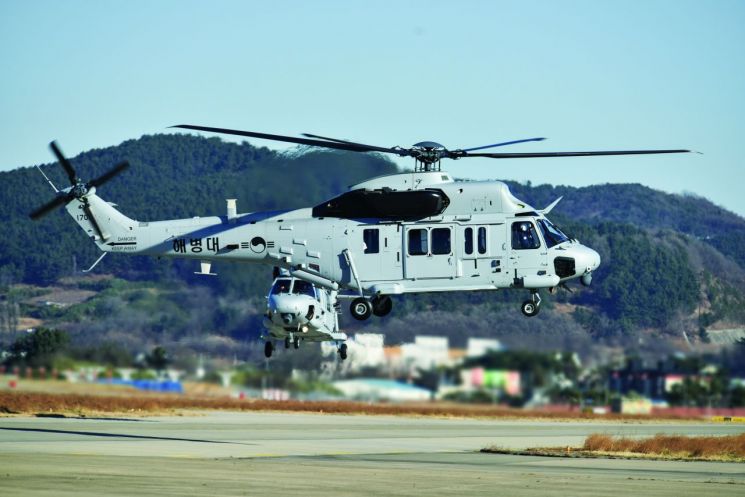
The Marine Corps’ ongoing amphibious assault helicopter acquisition project is expected to have its project implementation strategy decided this year. The amphibious assault helicopter is one of the important assets that defends the amphibious maneuver helicopters vulnerable to anti-aircraft weapon threats during amphibious operations, blocks enemy reinforcements early in the landing operation, and supports ground combat units with firepower.
The Marine Corps has continuously advocated for the acquisition of such amphibious assault helicopters, resulting in its inclusion in the 2018 mid-term plan, followed by preliminary research for project implementation last year. According to reports, the number of units to be acquired is 24. The Marine Corps plans to form a Marine Corps Aviation Unit, scheduled to be established in 2021, by newly acquiring amphibious assault helicopters along with the 36 Marineon helicopters currently being procured.
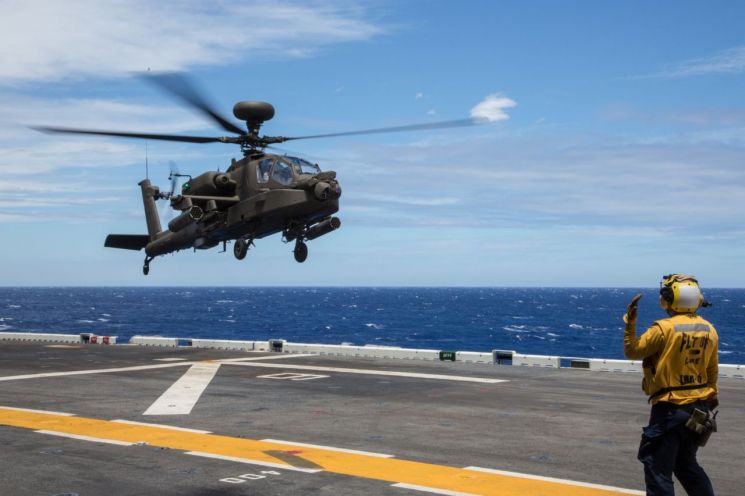
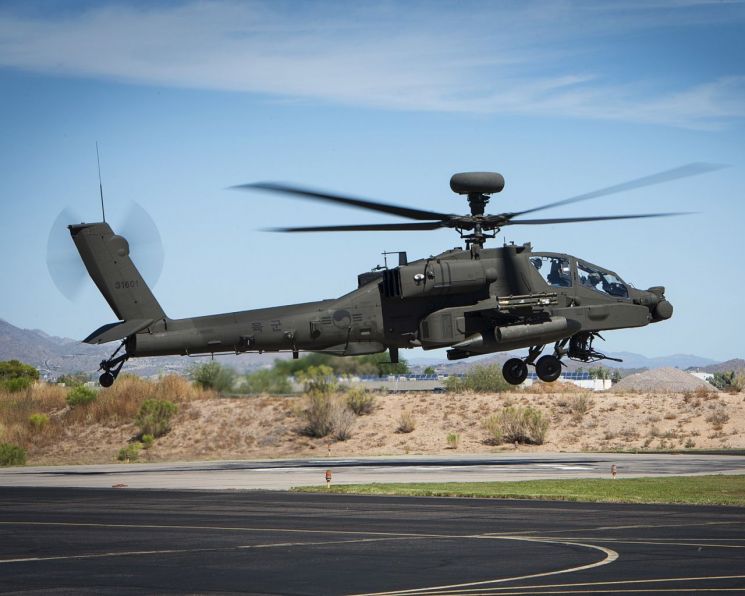
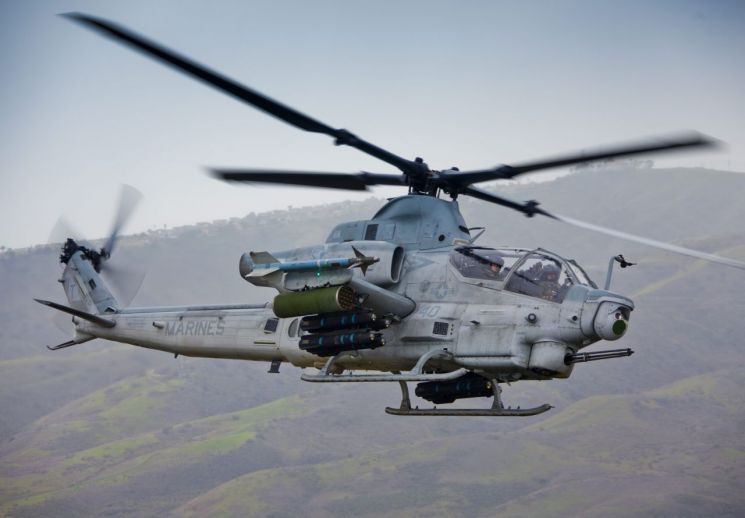
The biggest point of interest in this project is the choice of the helicopter model. Especially, the project implementation strategy expected to be decided this year will determine whether the acquisition will be of domestically produced helicopters or foreign-made helicopters. Regarding this, the models used as research materials during the preliminary study are known to include four foreign models: AH-64E, AH-1Z, T-129, and S-70i, and a domestic model based on the Marineon amphibious assault helicopter.
If the project implementation strategy decides on domestic helicopter acquisition, it is expected to be developed as an armed helicopter based on the Marineon. On the other hand, if foreign acquisition is decided, the other four models will be considered candidates, but the actual competition is expected to be between the AH-64E and AH-1Z models.
There is already a debate over the acquisition of domestic versus foreign helicopters. Those emphasizing operational aspects support the acquisition of an armed helicopter based on the Marineon. This is because developing based on the Marineon ensures high compatibility between the two models, facilitating parts procurement and subsequent logistics support. Additionally, since the airframe structure, including the cockpit, is basically the same, pilot and maintenance crew training can utilize the existing training system, thereby increasing efficiency through single-model operation.
However, drawbacks have also been pointed out. Since it is fundamentally based on a utility helicopter, its flight performance and armament operation capabilities may be somewhat inferior compared to dedicated attack helicopters. The amphibious assault helicopter, due to its mission characteristics, requires excellent maneuverability, attack capability, and high survivability, which may be limited in a utility helicopter-based armed helicopter. Furthermore, the need for a separate development period may delay the time to operational deployment, which is also cited as a disadvantage.
Meanwhile, if the project implementation strategy decides on foreign acquisition, the competition between the Apache Guardian and Viper will also be a point of interest. As is known, these two models are currently the main attack helicopters of the U.S. Army and Marine Corps, respectively, and are evaluated as the world’s best attack helicopters today, equipped with excellent flight performance, powerful armament, and advanced avionics.
© The Asia Business Daily(www.asiae.co.kr). All rights reserved.
![Clutching a Stolen Dior Bag, Saying "I Hate Being Poor but Real"... The Grotesque Con of a "Human Knockoff" [Slate]](https://cwcontent.asiae.co.kr/asiaresize/183/2026021902243444107_1771435474.jpg)

















