Available on Apple Watch 4 but restricted in Korea due to telemedicine regulations
ECG function activation in Korea enabled by iOS bug leads to proxy use
Samsung delays Galaxy Active Watch 2 ECG activation, preparing for FDA approval
Usage blocked in Korea regardless of medical purpose even if introduced in the US
[Asia Economy Reporter Han Jinju] Kim Minwoo, who uses the Apple Watch 4, heard that the electrocardiogram (ECG) function, which is restricted for use in Korea, can be enabled, and paid 15,000 won to an agency. This service creates a new iCloud account and accesses countries like the United States where the ECG function is supported to activate the feature. Due to a bug during the update process of Apple's operating system iOS version 13.4, the ECG function, which was restricted in some regions, was unlocked, allowing its use in Korea as well. Kim can now check his ECG with the Apple Watch 4.
Apple Watch Users Activating ECG Function via Workarounds
According to the industry on the 2nd, cases of activating the ECG function among Apple Watch users have recently increased. An electrocardiogram test checks the heart's electrical impulses that cause it to beat, verifying not only the heart rate but also whether the atria and ventricles are functioning regularly. However, this function has been a "pipe dream" for domestic smartwatch users for years. Although the ECG measurement feature was included starting with the Apple Watch 4, its use has been blocked in Korea. Samsung Electronics also plans to introduce this feature in the Galaxy Watch Active 2, but it cannot be used either. The main reason is that remote medical treatment through ECG checks is illegal in Korea.
Like Kim, it is possible to enable the Apple Watch 4's ECG function through a kind of workaround, but this does not mean remote medical treatment. It only allows users to check their own ECG status with the Apple Watch 4. Kim Minwoo said, "If remote medical treatment becomes possible, the usefulness of the ECG function will increase, but for now, I am satisfied with just checking my heart condition."
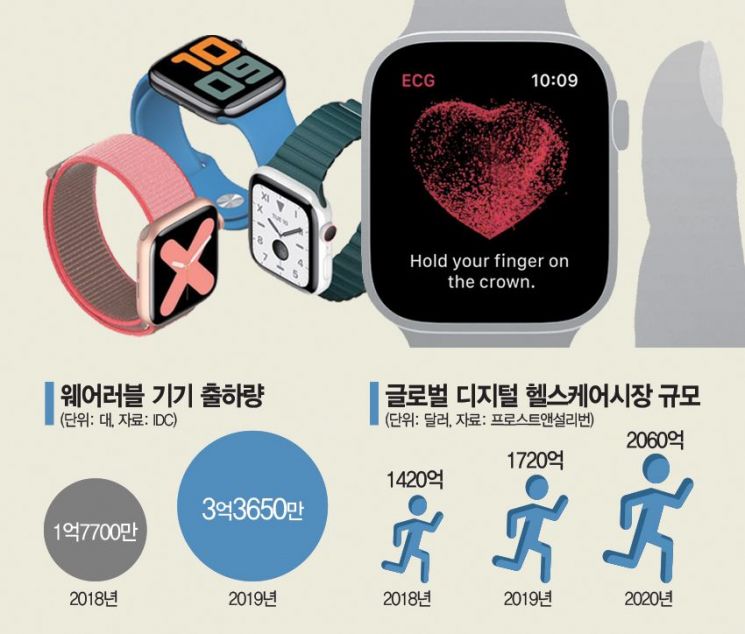
The market integrating healthcare functions into wearable devices such as smartwatches is rapidly growing. According to market research firm Frost & Sullivan, the digital healthcare market is expected to grow from $142 billion in 2018 to $206 billion in 2020. Another market research company, IDC, reported that shipments of wearable devices including smartwatches surged from 177 million units in 2018 to 336.5 million units in 2019.
As demand for healthcare features in smartwatches increases, Samsung Electronics released the Galaxy Watch Active 2 equipped with an ECG sensor in September last year and is undergoing the U.S. Food and Drug Administration (FDA) approval process. In the U.S., a software update was planned for the first quarter of this year but has been delayed. Samsung stated, "More time is needed to optimize the ECG function."
Remote Medical Treatment Regulations Weaken Digital Healthcare Competitiveness
Unlike the U.S., the reason why the ECG function of smartwatches cannot be used in Korea is due to regulations. The current Medical Service Act defines "remote medical treatment," which involves receiving medical care through network-connected medical devices without visiting a hospital, as illegal. Although smartwatches themselves are not medical devices, the ECG measurement function is considered a medical act. Last year, the government's regulatory sandbox project aimed at resolving regulations selected Huino's "wrist-type ECG device," which ironically indicates that remote medical treatment businesses are difficult under current laws. In reality, it is difficult for similar smart device businesses like Huino to enter the market.
The government partially allowed remote medical treatment in response to the spread of COVID-19, but this is an extremely exceptional case. An industry insider said, "It is very contradictory that we, a smartphone-advanced country, cannot enter the digital healthcare market," adding, "To lead the blue ocean digital healthcare market, it is necessary to lower the entry barriers for remote medical treatment."
© The Asia Business Daily(www.asiae.co.kr). All rights reserved.

















