[Asia Economy Reporter Oh Hyung-gil] Life insurance companies are facing increased foreign exchange hedging risks due to heightened exchange rate volatility caused by the spread of the novel coronavirus disease (COVID-19). Life insurers, which have continuously expanded their overseas investment scale, are deeply concerned about devising exchange rate response measures amid the adverse effects of COVID-19.
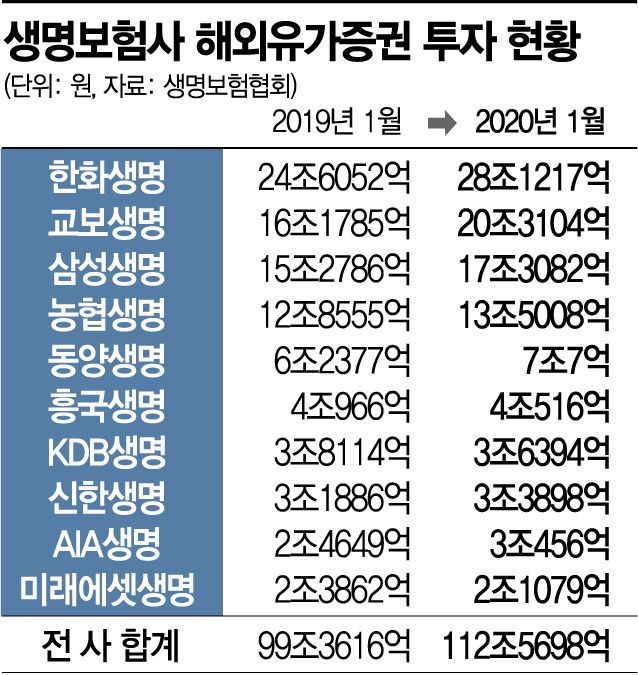
According to the Life Insurance Association on the 2nd, the investment scale of foreign currency securities by 24 domestic life insurers reached 112.5698 trillion KRW as of January, a sharp increase of 13.3% from 99.3616 trillion KRW in the same month last year.
Hanwha Life held the largest overseas securities portfolio at 28.1217 trillion KRW, marking a 14.2% increase compared to the same period last year. This accounted for 28.9% of its total managed assets of 97.1349 trillion KRW.
Kyobo Life’s overseas securities investment also rose significantly from 16.1785 trillion KRW to 20.3104 trillion KRW over one year, an increase of 25.5%. Its share of total managed assets grew from 20.3% last year to 23.6%.
Samsung Life followed with 17.3082 trillion KRW, then NongHyup Life with 13.5008 trillion KRW, Tongyang Life with 7.0007 trillion KRW, and Heungkuk Life with 4.0516 trillion KRW.
Among small and medium-sized companies, KDB Life and AIA Life saw slight decreases in foreign currency securities investments. This is interpreted as a sign that large companies are actively increasing overseas securities investments.
Life insurers had no choice but to turn overseas instead of the domestic bond market as the low interest rate environment persisted last year, causing negative spread losses due to their inability to raise asset management yields to match the promised interest rates to customers.
While the shortage of long-term domestic bonds was a factor, they aimed to increase asset management yields through overseas bonds and reduce the duration gap between assets and liabilities by making long-term asset investments. This was a preemptive measure to respond to the new International Financial Reporting Standard for insurance contracts (IFRS 17) and the new solvency regime (K-ICS).
However, after the COVID-19 outbreak, the won-dollar exchange rate has experienced sharp fluctuations, increasing foreign exchange hedging risks. Although there is no loss risk from exchange rate fluctuations if a hedging contract is in place, the maturity of hedge products requires rollovers, and exchange rate volatility may become a burden. There are even warnings that aggressively secured overseas assets could turn into risky assets.
Life insurers are actively preparing countermeasures, such as revising response scenarios to exchange rate volatility. A Hanwha Life official said, "Considering current exchange rate fluctuations, we have established foreign exchange hedging measures through the first half of this year. Although overseas bond profits are still higher, so it is not a problem yet, we plan to monitor exchange rate trends after the second half and respond accordingly."
A Samsung Life official also stated, "Most overseas bonds are long-term with a five-year maturity, so there is no immediate significant impact from exchange rate fluctuations. However, we are responding with a strategy to minimize exposure to exchange rate volatility and are closely monitoring future developments."
Experts are concerned about profit deterioration due to increased costs from sudden exchange rate fluctuations.
Im Jun-hwan, Senior Research Fellow at the Korea Insurance Research Institute, warned, "Since COVID-19, a storm of exchange rate volatility has been blowing, and it is uncertain whether it will intensify or subside soon. Navigating this could lead to shipwreck." He added, "Since domestic life insurers do not have large capital bases and may not be able to endure, partially suspending overseas asset management and observing the situation could be another way to overcome the crisis."
© The Asia Business Daily(www.asiae.co.kr). All rights reserved.
![Clutching a Stolen Dior Bag, Saying "I Hate Being Poor but Real"... The Grotesque Con of a "Human Knockoff" [Slate]](https://cwcontent.asiae.co.kr/asiaresize/183/2026021902243444107_1771435474.jpg)
















