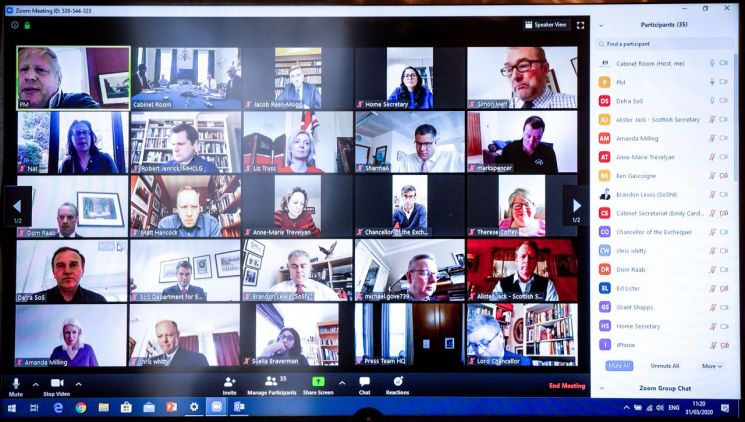
 British Prime Minister Boris Johnson (top left), who is self-isolating at his London residence after testing positive for COVID-19, is chairing a cabinet meeting via the video conferencing platform Zoom on the 31st of last month (local time). [Image source=Yonhap News]
[Asia Economy Reporter Seulgina Cho] Zoom, which has established itself as the leading video conferencing platform along with the new terms "Zoomer" and "Zoom University," has recently been embroiled in cybersecurity controversies, drawing immediate attention to alternative applications that can replace it.
Before Zoom, Skype, once considered the icon of video calls, Webex which started in the 1990s, StarLeaf, a platform mainly for large corporations, and the video conference app Jitsi Meet are representative alternatives.
On the 1st (local time), IT media The Verge introduced other applications for those hesitant to use Zoom due to recent reports in an article titled "The Best Video Conferencing Platforms to Replace Zoom."
Zoom, which allows up to 100 participants to join a video conference simultaneously, has become a representative video conferencing platform enjoying explosive popularity worldwide since the outbreak of COVID-19, as remote work and remote classes were introduced. It has been used not only for major companies' video meetings and university online classes but also in the UK Cabinet meetings, attracting attention.
However, recently, hackers have illegally intruded and played pornographic videos in so-called "Zoom bombing" incidents, making it a target of major cyberattacks. There have also been privacy leak controversies, such as an error where personal information of users accessing Zoom on iPhones was transmitted to Facebook without consent.
The Verge reported, "As users flock to Zoom and the spotlight shines on it, there are considerable complaints about privacy and security issues," and suggested, "You can also try other free video conferencing apps," sharing user reviews.
First, Skype, developed in 2003, gained popularity as a platform for free one-on-one video calls via PC. By pressing the "Meet now" button in the app, video conferencing is possible. The maximum number of participants varies depending on the device. Call records can be saved for up to 30 days, and the app allows blurring of the surrounding background during use. Screen sharing for presentations is also available. However, The Verge noted frequent page errors during free video calls on PC and recommended using the mobile app.
Webex, a representative video conferencing app where Zoom CEO Eric Yuan once worked, has been in use since the 1990s and is mainly known for corporate use. Currently, Cisco is running a trial promotion allowing free use of all Webex features for 90 days considering the COVID-19 emergency. The maximum number of participants has been increased from 50 to 100. The 40-minute time limit has been removed, and call-in features such as audio calls have been added.
StarLeaf, a platform for large corporations, is unfamiliar to individual users. The Verge introduced that StarLeaf does not allow personal sign-ups via its website but is providing basic video and messaging services for free during the COVID-19 crisis. The maximum number of participants in video meetings is 20, with a time limit of 46 minutes per session.
Jitsi Meet, a video conference app, is also an unfamiliar name to non-corporate users. It supports up to 75 participants simultaneously, but the company notes optimal service is available with 35 participants. Both public and private chats are possible. Currently, as a beta service, it supports a feature to blur the background of video meeting participants. It integrates with Slack, Google Calendar, and Office 365.
Another platform, Whereby, offers a relatively limited free version. The maximum number of participants is 4, and the host has a locking authority to restrict user access. Chat and screen sharing functions are also supported. The pro version, costing $9.99 per month, allows up to 12 participants per room in up to 3 meeting rooms.
The free version of Google Hangouts allows video meetings with up to 10 people. For voice meetings, up to 150 participants can join. The Verge noted that additional features are limited to text messaging and screen sharing but praised its ease and speed of calls. Other alternatives to Zoom include RemoteHQ, Toky, and Highfive, but some platforms do not offer free versions. BlueJeans requires a minimum payment of $9.99 per month for unlimited video meetings with up to 50 participants. Houseparty was not recommended because all participants must register personal information such as name, email address, date of birth, and phone number.
After the COVID-19 crisis, popular video conferencing platforms alongside Zoom include Slack and Microsoft Teams. The daily users of MS Teams, a messenger-based collaboration tool, surpassed 44 million last month. Slack, a messenger-type collaboration tool created by American developer Stewart Butterfield, also reported an increase of 7,000 paid subscribers between February 1 and March 18.
© The Asia Business Daily(www.asiae.co.kr). All rights reserved.
![Clutching a Stolen Dior Bag, Saying "I Hate Being Poor but Real"... The Grotesque Con of a "Human Knockoff" [Slate]](https://cwcontent.asiae.co.kr/asiaresize/183/2026021902243444107_1771435474.jpg)
















