A total of 2,825 trillion won invested over three previous rounds
Additional discussions underway to invest 2,448 trillion won in infrastructure and more
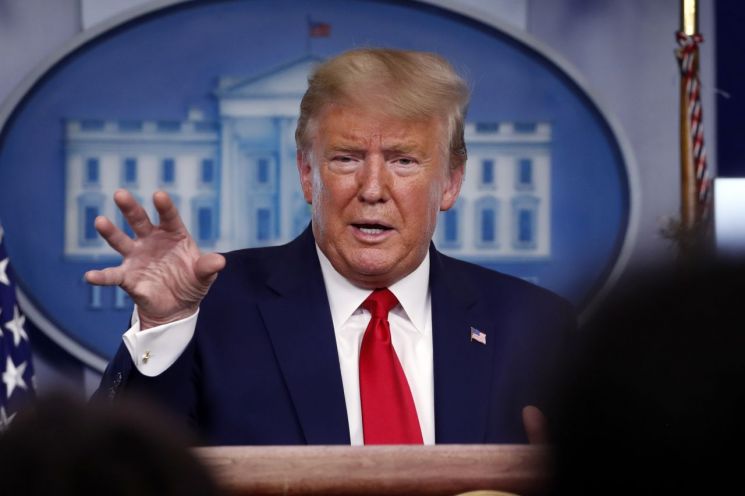
[Asia Economy Reporter Kwon Jae-hee] The Trump administration is preparing another massive budget bill following three rounds of emergency budgets passed in response to the novel coronavirus disease (COVID-19). This comes just four days after signing the final third-stage bill, signaling an all-out mobilization of national finances to overcome the crisis.
On the 31st (local time), U.S. President Donald Trump tweeted, "Now is the time to pass the infrastructure bill that has been awaited for decades," referring to a $2 trillion (approximately 2,448 trillion won) budget bill, and added, "We must focus solely on jobs and rebuilding infrastructure."
Although the U.S. has passed three budget bills this month alone, it still deems them insufficient and believes a large-scale budget bill is necessary for additional economic stimulus.
Previously, Congress passed emergency budget bills of $8.3 billion in the first round and $100 billion in the second. On March 27, the massive third-stage bill worth $2.2 trillion was passed and signed by President Trump. Now, just four days after signing, another large-scale budget is being requested.
If this bill also passes, the U.S. will have poured an astronomical total of $4.3 trillion (approximately 5,263 trillion won) into COVID-19 response efforts alone. This amount is more than 10 times South Korea’s annual budget of 513 trillion won.
While the previously passed bills focused on expanding COVID-19 testing, direct cash payments to Americans, and aid to affected businesses, this time the intention is to stimulate the economy and create jobs through large-scale construction and infrastructure projects.
Earlier, during the 2016 presidential election, President Trump pledged to create hundreds of thousands of jobs through a $1 trillion infrastructure project.
Trump’s plan is receiving more positive responses from the Democratic Party than from his own Republican Party. Political media outlet The Hill reported that a large-scale infrastructure package is one of the few policies supported bipartisanly by both Republicans and Democrats, but the issue of securing funding has led to a deadlock.
The Republican Party opposes raising taxes as a source of infrastructure funding.
Trump’s mention on Twitter that the Federal Reserve’s benchmark interest rate is 'zero' is also interpreted as a sign that he is considering issuing government bonds rather than increasing tax revenue.
Currently, the Democratic Party is showing a more proactive stance on the fourth-stage bill in Congress. House Speaker Nancy Pelosi stated at a press conference on the 30th that the fourth-stage budget bill is already under review and will include a large infrastructure budget.
The Democrats advocate for improvements to public water systems, expansion of hospital capacity, and upgrades to communication networks necessary for remote work, online learning, and telemedicine. There are also calls for expanding paid leave for workers, strengthening labor protections, and replenishing pension funds.
Meanwhile, Republican leadership is taking a relatively cautious stance, saying it is premature to discuss additional bills so soon after the passage of the third-stage bill.
Senate Majority Leader Mitch McConnell appeared on a broadcast that day and said, "We need to wait a few days or weeks to see how things unfold," adding, "I do not think Democrats will allow opportunities to achieve items unrelated to COVID-19."
House Minority Leader Kevin McCarthy also expressed uncertainty on the 29th about whether a fourth-stage bill is necessary.
The Wall Street Journal (WSJ) predicted that serious discussions will begin around late April. Both the Senate and House entered recess until April 20 after passing the third-stage budget bill last week.
However, given the ongoing surge in COVID-19 cases and pressure from President Trump, more active discussions could take place sooner.
The Washington Post (WP) evaluated that "Trump’s tweet aligns with the demands of many Democratic lawmakers," and The Hill predicted that "Trump’s support for an additional budget bill could pressure the hesitant Republican leadership to back such measures."
© The Asia Business Daily(www.asiae.co.kr). All rights reserved.

















